
Author: Ged
Photos: Rach (unless specified otherwise)
16th April
Arriving relatively late back into Hanoi from Halong Bay there was only one thing on our mind: food. We got a tip from the hotel’s receptionist who said if we’re in Hanoi we need to eat Bún chả and she just so happened to know the best place near our new hotel. We don’t know if it was the best in Hanoi, but it was bloody good. Bún chả is similar to Phở in that it involves broth and noodles, but is totally different in flavour. Grilled fatty pork cutlets with mini grilled minced pork patties form the core of the dish and it’s served with fresh herbs, radish leaves, and optional chillis and garlic.
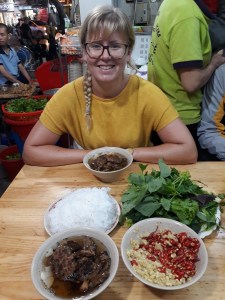
It was served within about 30 seconds of ordering and was simply amazing. Ged could have eaten this every day for the rest of the trip and at 70,000 Dong per person with a beer (about £2.30), we could have afforded to as well. We walked off the grub doing some window shopping and taking in the sights of the streets before turning in to another new bed (the room had this curious set up for a bathroom though – WTF?!)
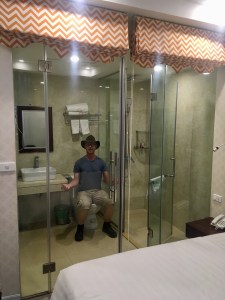
Off to sleep we went. Sadly the next day would be our last in Hanoi and we had to make the most of it.
17th April
Our flight wasn’t until the evening so we essentially had one more day to see what the place had to offer. We had three things left on our original to do list: find out how close we could get to a moving train (all will be explained!), find out about the lives of Vietnamese women, and find out more about the oldest temple in the city. Here’s how we accomplished our mission:
1. Train street.
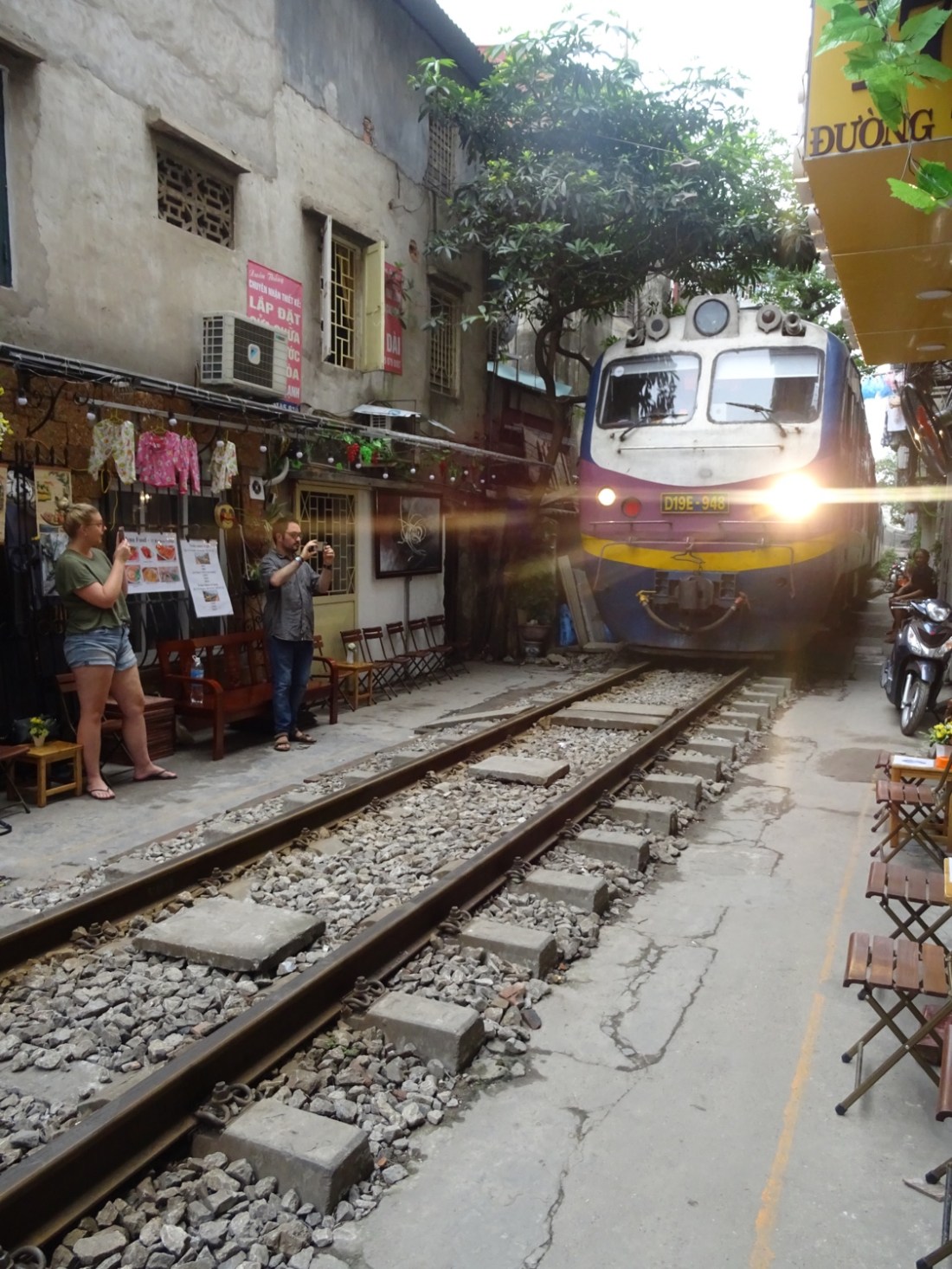
Hanoi, like most major cities, is serviced by a good train system that criss-crosses the heart of city. However,where Hanoi is different to most places we’ve been is that there are no restrictions on people walking down the lines. Rather, there are often thriving communities with markets, restaurants, barbers and guest houses that line the sides of the tracks. We struck out to see these for ourselves and came upon such a “train street” just off Phùng Hưng Street. Wow. Anyone could just walk down the tracks to the shops and cafes that had tables out right up to the tracks.
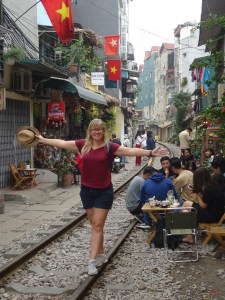
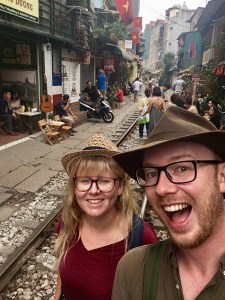
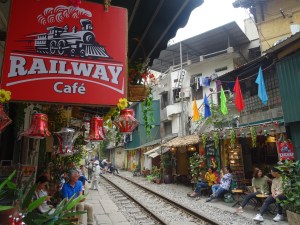
We were told by several cafe owners that another train wasn’t due for hours so we confidently took some daft pictures on the lines before wandering off down the tracks towards the city’s main train station to explore.
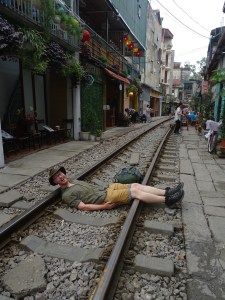
People here really live, and make a living, on the edge, between the train times.
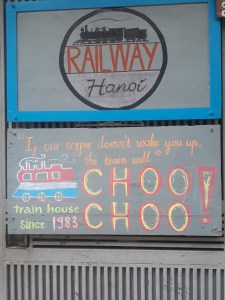
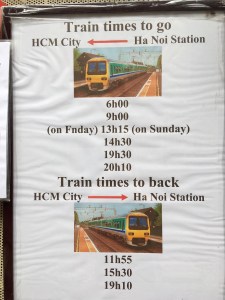
Workshops, living rooms, bars and cafes, and even playing kids pop up and are quickly put away again as the train approaches. Madness.
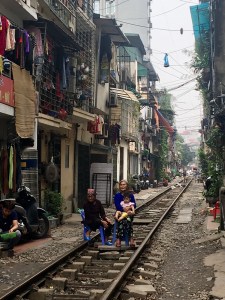
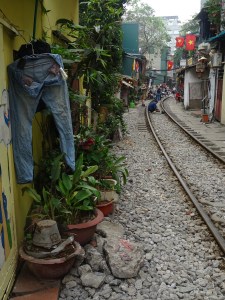
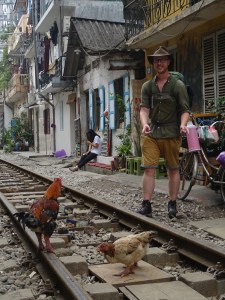
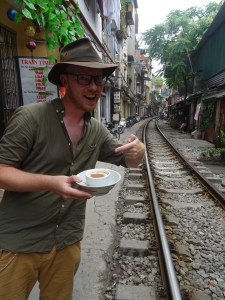
We were still disappointed we hadn’t actually seen one of these trains go past us so we turned down the tracks off Khâm Thiên Street. Quieter than our previous train street, we strolled along and decided it was time for a drink (another egg coffee for Ged). No sooner had we placed our order and we were told to sit back quickly!! Tables in front of us were unceremoniusly yanked away and we were moved behind a yellow line we hadn’t noticed before. Thunder rumbled down the tracks. Within seconds an enormous train charged past us, barely 12 inches from where we sat.
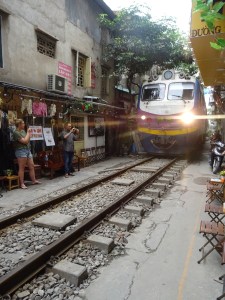
The train stops for no one so getting out of the way quickly is imperative. After about 30 seconds the train had passed and we could sit back in our original spot. Chairs and tables were put back out and our drinks arrived. Madness. Pure madness.

This is said to be one of the most dangerous tracks in the world and we can believe it. A train arriving early could be deadly! We finished our drinks still high with andrenaline and eventually got off the tracks, safe in the knowledge that another wasn’t due for hours. Phew!
2. Museum of Vietnamese Women.
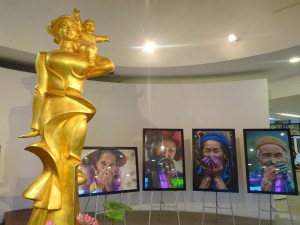
This interesting museum is in a lovely modern neighbourhood and only costs about £1.50 to get in with an audio guide. Split over several floors, the museum shows women in Vietnam’s past and present and their roles in traditional family life, as warriors in the various wars, in spiritual life, politics and in industry.
We saw how women were both hard at work in the fields, harvesting rice with sickles while the men made tools, but have also played an important role in the defence of the nation. As far back as 40AD in the struggle for independence from the Chinese, women were mounting successful oppositions. A victory over 290,000 Qing Chinese invaders was in part due to a female commander-in-chief, and during the most recent battle for independence, communist women founded revolutionary bases, developed a female military force and began the Women’s Union (now 85 years old). More famously, women guerrilla fighters were a popular army founded in villages to fight against enemy raids and destroy enemy posts. A total of 980,000 Vietnamese women have participated as guerrilla fighters. Against the French, war chief Nguyen Thi Chiên directed over 40 battles and aged 21 captured, unarmed, her first French soldier, and so became known as the ‘woman who captures the enemy unarmed.’ She was the first to receive the title ‘Hero of the people’s armed forces’ in 1952, awarded by the state. With so much history we wished we could have been able to take more of this in, but that would have required a longer amount of time than we sadly had.
Another exhibition showcased traditional women’s fashions and how they differ from region to region. For example, the black garments of the hill women of the north (complete with black lacquered teeth) contrast completely to the colourful skirts and bare midriffs of some women of the south.
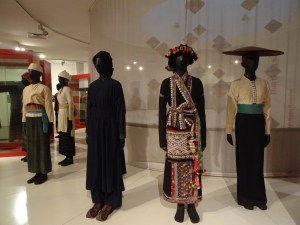
Both beautiful in their own way, but very definitely their own identities.
We also learned about the Ao Dai, the long tunic national dress, synonymous with Vietnamese women’s dress. Every woman will own at least 2. These full length dress and trouser combinations have to be tailored to fit specifically to the body and a girl should get her first one when she’s 15-16 years old. The three you see here in blue, pink and beige were made by 3 famous designers in Vietnam.
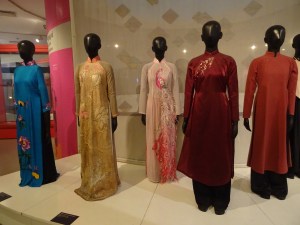
Vietnam is far from an equal country in terms of how women are treated, but it is clear that women have been unassailably involved with shaping this country. There doesn’t seem to be an obvious call for women’s equality in Vietnam, but it is clear from the museum’s showcasing of specific women’s achievements that this argument is being made. It did spend some time highlighting the difficulties women in Vietnam face in earning a living while simultaneously looking after a family, with not many ‘professional’ opportunities available to women. Many end up selling fruit, vegetables or other items on the street, which can make for a very hard life.
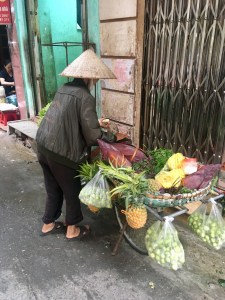
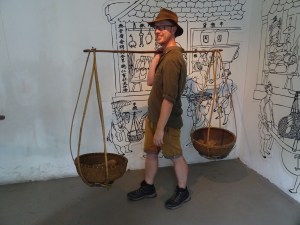
The museum also taught us one another important lesson we had yet to learn – about the Vietnamese conical hat! Images of these have been found carved into objects dating back 3000 years, but no one knows really knows when they first became popular. It is thought that the modern version appeared in Hue in the 16th century, used as protection against the elements – sun and rain alike. Its design is pretty genius – a rattan or bamboo frame held together with rattan or nylon fishing wire. This is then covered in coconut, palm, bamboo or rattan leaves. Sulphur is burned to prevent mould and resin waterproofs it. The inside of the hat is often embroidered with images or words. Practical and iconic, although Rach betted there would be no chance of Ged swapping out the Indiana Jones hat for one of these….!
Equally educational and celebratory this museum really highlighted how much women have given, and continue to give, to Vietnam. Go if you are ever in Hanoi!
3. Bạch Mã Temple
Our last objective for the day was Bạch Mã Temple, or White Horse Temple to the locals. Beautifully ornate, the air is heavy with the smell of incense as you walk into this serene sanctuary in the heart of Hanoi.
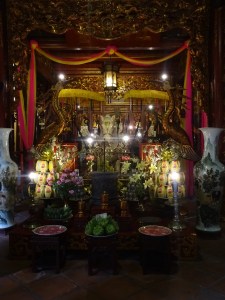
The temple was originally built on a nearby mountain but moved to its current location at some point between the early 11th and 13th centuries to serve the growing Hanoi population and to protect it inside the city walls. The current structure, with a shrine to Confucious, was built in the 18th century and is in the same style that carried on in the rest of the city until the end of the 19th century. What is particularly astonishing about the place is the change in atmosphere you feel simply by walking through the gates into the shaded courtyard, complete with fragrant mandarin orange trees. We spent about 30 minutes here taking in the sculptures and beautiful calligraphy, even if we didn’t understand it. We could have spent longer but we had a plane to catch! After a quick bowl of beef noodle broth in a nearby eatery (no English name provided in the menu, but different from the ones we’d enjoyed so far) we recovered our bags from the hotel and booked a cheap Grab taxi to the airport.
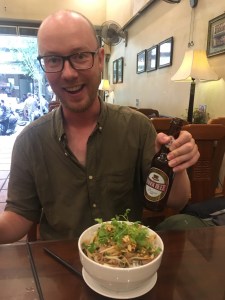
We’d loved Hanoi; the mix of chaos and calm, the super modern and the ancient, the serene spiritualilty and the manic utility of the crafts people. Mostly we had loved the food and Ged’s final words in the city were, “I’ll be back.” TTFN Hanoi!!
 Around the world in 140 days