
Author: Both
Photos: Rach (unless specified)
Following our rest day in Cusco after the Inca Trek we started to make our way towards Bolivia on 04/02 via an all day bus to Puno – a good opportunity to catch up on some sleep and recharge properly! We would be at Puno to visit the highest navigable lake in the world – Lake Titicaca, to explore the floating islands and to learn about how indigenous people live on and around the lake. This would mark yet another new experience for us at this midway point of our 35-day G Adventures trip!
1. Puno city
As the bus crested the hill on our way into Puno we got a full view of the city and the gigantic lake behind it.
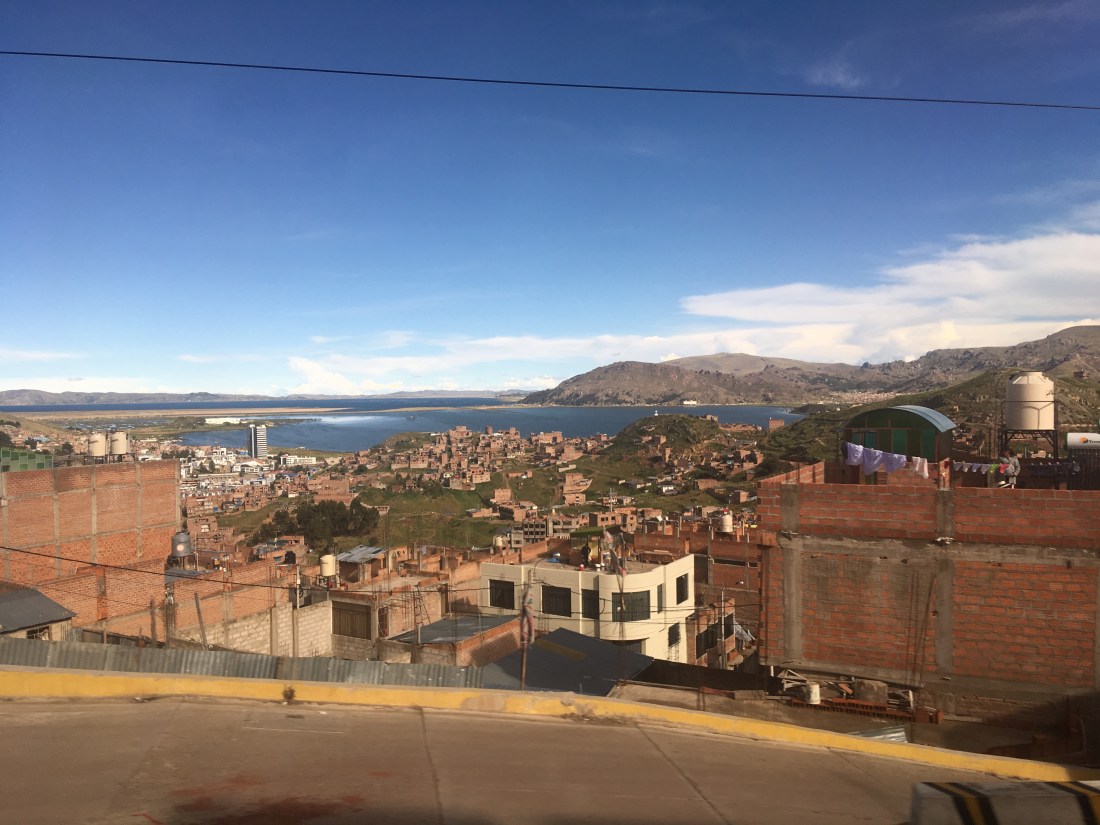
We had spent the past 7 hours on a bus from Cusco and were keen to get clean and stretch our legs. Our hotel strongly reminded us of a nursing home you wouldn’t really want to leave your loved one in, but the shower was hot and we were soon out into the early evening of Puno. Our CEO Jesus told us a little information about the city and its economy, which was mostly based on mining in the surrounding area followed by activities on the lake. He reassured us that we had just missed the miner’s festival that is always a raucous affair with most of the city over-indulging themselves. The festival is rumoured to include the getting drunk of an unsuspecting tourist who is then taken and sacrificed in the hills and never seen again. Of course no proof of this activity exists, but perhaps it wasn’t a bad thing we missed the festival. Puno didn’t really endear itself to us. The plazas are pleasant enough, but there are some areas that are way too touristy and the front near the lake is something like a run down Southport (complete with creepy kids rides and bizzarely-shaped pedalos). Needless to say we were glad we would only spend two nights there in total.
After Jesus’ quick tour we headed to the local food market. This place wasn’t massive but it was unlike any market we’d ever been to. There were many religious icons from the Catholic faith and it was organised so that each row sold the same thing. We were told that it would be best to bring presents of food to the families we would visit in the homestays (more on that later), and that dried goods like rice, pasta, sugar, and salt would be best. We headed down the dried goods aisle and found every stall sold almost identical goods for identical prices. We couldn’t understand what the point of all these stalls was if they all sold the same goods for the same price! We picked a vendor who seemed friendly enough and bought our food parcel along with a selection of spices. Buying these simple goods for presents felt very strange to us, but perhaps we would understand better on the next day. We ate a simple meal of rice and fish and turned in for the night. We drifted off to sleep with a little trepidation about what tomorrow would bring.
2. Lake Titicaca
Next day we were up early as per usual and met the rain as we headed out of the hotel to our ‘special transport’, which turned out to be cycle rickshaws… cue the waterproof jackets and bin liners!
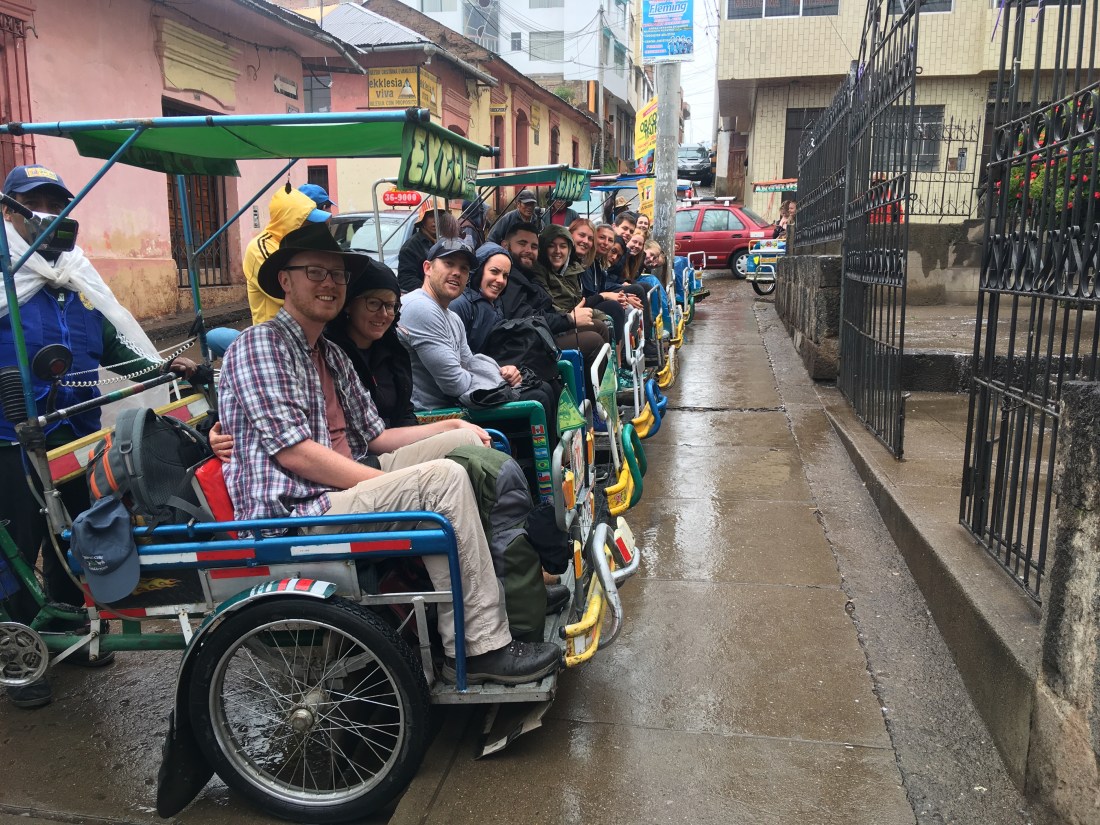
Nethertheless it was fun being hunkered down under a makeshift roof with the guy peddling like crazy to race us through traffic against the rest of the group!
At the harbour we boarded our boat which would move us around the lake for the next 2 days. A bit about the lake – not only is it 3892m above sea level, it is also pretty huge at 174km in length. So much so that it straddles Peru on the north side (approx 60%) and Bolivia in the south (40%) and several languages are spoken – Aymara below Puno and Quechua above it! The name embodies this fusion – ‘Titi’ means Puma in Aymara, and ‘Caca’ means Stone in Quechua. There is a Puma stone situated in the Isla del Sol in the Bolivian part of the lake!
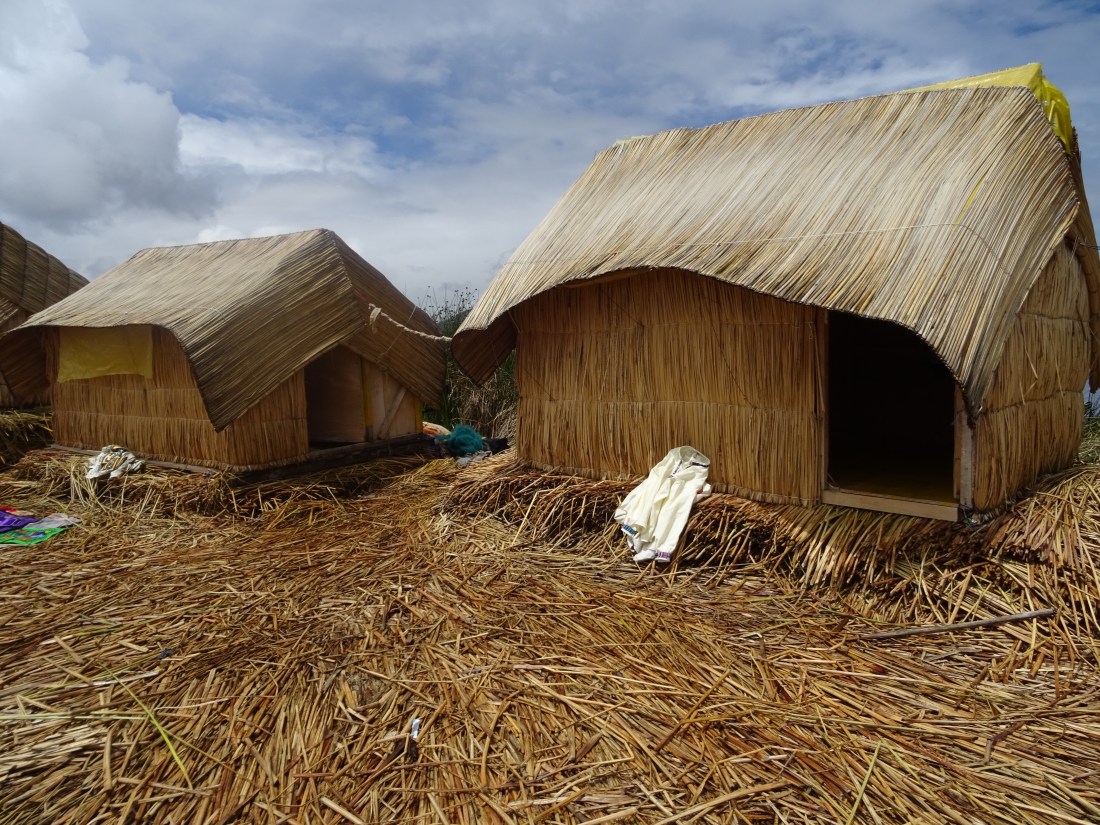
Anyway, the morning’s rain persisted, much to Rach’s disappointment, but with a bit of patience and stretching the schedule a little, the clouds finally parted and we disembarked onto Uros Floating Islands! This was really fascinating – whole communities of people (1,100 in total across 80 floating islands) have made homes here from Totora reeds, which are layered on top of each other to make floating islands, upon which reed houses are built!
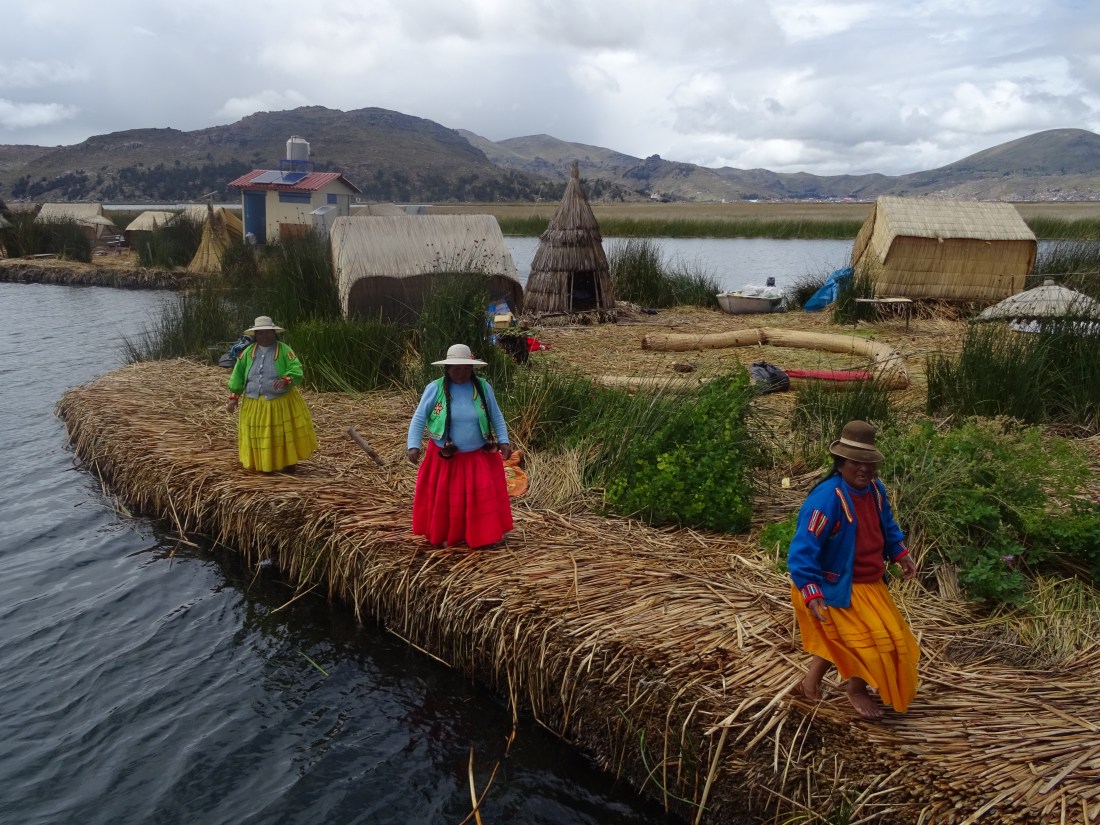
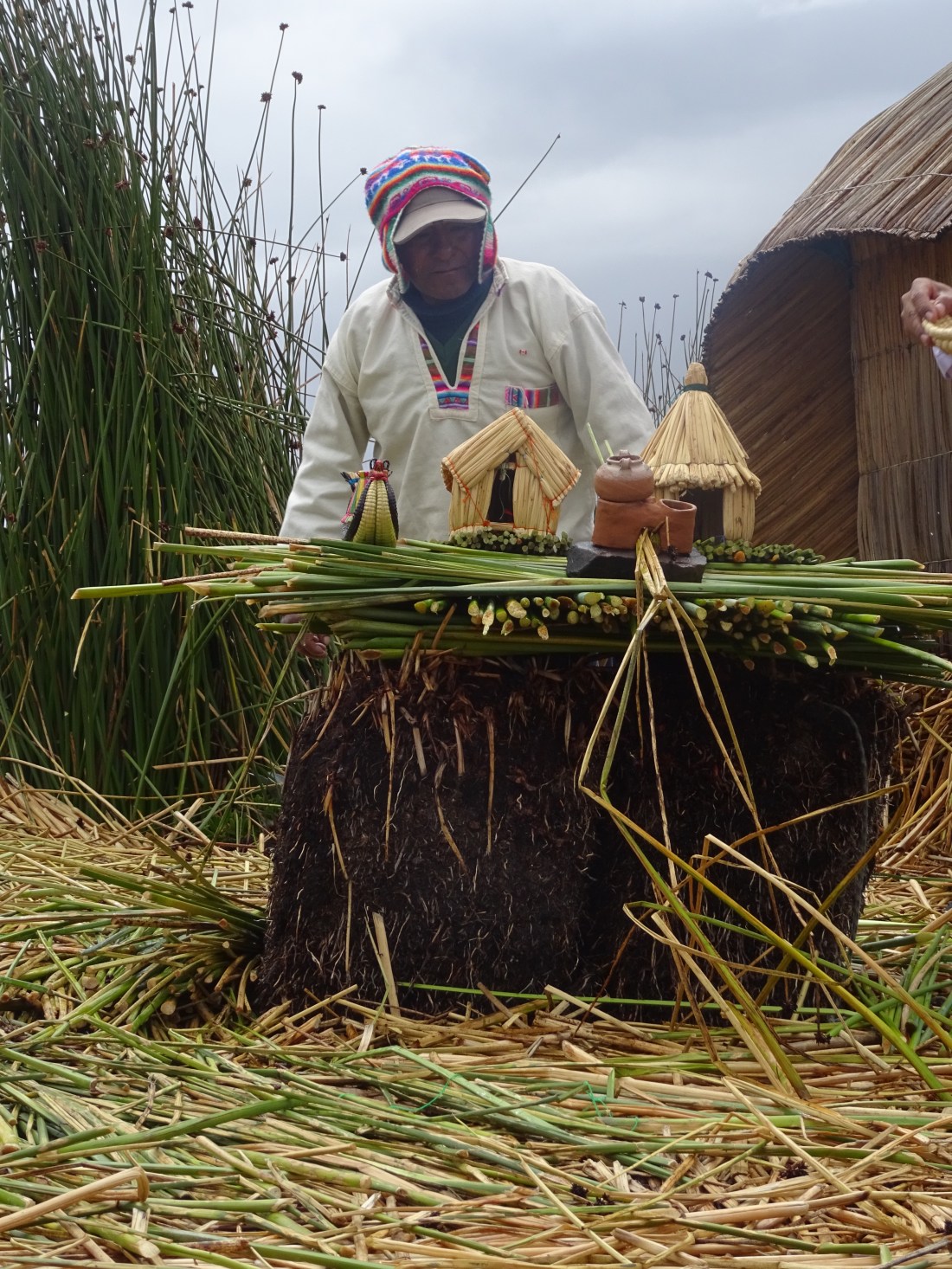
We were greeted warmly on the islands by the locals, who proceeded to demonstrate how the houses were constructed, and maintained over time by layering on more once per week in rainy season, and once per month in the dry season (see pic). We were amused to hear that they play soccer on the reeds to compress them down and even the ground!
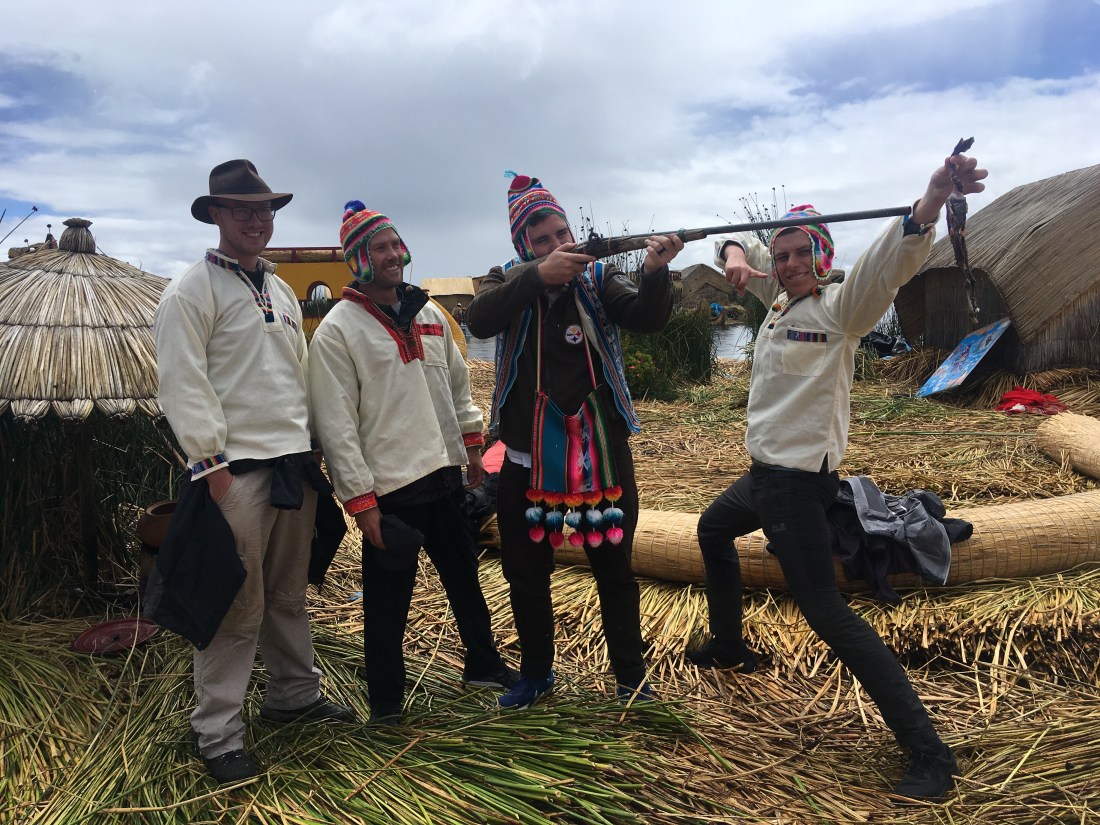
 We also heard about how they live – they eat the root of the reeds (the part underwater) as it contains lots of calcium! Aside from reeds, their diet also heavily relies on trout from the lake, duck eggs and duck jerkey! They weave beautiful murals and make their own clothing, and we were even invited to dress in the way they do – I think it suits them better than it did us (perhaps apart from Dries, who went on to buy his tunic he loved it so much!) Here are the boys all kitted out:
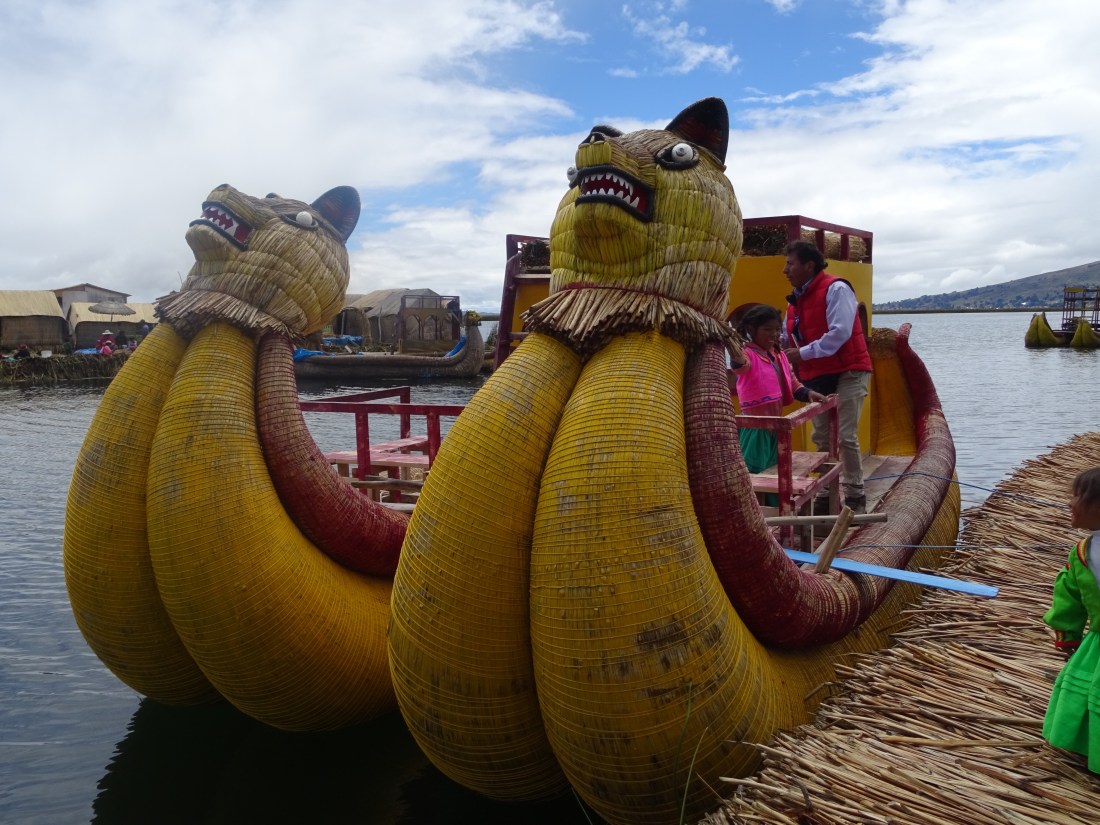
 We then took a traditional, but beautifully elaborate, reed boat, where on the top deck we were rowed around more of the islands for a 360 panoramic view, enjoying the sun!
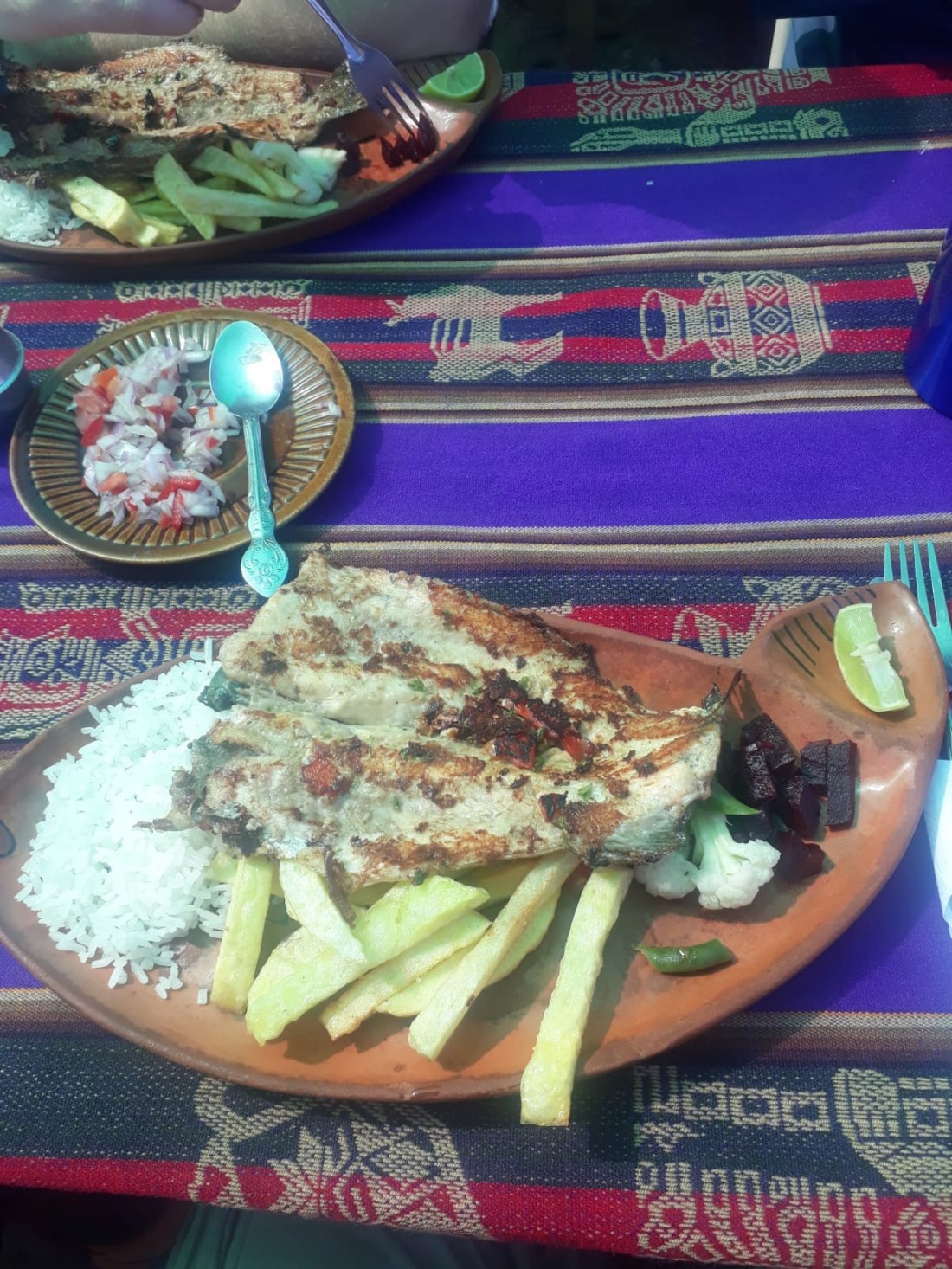
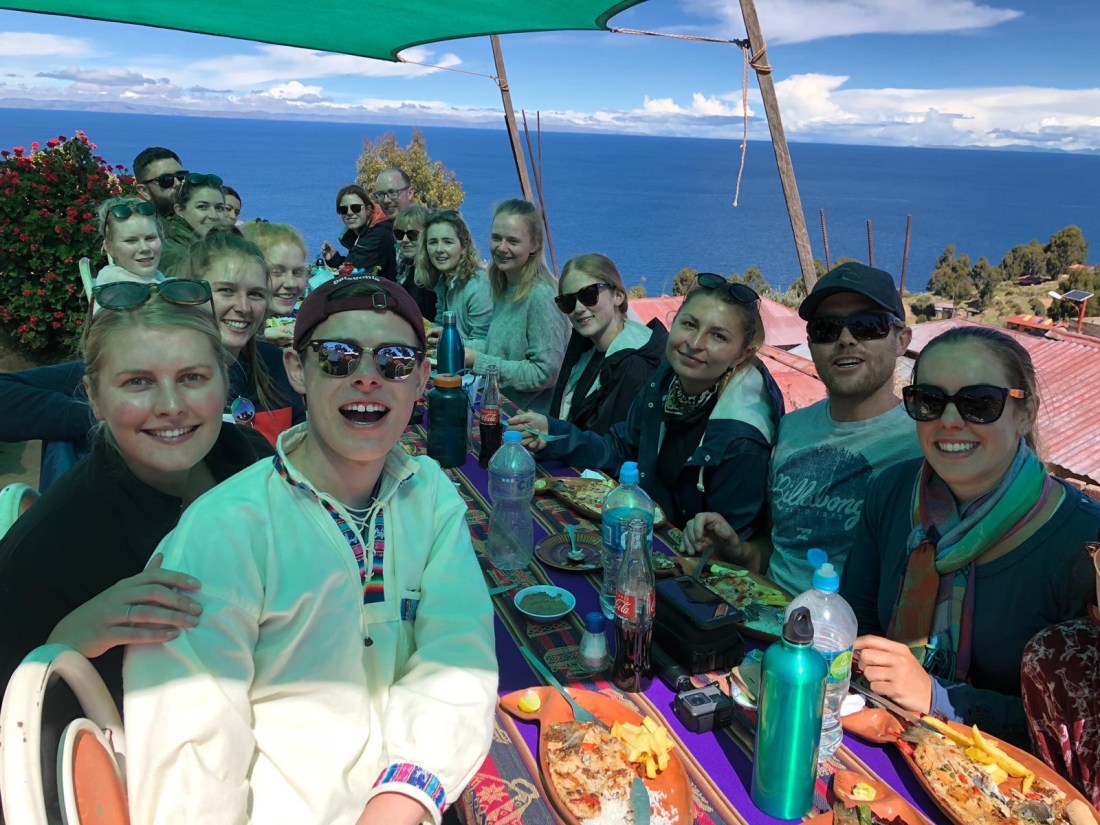
Next we sailed over to a peninsula called Luquina, and walked up into an old Quechua town for lunch of fresh caught trout – one of the best things we’d eaten so far in Peru with a view to boot!
We also learned here about how the locals go about finding love – couples are given 1 year to live together to ‘test’ a relationship before they get married (seems sensible!) However in order to initiate this and get agreement from the family, the guy must first of all invite his love interest to agree and to do this, he throws a stone at her back and if she turns around she has agreed! That wouldn’t fly back home!
3. Homestay on Lake Titicaca
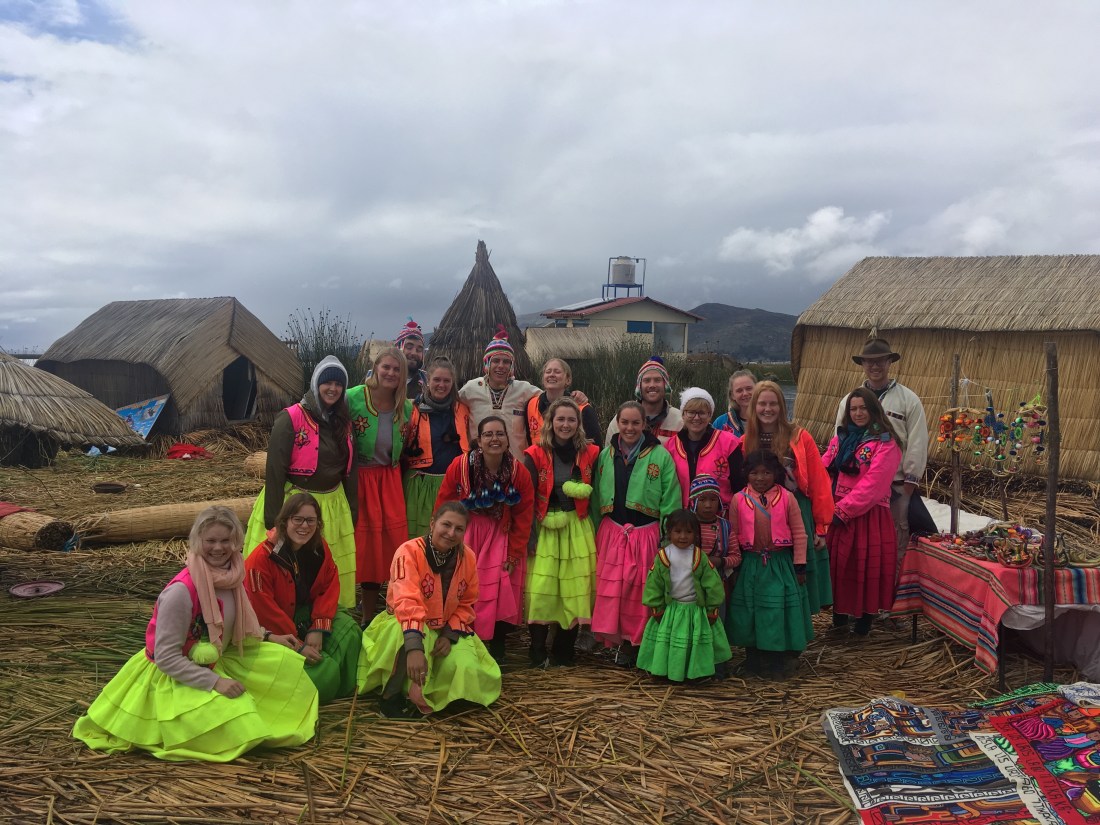
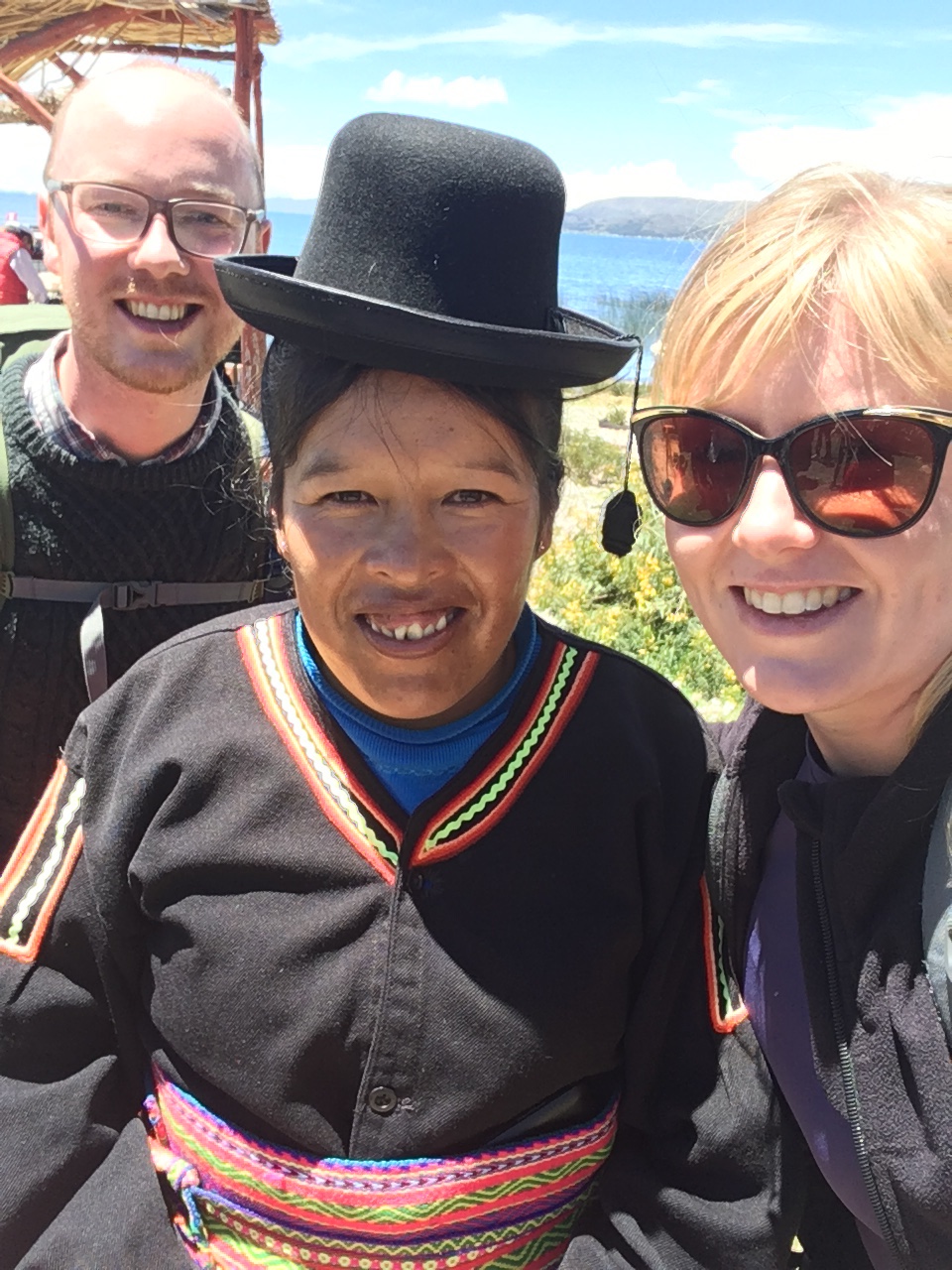
After that we went a little further down the lake to our homestay for the evening. Ged and I would be hosted by two sisters, Stephania and Hilda (pictured with us below)
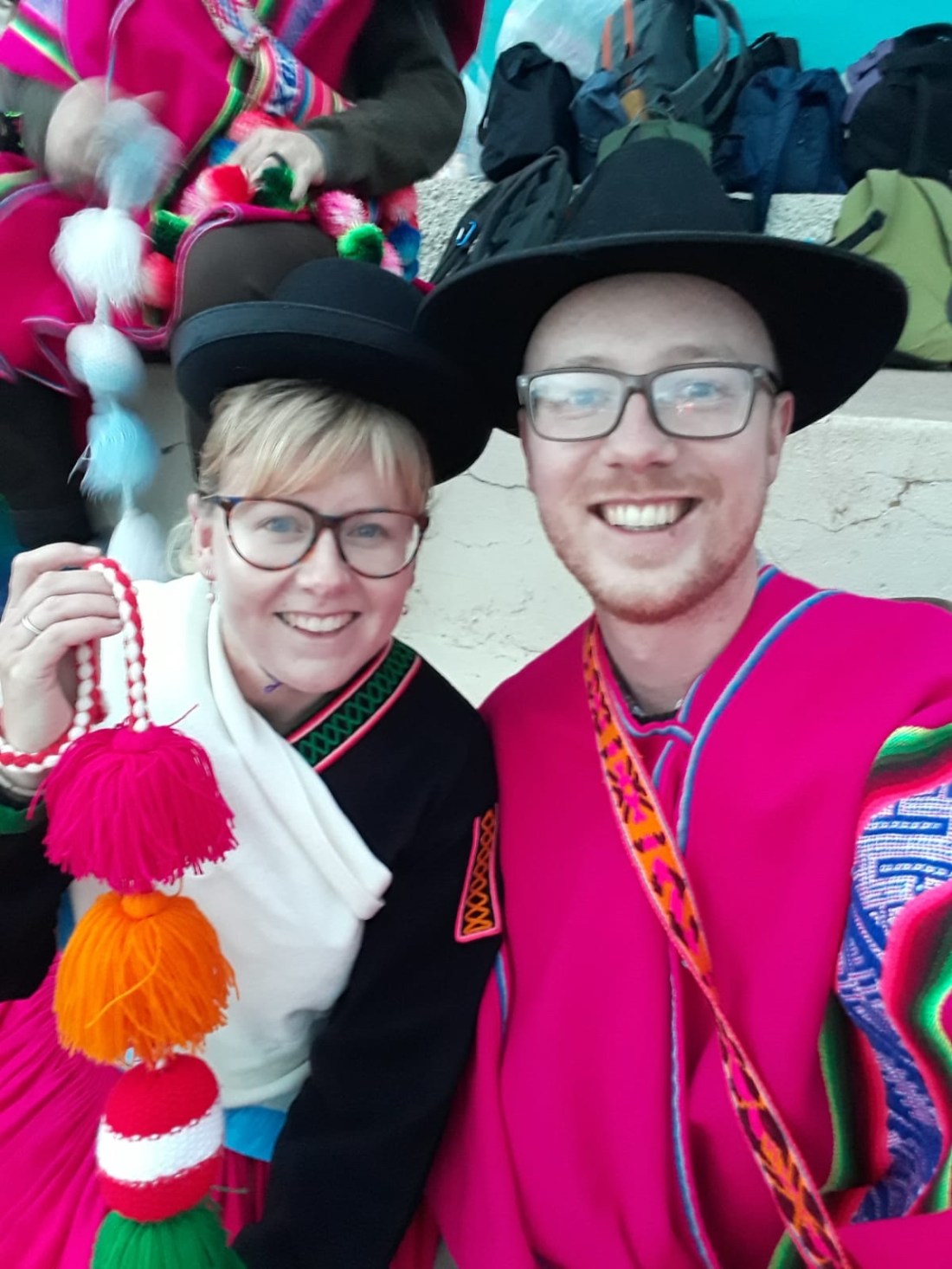
Before we got properly acquainted though, we went up the hill, accompanied by village band(!) to the community school football pitch for a game of soccer with the locals. Needless to say everyone who played (Ged included) that the altitude was a killer! But that didn’t stop us winning, but by some luck we’d say! After we all dressed in the traditional dress of the community and learned a partner dance, which we performed with much enthusiasm but little skill!
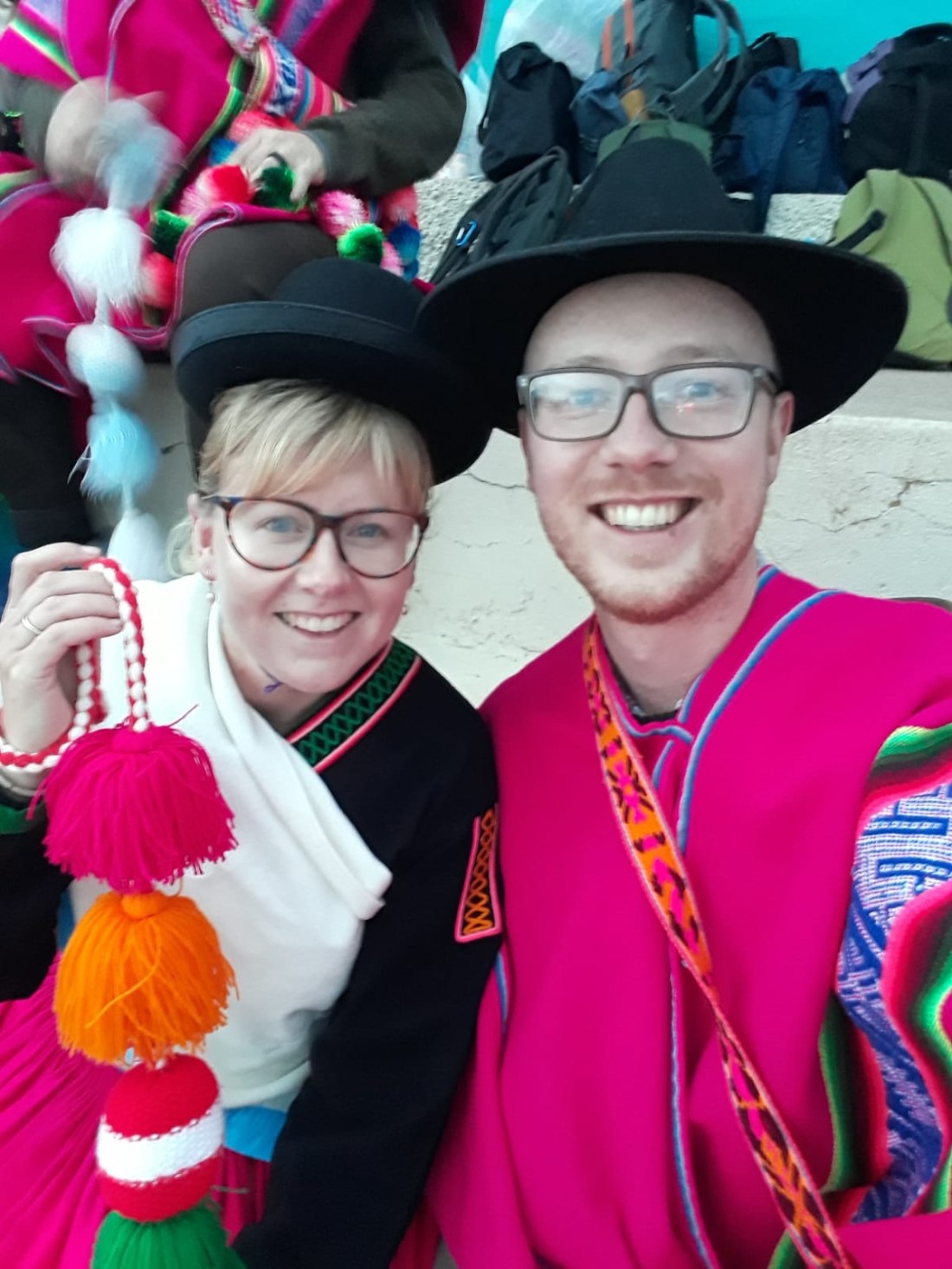
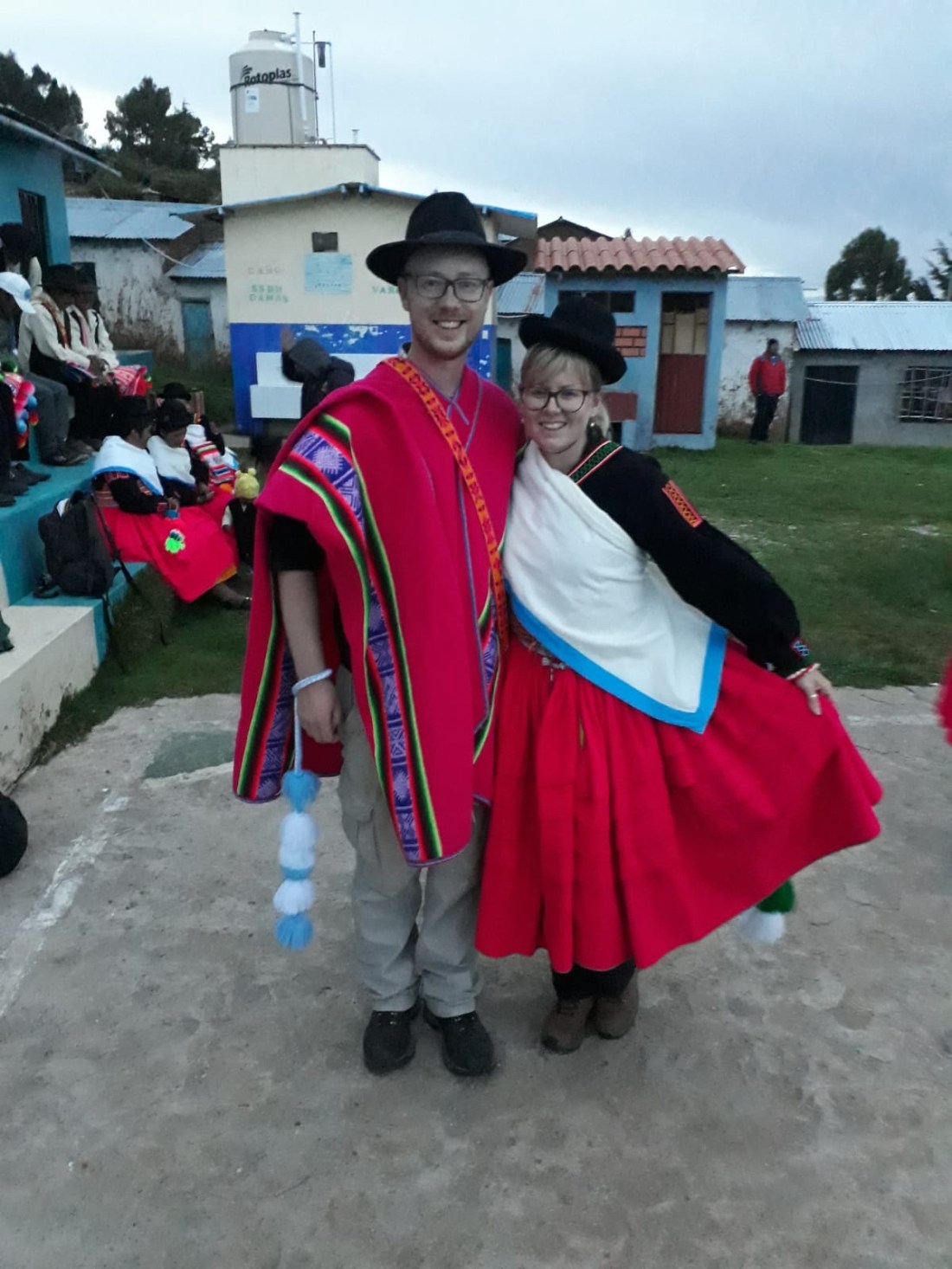
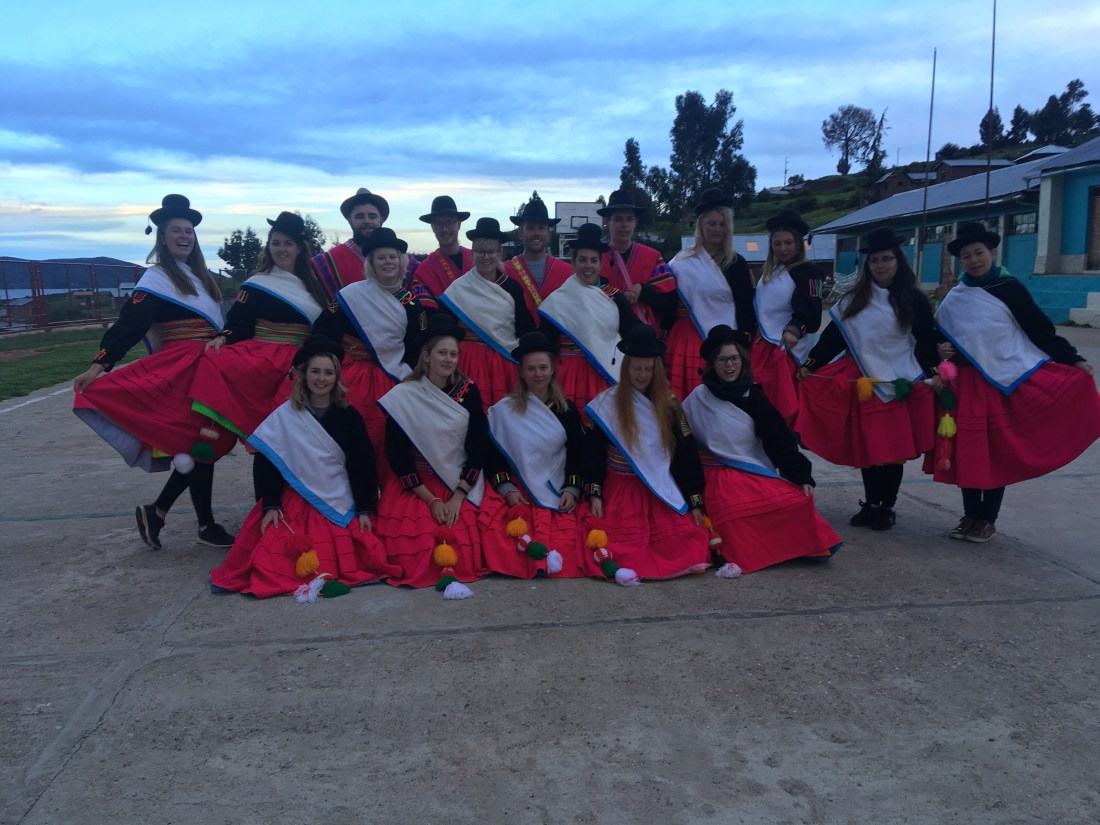
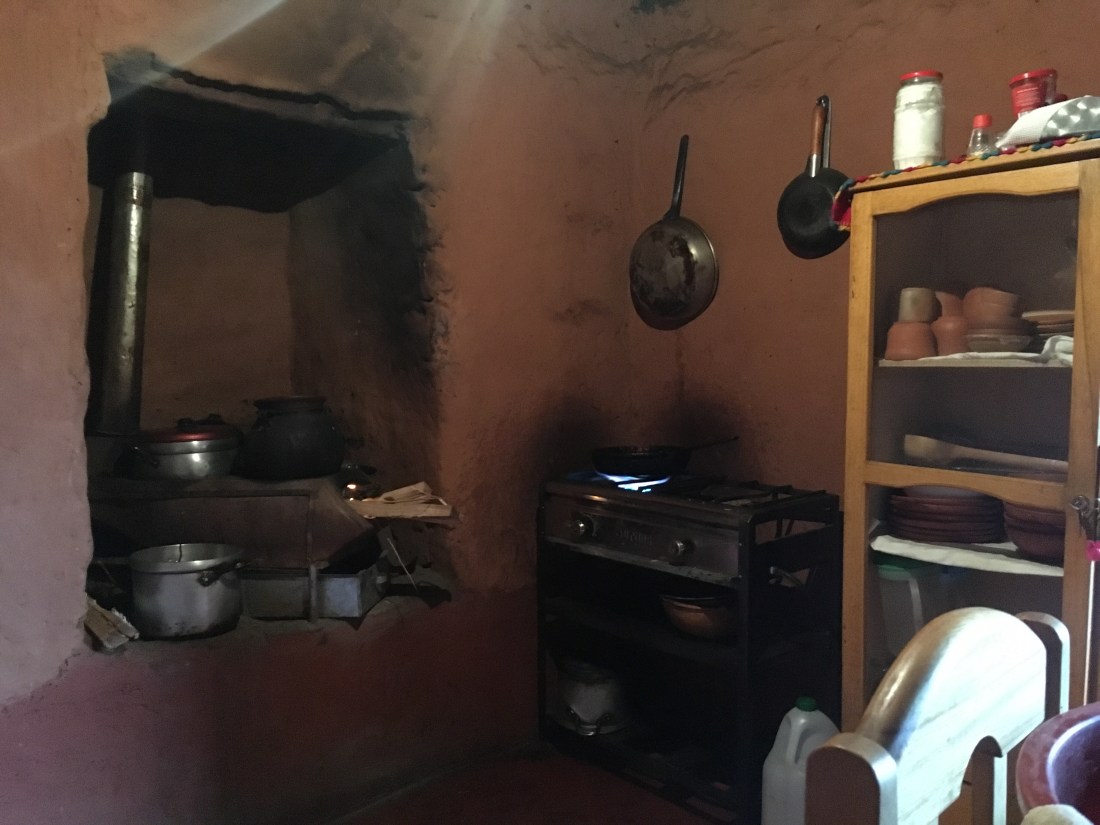
Then off we went with Stephania to settle into their guest house and have dinner with them in their rustic kitchen (pictured), attempting some conversation in Aymara from the phrase sheet we had and doing the rest in Spanish with the help of google translate.
We had a good dinner and learned a little about their family, including their dog Tarzan!
The next day we got up early to help with their daily work – we shaped bread (unleavened, a bit like pitta, and fried in a pan) for breakfast, then chased sheep to tie them down to graze in the neighbouring field!
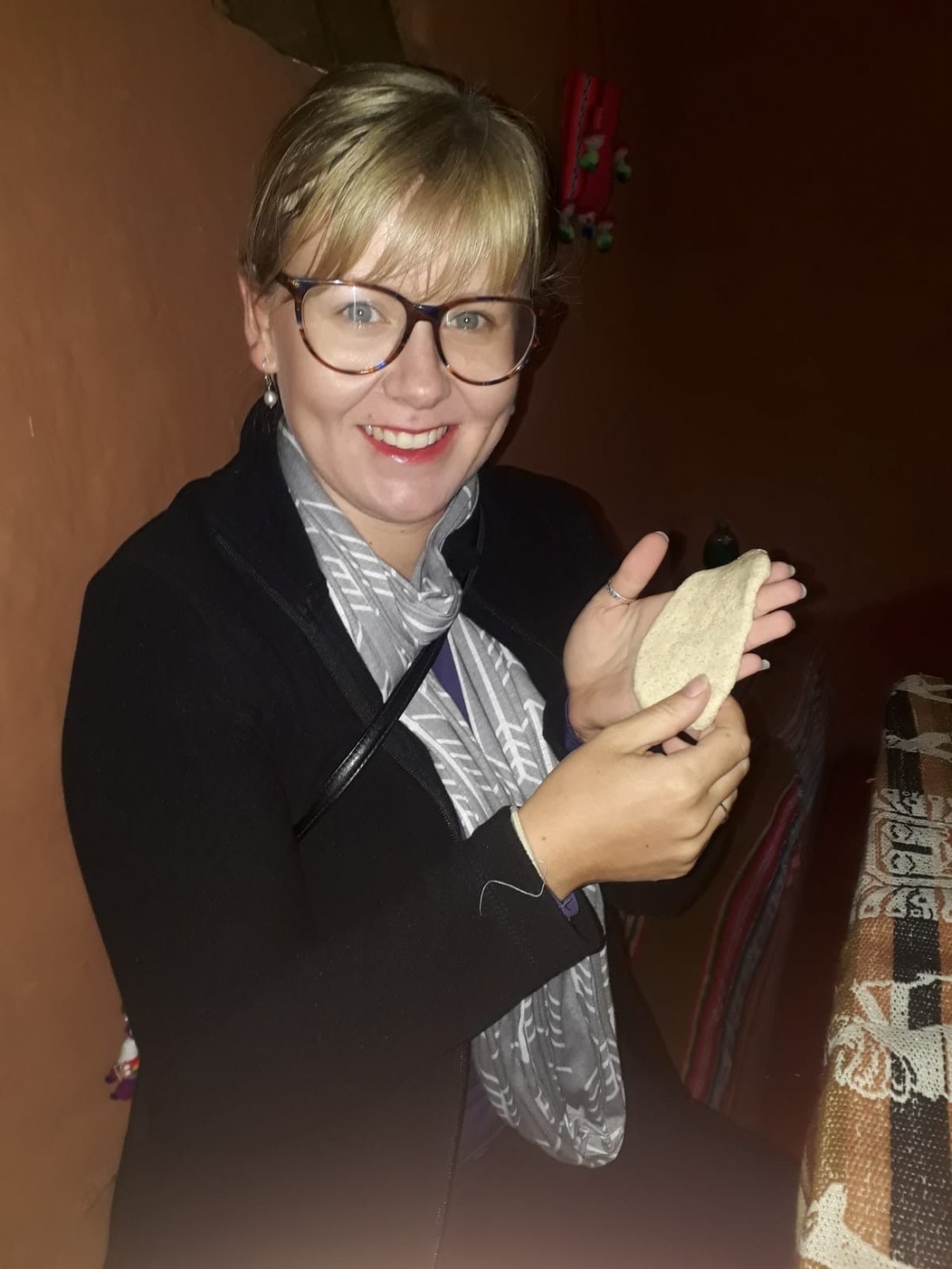
We also fed the oxen and peeled vegetables for the soup at lunchtime. We then had some time to walk along the top of the village to get a good view of the lake, and by chance to help out our friend Hillary moving a log up her family’s slopey field!
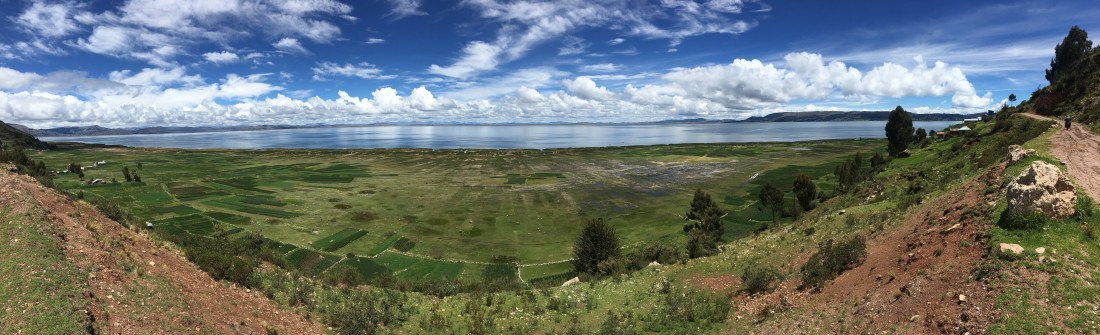
We saw other families doing similar activities – tending to sheep, fathers and sons going out to fields to look after the crops of wheat, corn, quinoa, potatoes and fava beans.
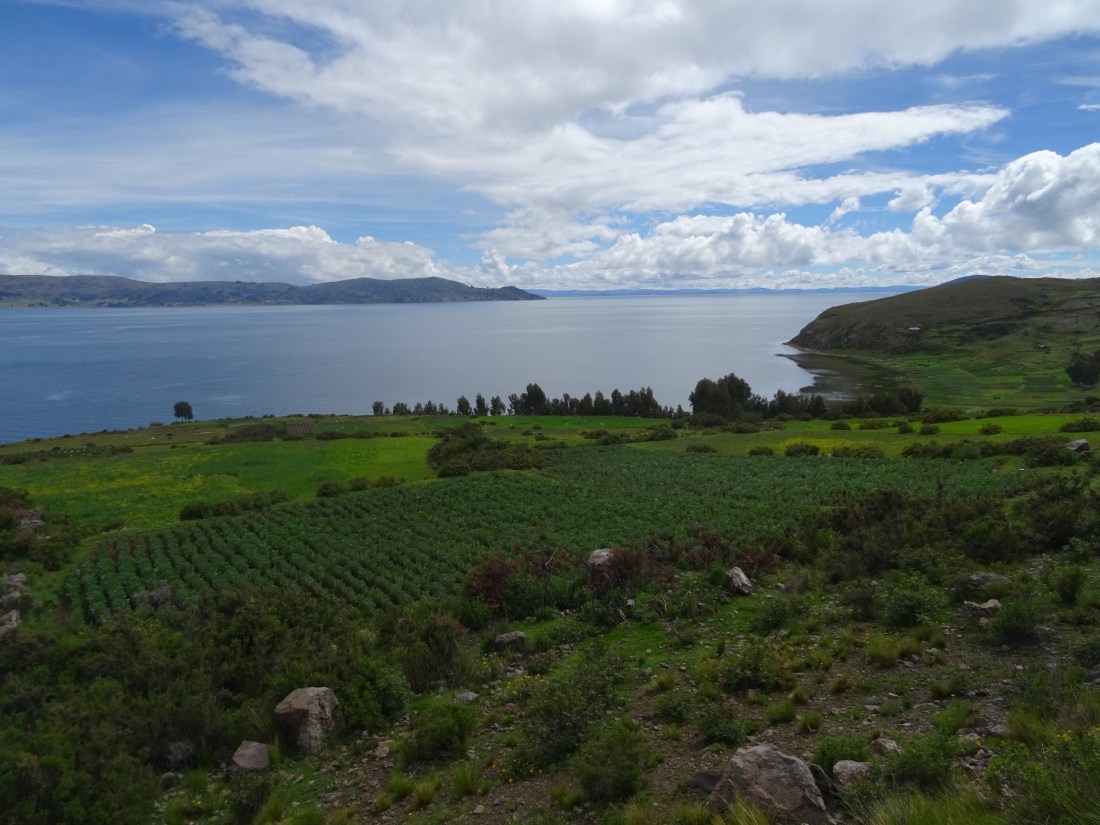
With regards to the experience of staying as tourists with indigenous people, it’s fair to say we hadn’t really understood what staying in the community would actually mean. Ged in particular hadn’t read the details and thought we were just staying in a lodge. It was evident from the brand new guest buildings and the weekly visitors’ signatures in the guest book that tourism is having a massive impact on life in the community we visited. For better or for worse. There are many, many articles discussing the pros and cons of ethno-tourism that generally agree that it is extremely rare that the community truly benefits from it. At best the way of life is diluted by, or exagerated for the tourists, and the community becomes more reliant on money from tourism than on their usual subsitence methods (if the tourists stop coming there is then a crisis for the community). Traditional communities also tend to be asked by tour operators to perform in “traditional” clothes and act as tourists expect, which was the case to some degree with our visit. The worse case scenarios are when tourists bring diseases alien to a community and seriously harm the health of the people they visit. There seem to be far too many examples of death following buses full of tourists with flashing cameras. The stay we had seems to be one of the better examples of ethno-tourism but it still was not perfect (sugary sweet presents from many previous visitors had ruined the locals’ teeth who have very limited access to dental care). In future we will read more into what organised tours include and consider what type of tourists we want to be.
After lunch we said our goodbyes and it was time to get back to Puno. Tomorrow we depart Peru for good for Bolivia – first stop La Paz!
4. Peru/Bolivia border crossing
We woke wondering what the border crossing into Bolivia would be like but in reality it was straight forward. An exit stamp at the Peru desk, an entry stamp at the Bolivia desk, a quick pat down of our bags, and we were through. We sat in what was now the Bolivian sun and waited for the rest of the passengers on our bus. For ages…… it seems some bright spark had dual citizenship of the USA and the UK. He entered and exited Peru with the USA passport and tried to enter Bolivia with the UK passport to avoid the $150 immigration fees US citizens have to pay. The Bolivian border guards were not exactly happy when they couldn’t find the Peruvian exit stamp. Eventually they permitted him entry if he paid a fee but he was lucky. The lesson of the day was don’t try and mess about with border guards!! Soon enough we were trundling along a landscape that was identical to the Peruvian side of the border towards La Paz.
5. La Paz
We arrived into La Paz relatively late in afternoon but went for a walk with our tour guide to get a feel for the place. La Paz is high, the highest capital city in the world in fact! At 3,650m (11,975ft) above sea level you really feel the lack of oxygen as you walk up steps and breathe in the pollution.
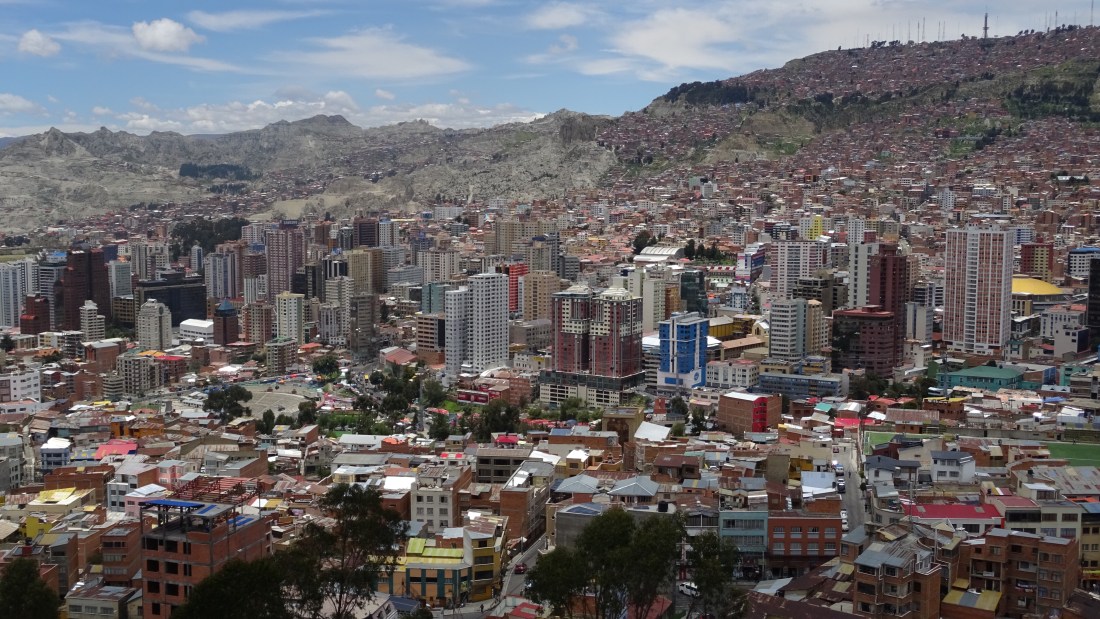
La Paz supposedly means “the peace” but the city is anything but. It is very noisy and chaotic with a population of around 2.3 million people. There are some bullet holes still in the walls of buildings in the main square from a recent conflict between the police and the army that included the shooting of several civilians. A reminder that peace should not be taken for granted. We walked to the so called witches’ market to peruse their wares for potion production. On face value these stalls sell the usual tourist tat apart from one item. Most stalls had at least one dried alpaca foetus hanging at the front. These are bizarre to see and are used by locals as offerings to Pacha Mama (Mother Earth) to bring a fertile harvest or good luck in general. We were reassured that the foetuses are from alpacas that died naturally, rather than removed on purpose. After this we went to the nearby cathedral of San Francisco. This is quite understated for a cathedral but is beautiful in its own way. The most interesting thing for Ged was the plastic statues of saints which looked awful but were encased in glass and framed in gold leaf. After an out of breath walk back to the hotel we grabbed a quick beer and some food before having a good night’s kip, ready to explore more the next day.
We woke determined to make the most of our only full day in La Paz. Rach had done her research so we jumped into an Uber to a viewpoint over the city. From Mirador Killi Killi the views were astounding. We could see just how massive and spread out La Paz is and the rolling hills and mountains that surround it. It was totally worth the £1.30 and 20 minutes in the car to get there.
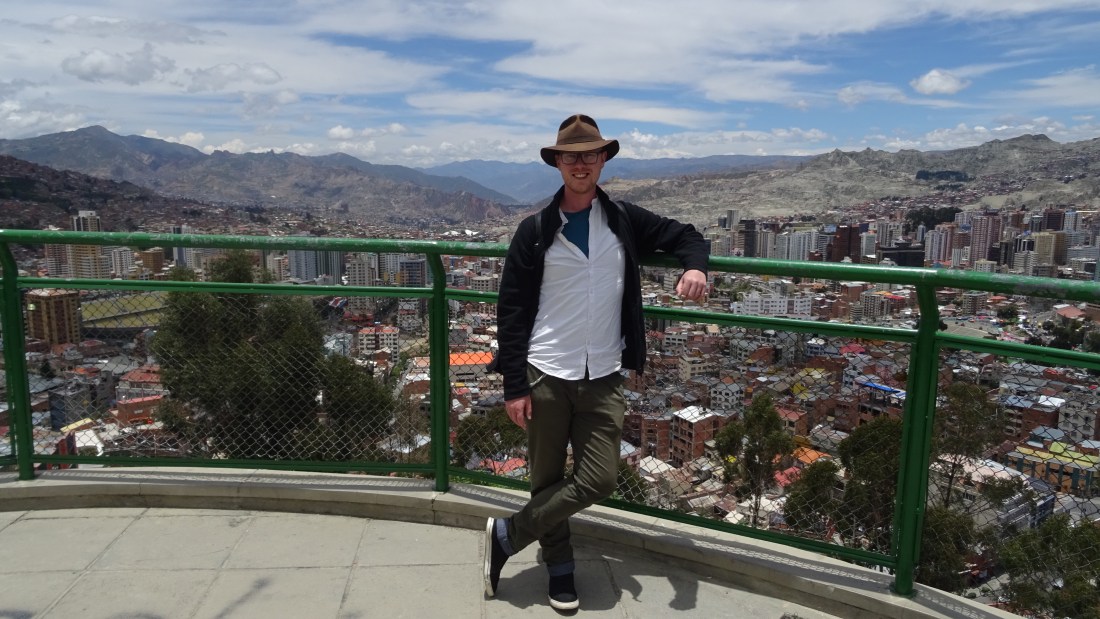
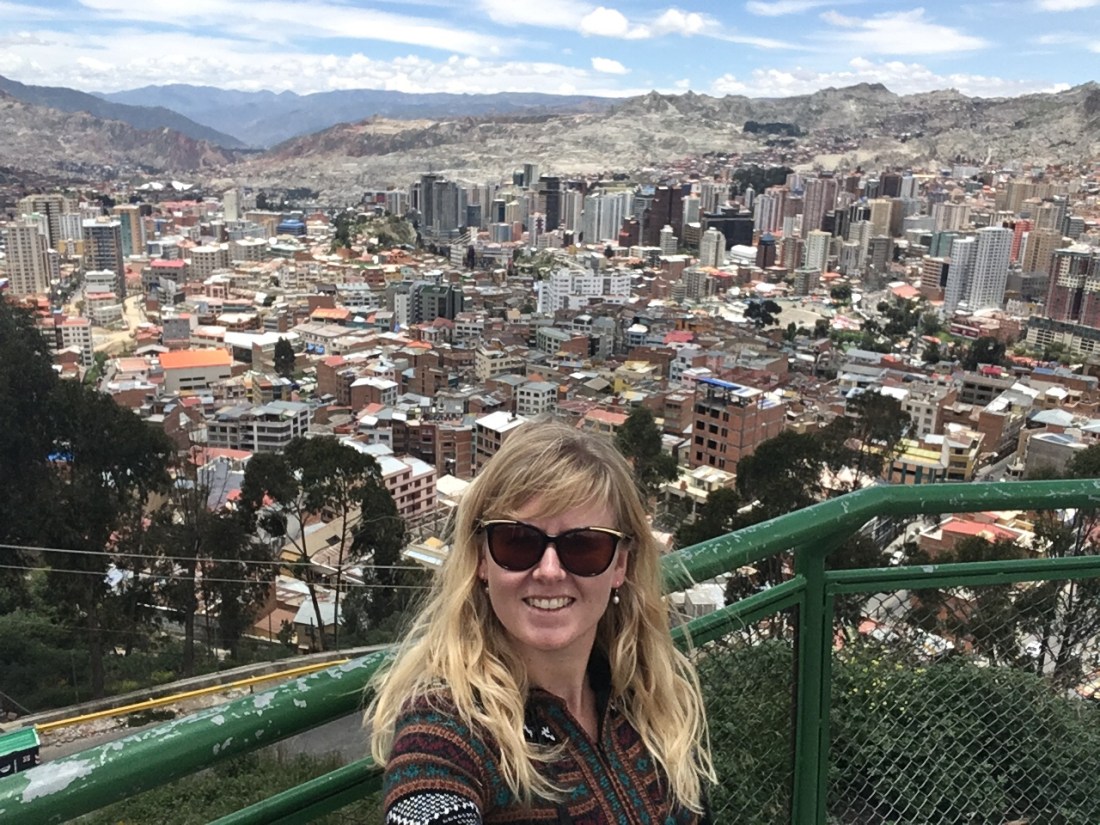
Next we decided to visit the Museo Instrumentos Musicales de Bolivia as both of us, particularly Rach, love music. The museum was about 50p to get in and was amazing. It started with an introduction to traditional Bolivian instruments such as pipes, guitar like instruments, and drums. The pipes were particularly cool as they were made from all sorts of things including carved stone, bamboo, bird bones, and even the feathers of a condor. Every room was interesting and the standout pieces for Ged were the ukulele type instrument with a body made from a condor breast bone and a five necked mandolin (photos by Ged)
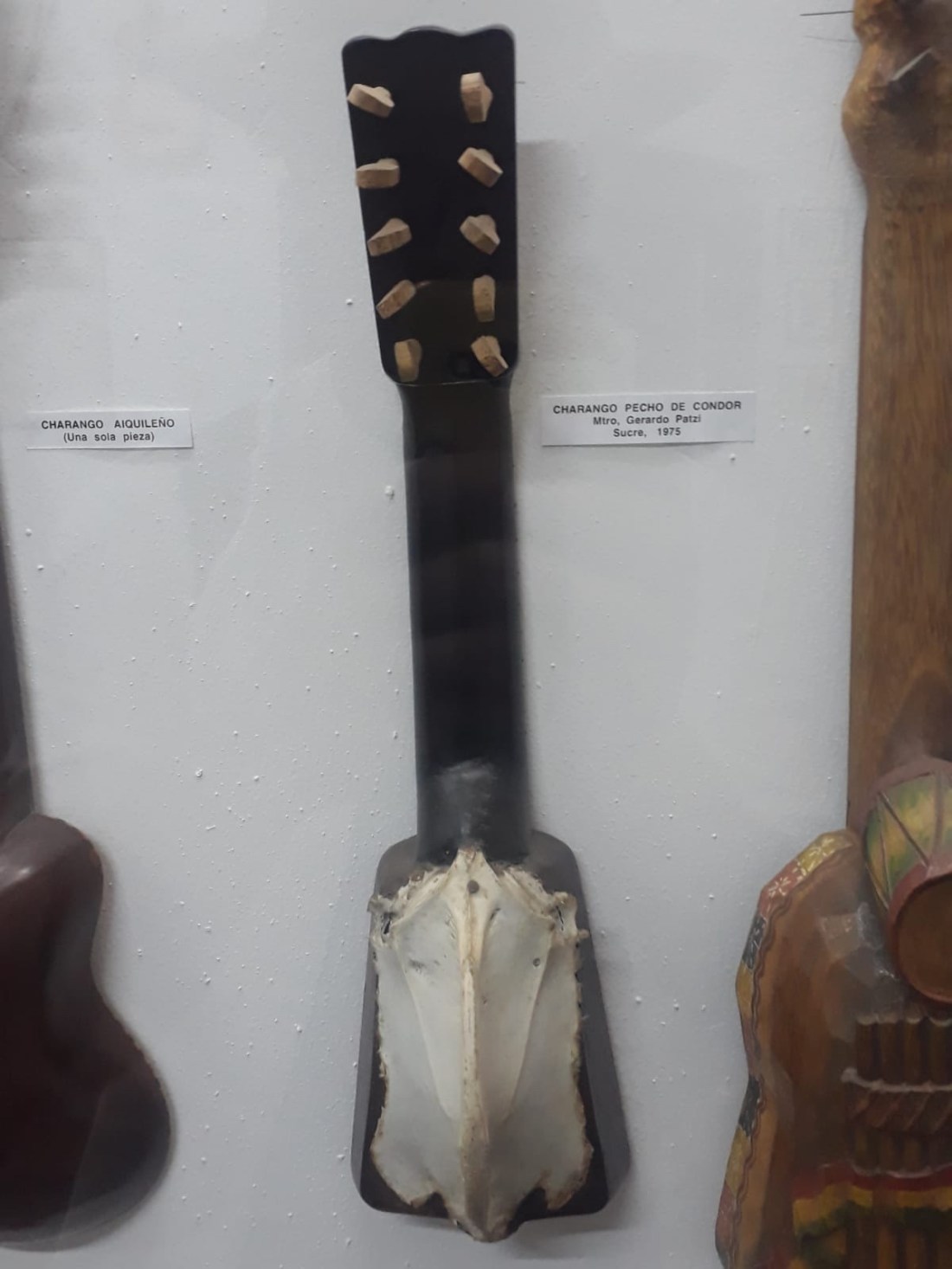
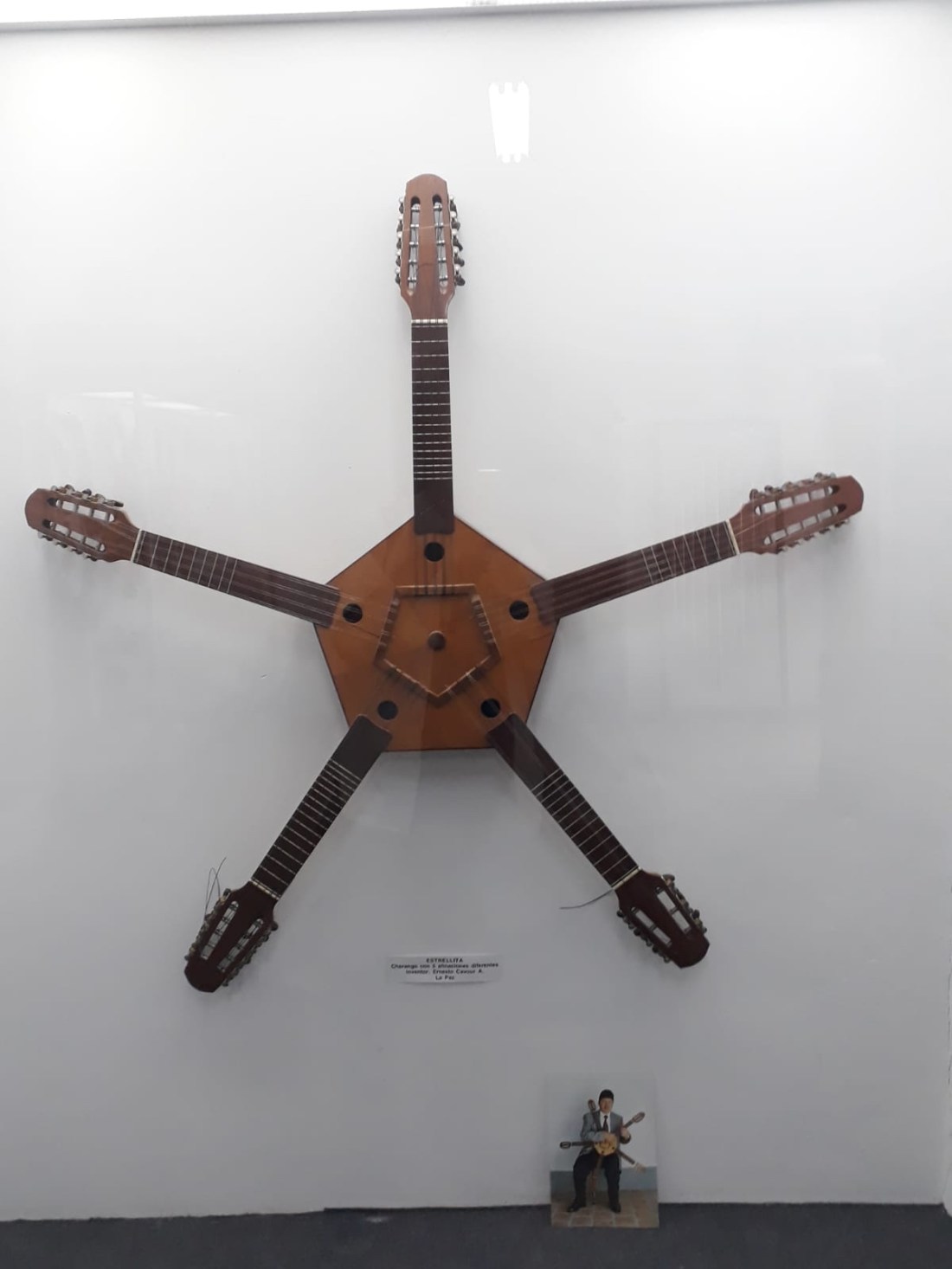
Crazy stuff but brilliant to see. After this we were famished so headed back towards our hotel to grab some grub with some of our group.
One of the main features of the skyline of La Paz is the cable car system. Opened in 2014, it is mainly used by commuters to traverse the spread out city. A few of us decided to see as much of the city as we could and travel the full length of most of the lines in the afternoon of our first full day. We had some great views and it was cool to people watch as we slowly bobbed along above the streets below.
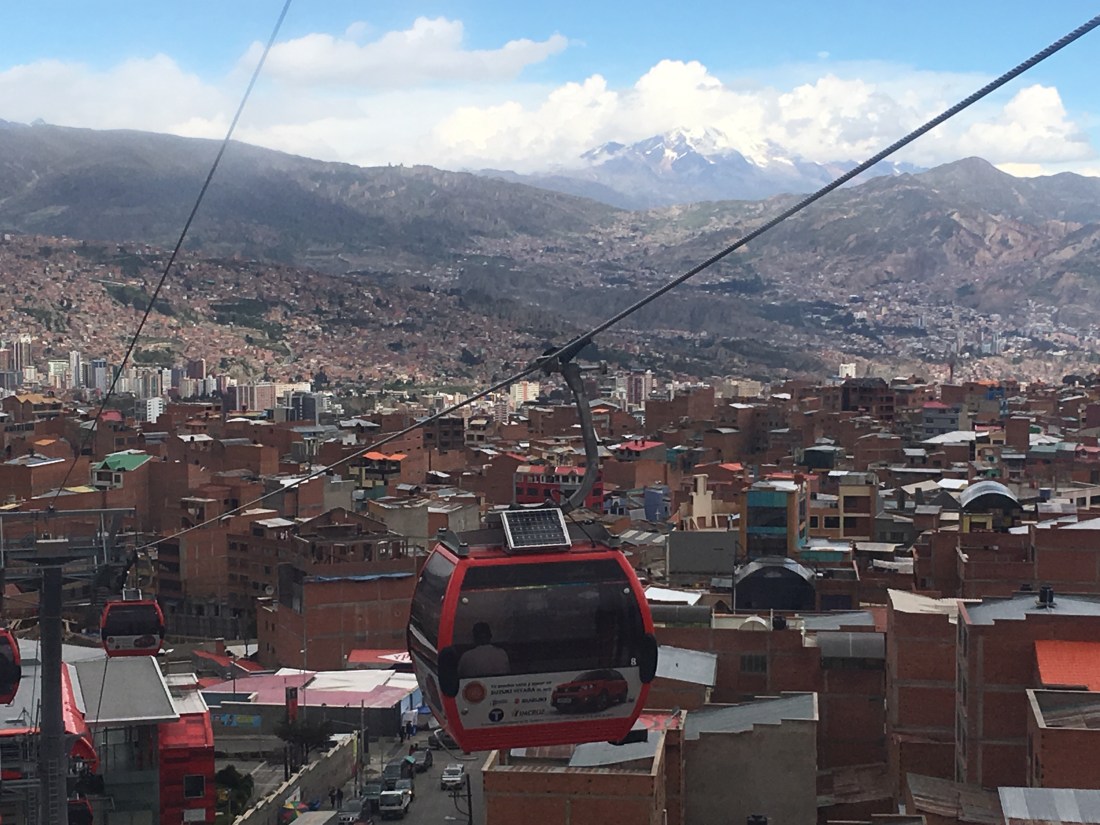
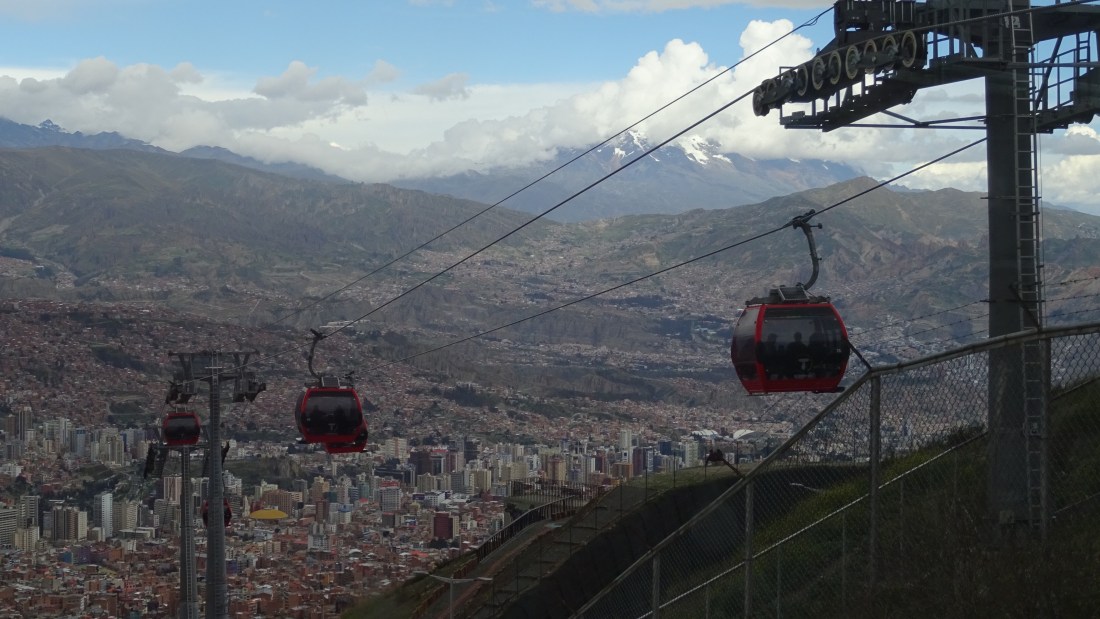 What was clear from our birds eye view is that there is a huge difference between the “haves” and the “have nots” in La Paz. Mansions in one part of the city and bare brick flats with no windows and corrugated metal roofs in another part. In any case, it was a relaxing afternoon hopping on and off cable cars and chatting about nonsense.
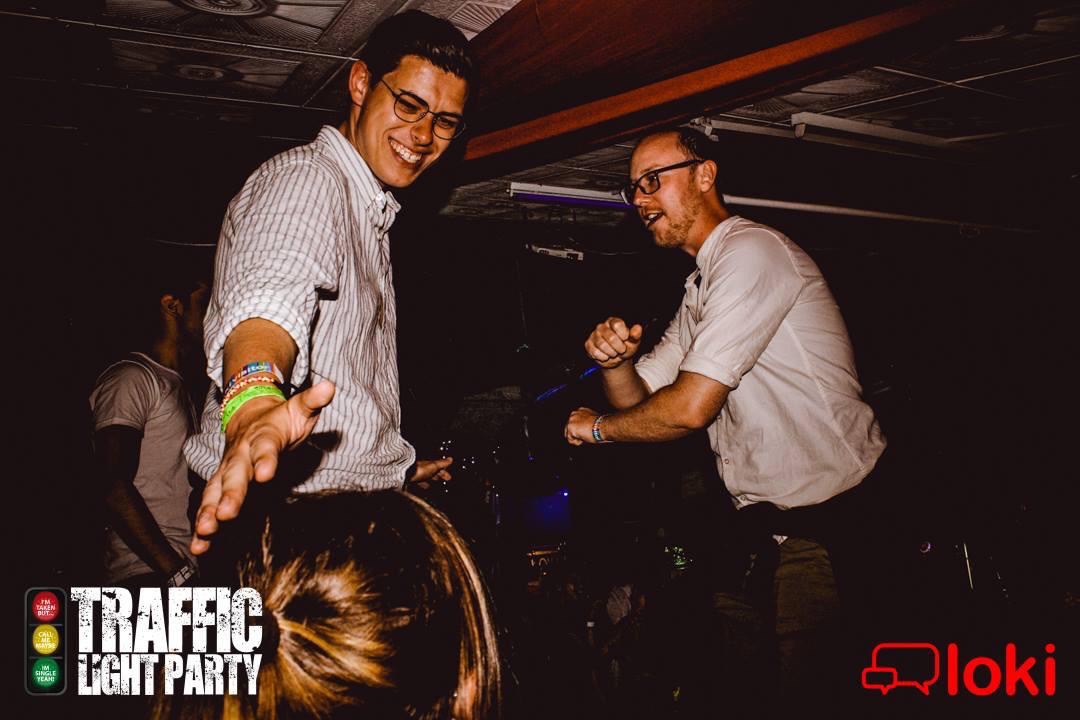
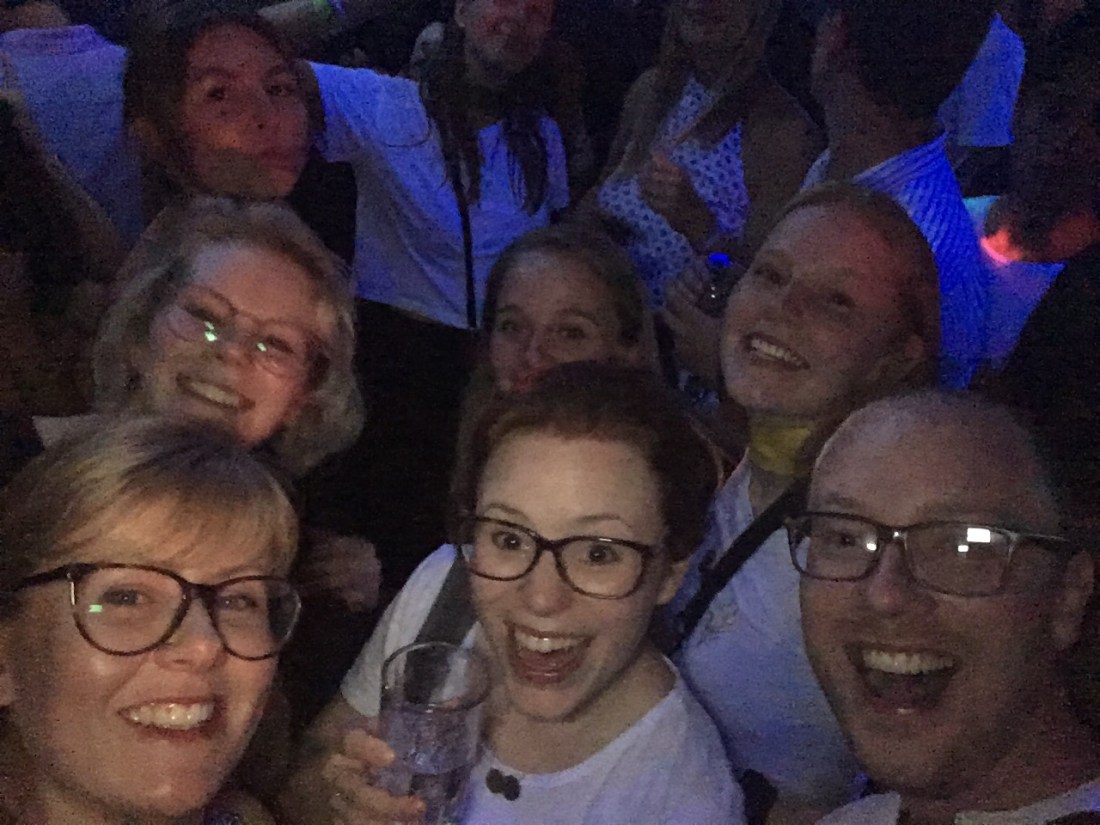
On our second night in La Paz we realised two things: A number of our group were leaving the next day and we had yet to have a night out on our travels. There was only one thing for it. We all followed Karoline (our young, party hunting, Norwegian companion) to the Loki hostal/bar/nightclub after a few strong beers in the “English” pub next to our hotel. The music was loud, the beer was terrible, and the shots were strong. We had a brilliant time and before long we were all dancing on tables singing away to pop songs we didn’t know we knew the words to. Dries and Ged even ended up having their picture put on the Facebook page of the bar for dancing on the tables. Ged blames the game at the bar where you try and throw your bottle cap into a bucket to win a free shot. Ged may have won too many times…..
The next day we realised that drinking at high altitude gets you drunk quicker than usual and that hangovers are swiftly brutal when you wake up. We downed pints of water and headed to a city tour we had booked for the last day. The tour itself was terrible thanks to our tour guide Reuben rather than because of the city itself, as he gave hardly any information and often gave wrong information when he did speak. We did however see some interesting things, including the valley of the moon (a compacted clay deposit eroded by the rain to form tall pillars).
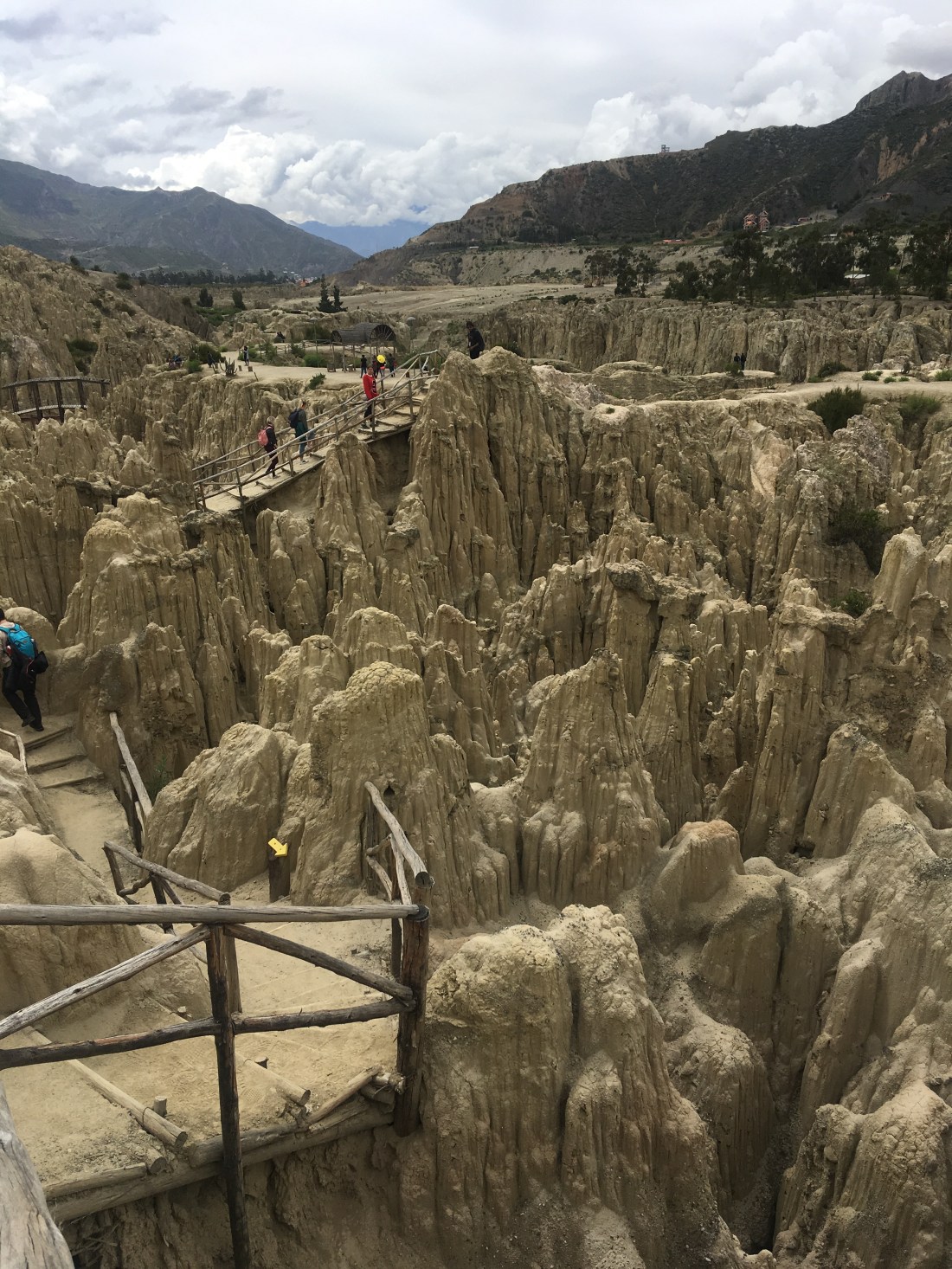
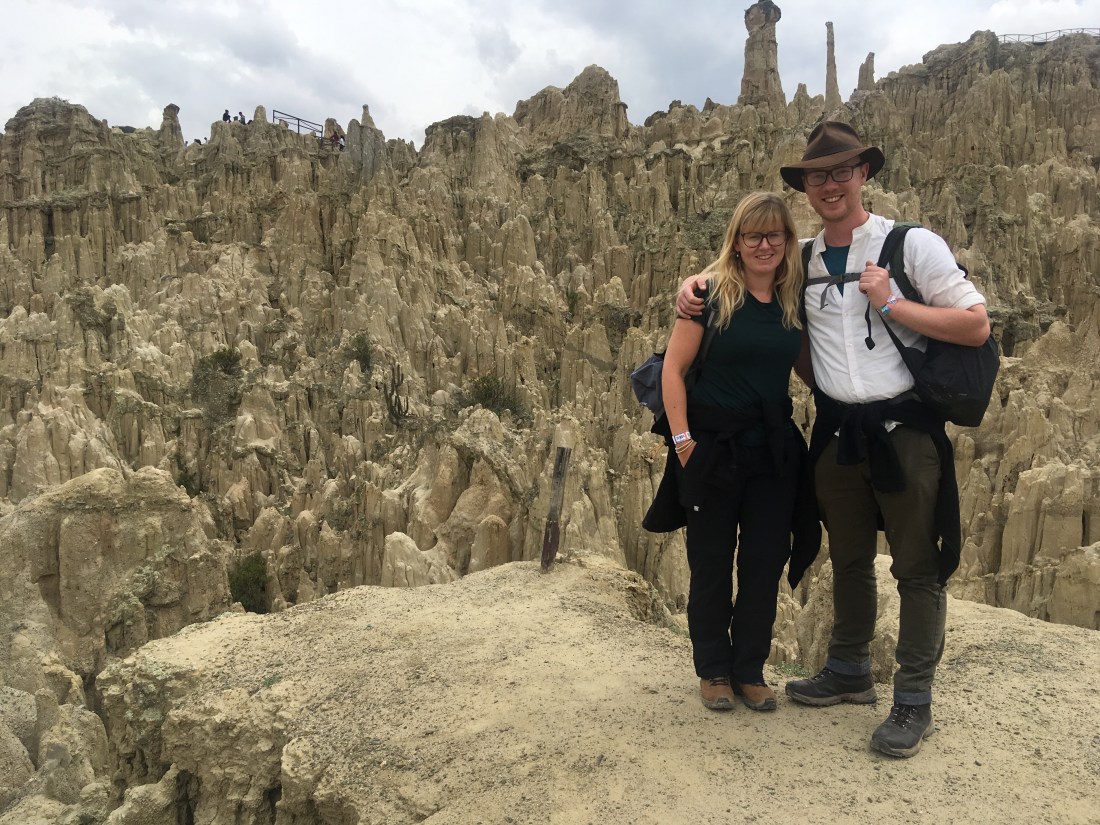
We also went to the main square with a clock that been flipped to represent the way sun dials work in the southern hemisphere, and the oldest standing colonial street in La Paz (Calle Jaén) which is surposedly haunted.
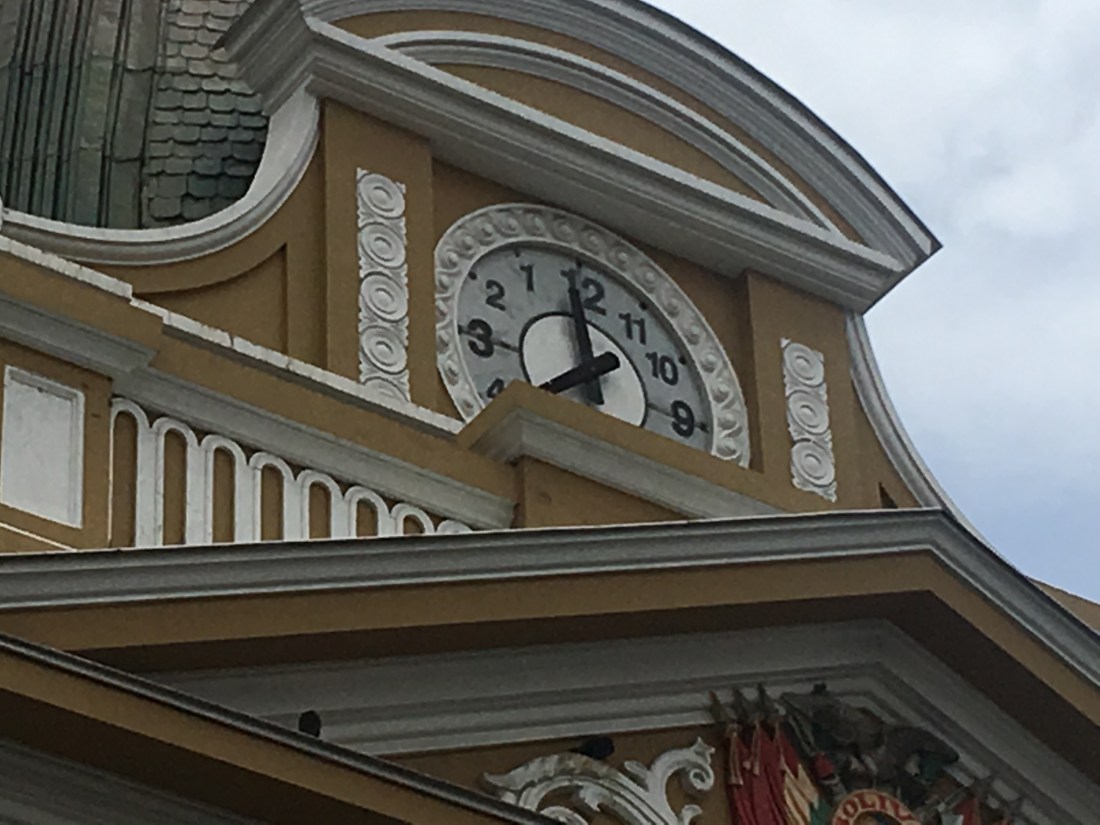
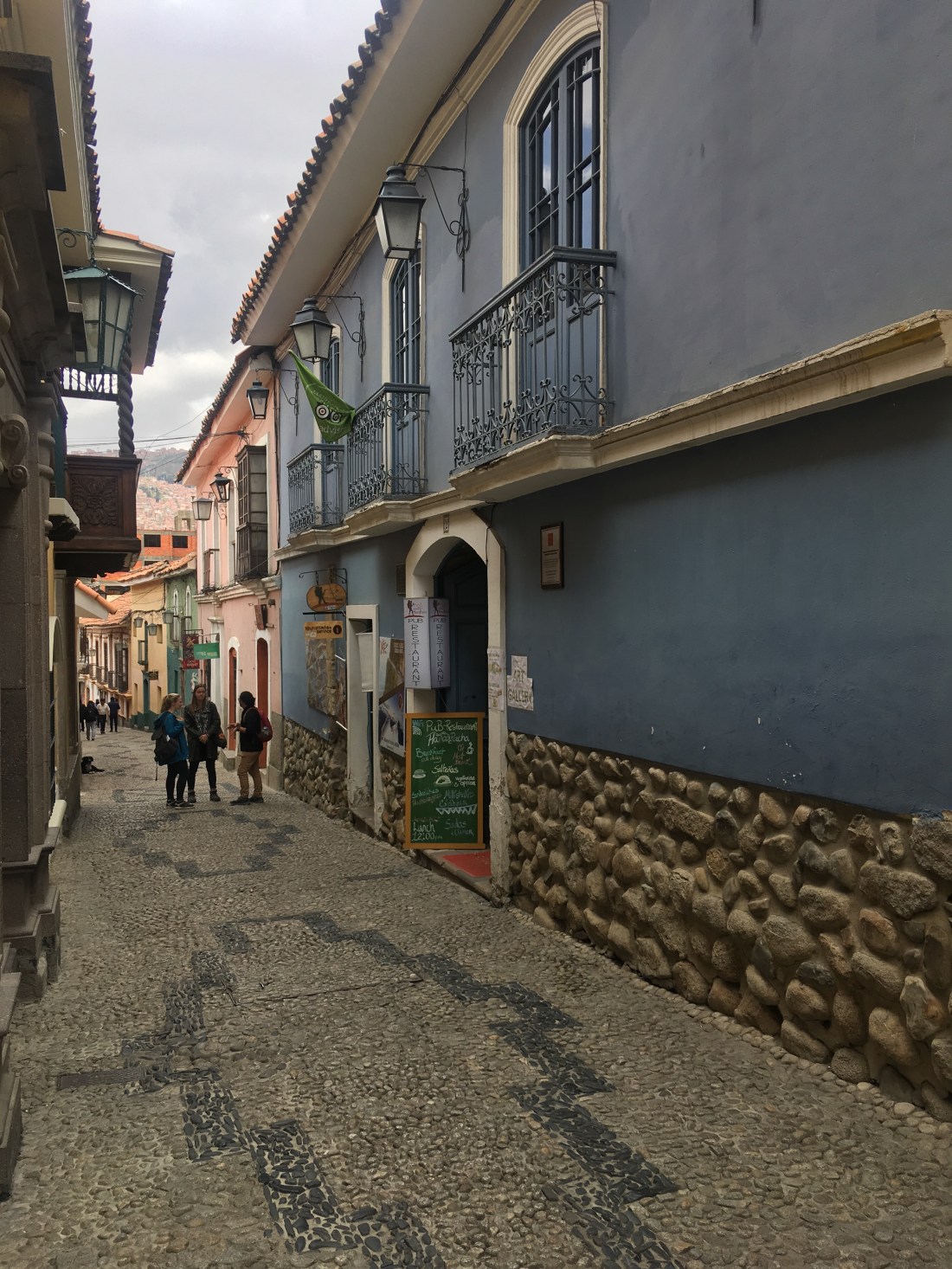
Overall though La Paz is an overly busy, polluted and noisy place and we were glad to be heading to a new place later in the day.
We got back to our hotel and it was time to say goodbye to some new, but good friends. We hadn’t spent a lot of time with each other really, but the hike to Machu Picchu had bonded people together and there was lots of hugging and a little crying as the remaining group wished the leaving folks – Dries, Lauren, Marine, Stacey, Lynden and Krista – well on their onwards travels. Rach was particularly sad that Hillary left us here too the previous evening, to go back to Canada (via Miami!) and she missed the chance to say goodbye, having felt quite altitude-sick when she first arrived!
Not long after the goodbyes it was time for new introductions. Seven new people were to join our group – a German couple called Frank & Sylvia, Claire from York, Kirsten who is English born but lives in Aus, two Belgian friends Pauline and Chiara and a Russian called Elena who lives in the US. We had a new guide too, Flor from Argentina, to take us the rest of the way to Buenos Aires. First impressions of Flor were great, and she got us really excited for our next part of the journey through Bolivia, Chile & Argentina!
Vamos!
 Around the world in 140 days