
Author: Ged
Photos: Rach (unless specified otherwise)
3 April
This was the day. Angkor Archaeological Park. At last we would get to see Angkor Wat. Ged was Machu Picchu levels of excited and woke up a couple of hours before he needed to. Our trip today was the main reason why many western folk visit Cambodia (we’re looking at you gap year people!). Our pre booked tuk tuk driver picked us up at 7:30am sharp and we were chomping at the bit to go!
First stop though; the ticket office. There is no getting around the fact that this amazing place is both a historical wonder and a modern day business, and therefore visiting the park is not cheap. A 1-day ticket costs US$37 per person, but there is no chance of seeing most of the park, and you will literally run through the main sights. We opted for the 3-day pass for $62 USD. Add on the tuk tuk driver hire ($25 USD per day) and visiting the Angkor Archaeological Park was going to set us back a total of $87 USD per person. Yikes! We could have spent even more by hiring a guide (recommended) but we opted for the free method, downloading a book about the temples in advance, which worked out just fine. To put the cost of visiting into perspective, the standard price of a meal at a restaurant in Cambodia is about $3 – $5. We could perhaps have gotten to the temples cheaper by renting pedal bikes or electric scooters, but pedal bikes take a lot longer to get around (so you see less) and neither of us have ridden scooters or motorbikes before. In the end we probably got to see what we wanted to see in the most cost effective way for the time we had available. It was still a dear do though. Oh well #JFDI.
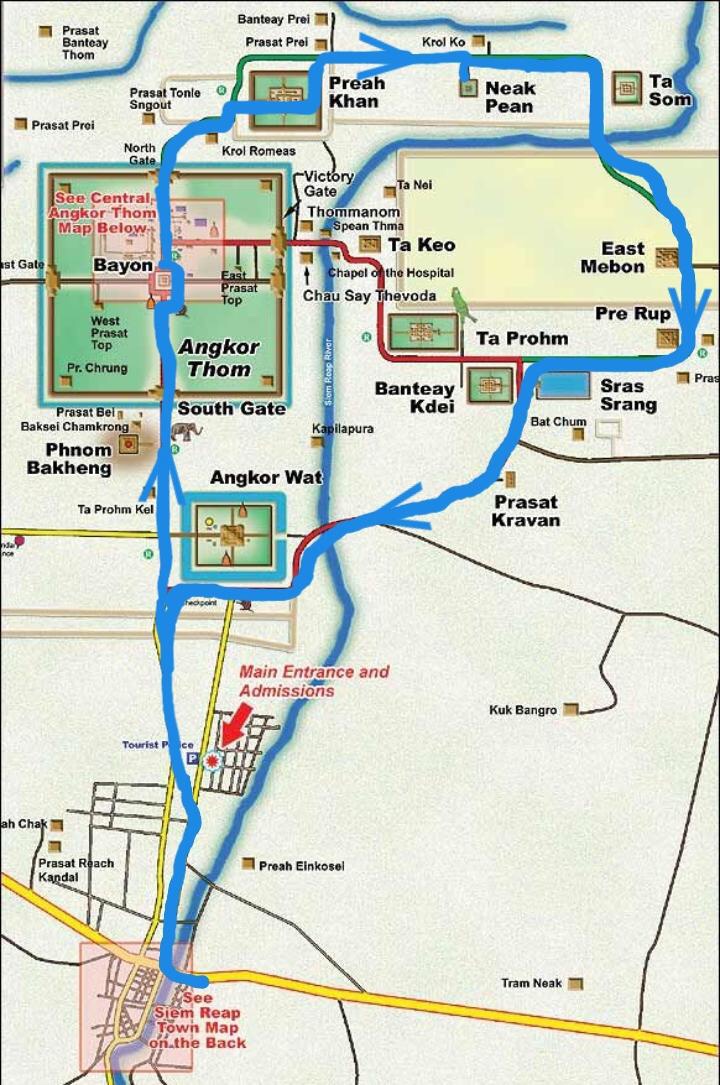
We entered the park with a pre-determined route planned by the hotel, which incidentally was the same route Rach had meticulously researched the night before for a few hours…… We had decided not to visit Angkor Wat, the main temple complex most folk would of heard of, on the first day. That would be our treat for the second day. Rather, we opted to visit other temples to get a fuller view of the culture and people that built/lived in this humongous megacity and temple landscape in the past. The route we took on the first day is listed and demonstrated in a map below. There is far too much information about each site so we will give our overall reflections in the blog and have linked to further info about each one below:
2. Bayon
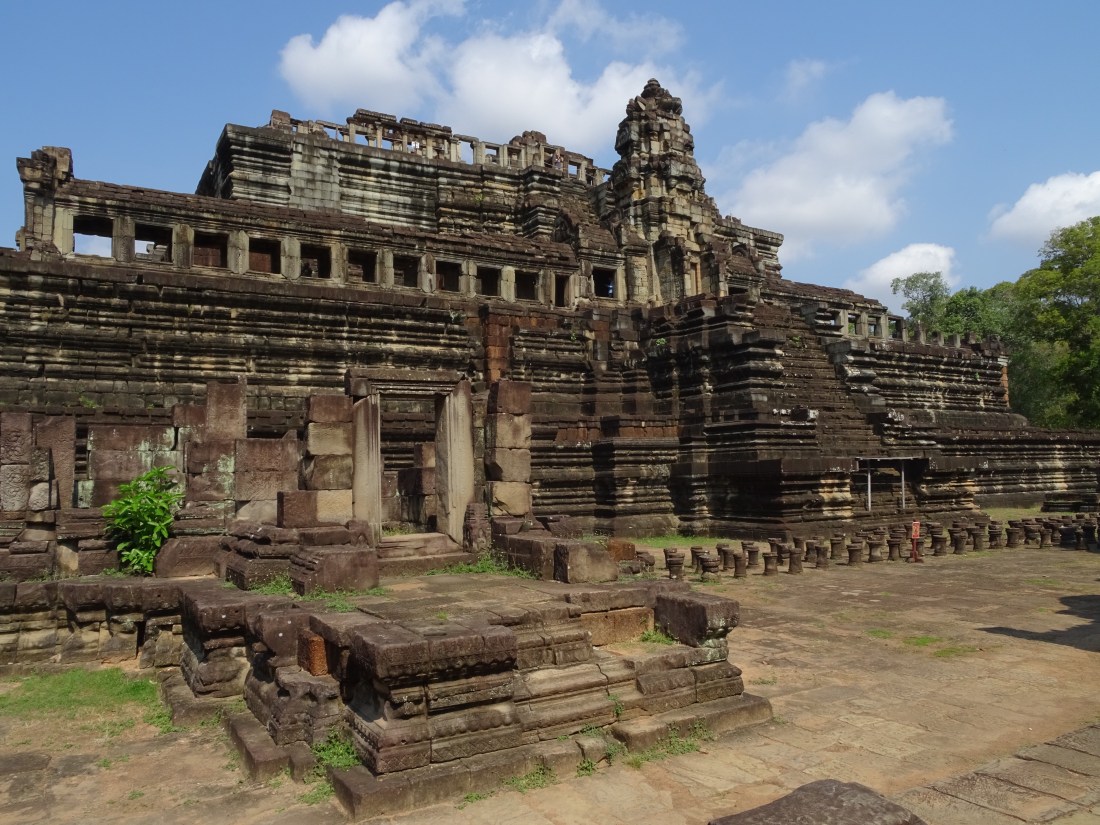
3. Baphuon
4. Phimeanakas
7. Preah Khan
8. Neak Pean
9. Ta Som
10. East Mebon
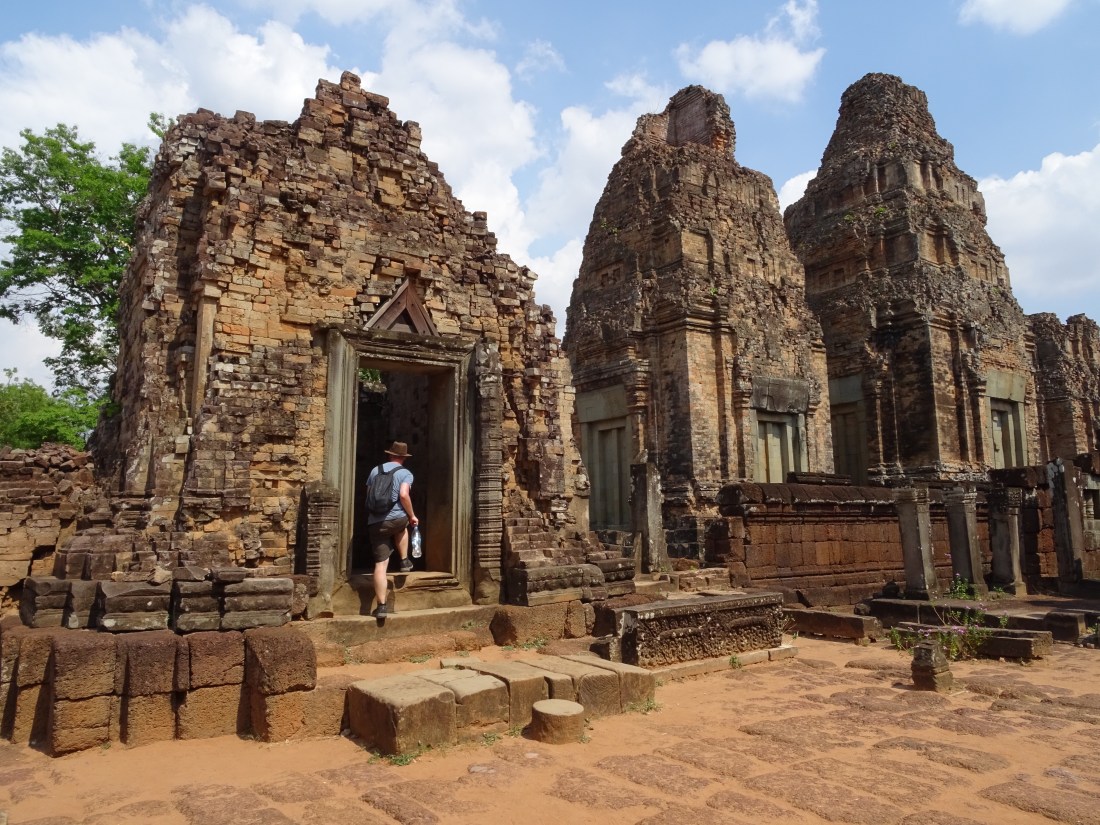
11. Pre Rup
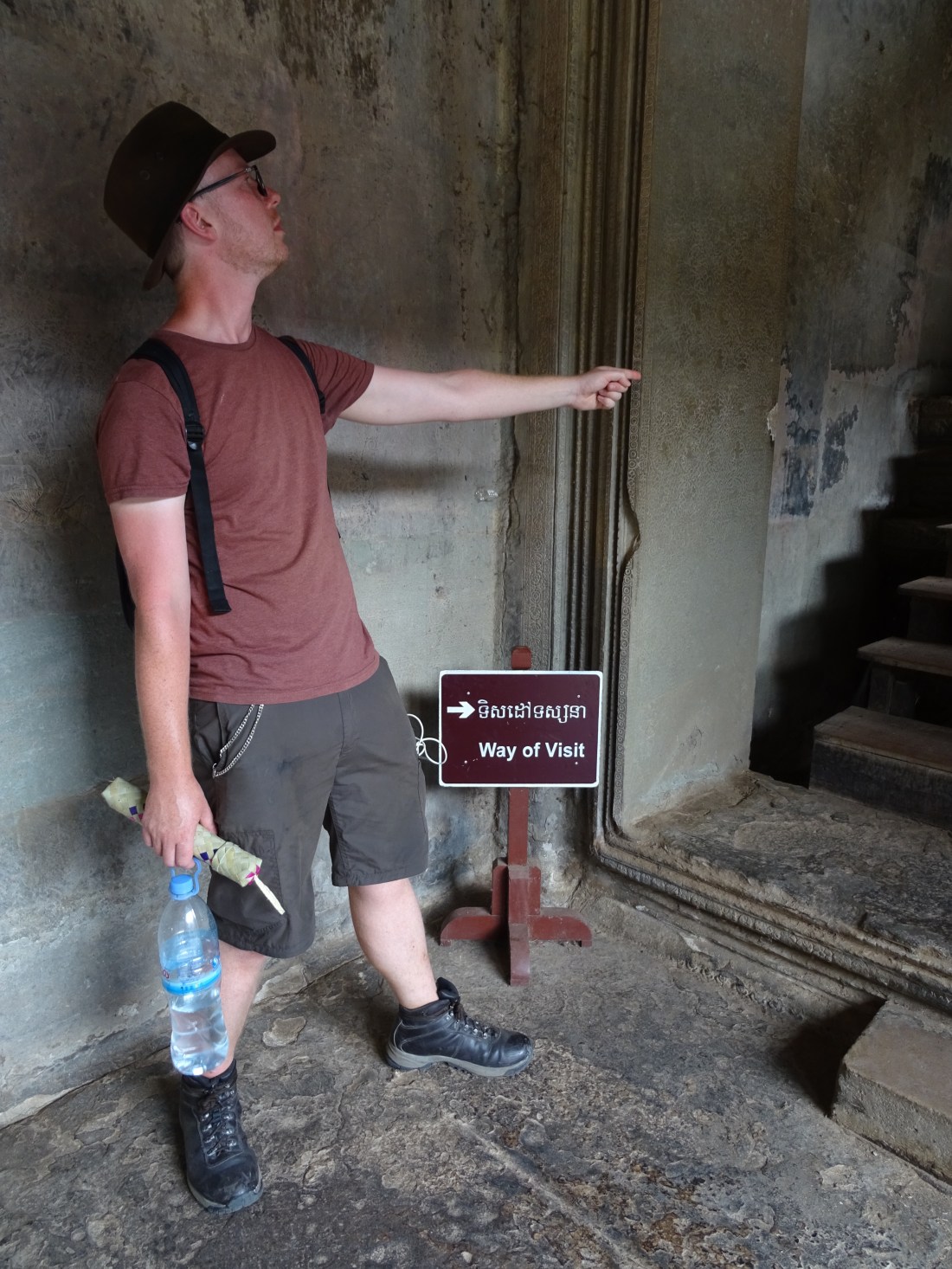
Before we go on though, one other note on taking a route through the park without a guide. Angkor Archaeological Park was, and still is for many people, a deeply spiritual place. We felt this frequently during our wanderings but were also constantly reminded of the new religion that is the main practice of the site today. Tourism, or specifically as this sign (one of hundreds across the temple complexes) says, ‘Way of visit’ has thousands of baying followers!
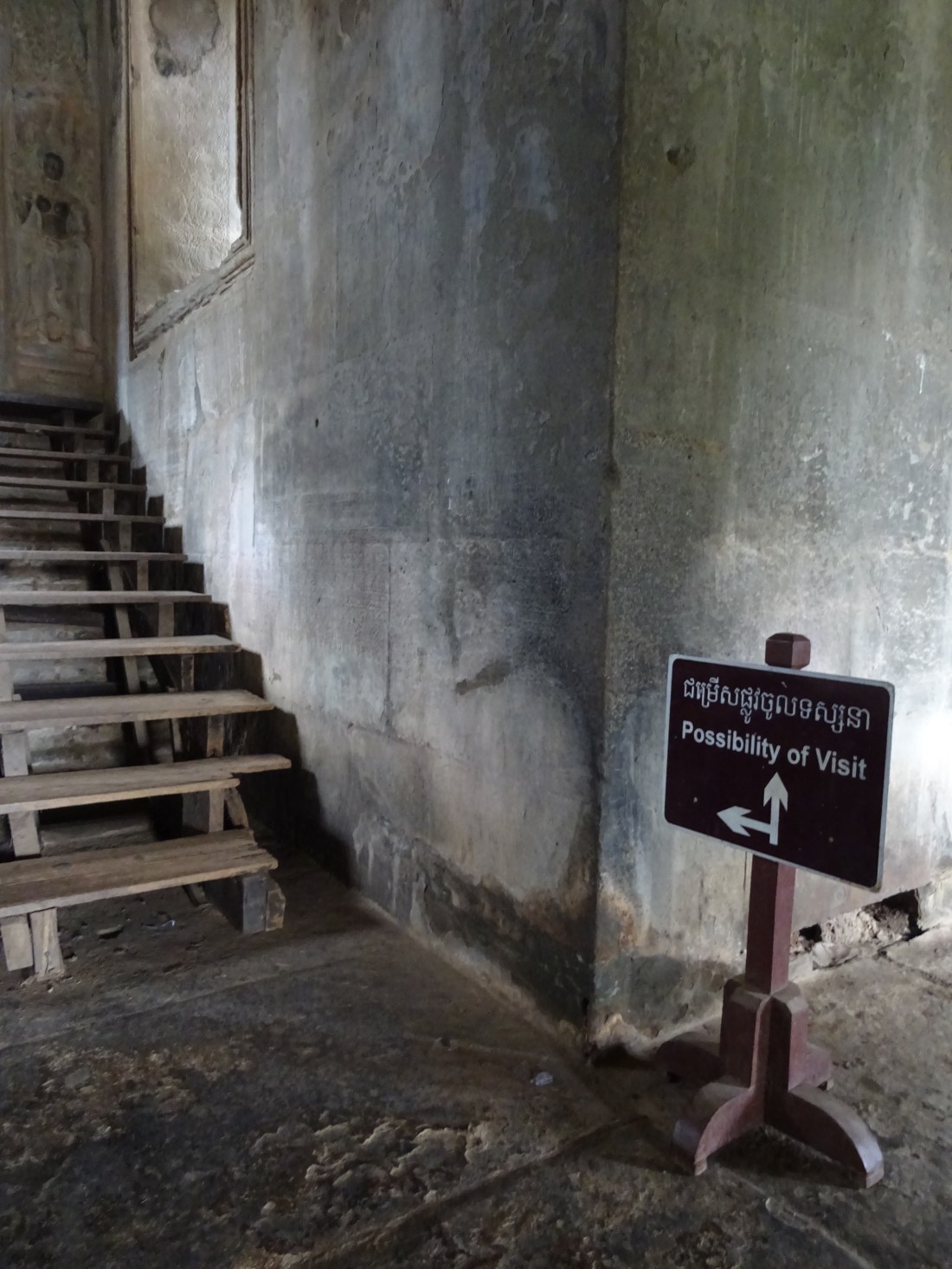
We too found ourselves to be followers of the ‘Way of Visit’, and later its sister religion, the ‘Possibility of Visit!’
We did our best to appreciate our new inanimate guides and learn all we could following our new path, starting at Angkor Thom South Gate. We were off!
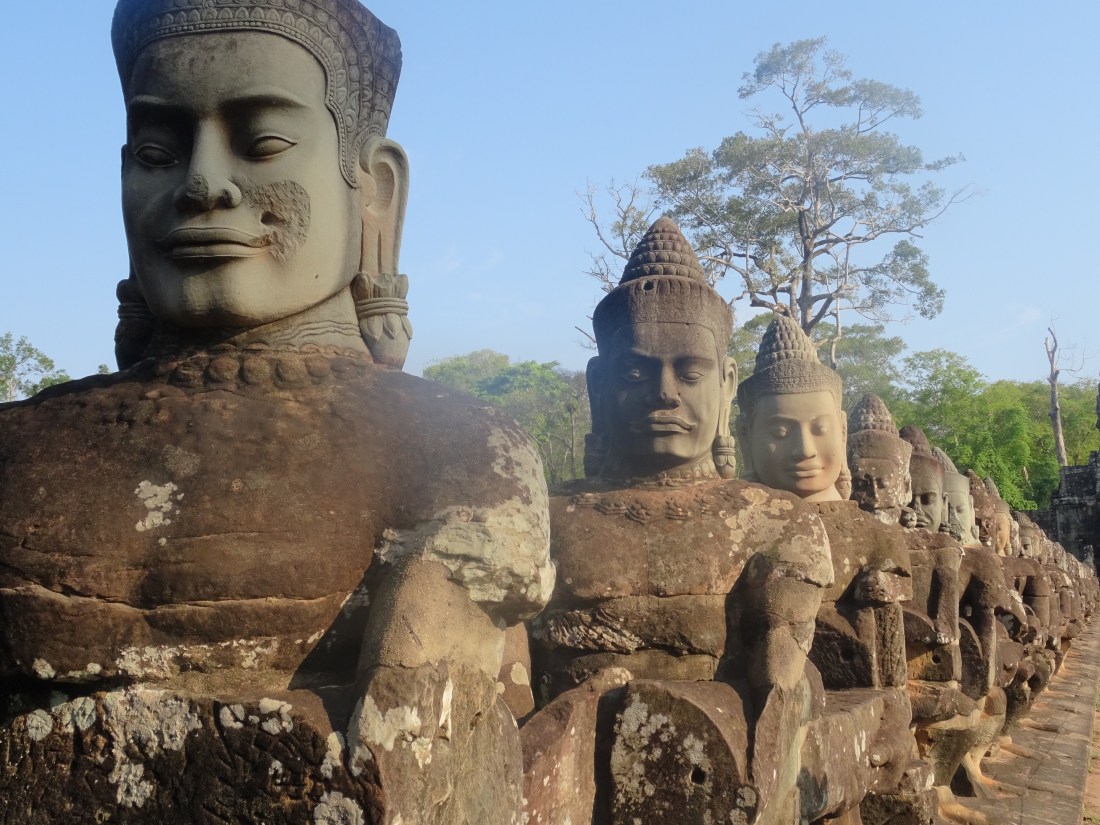
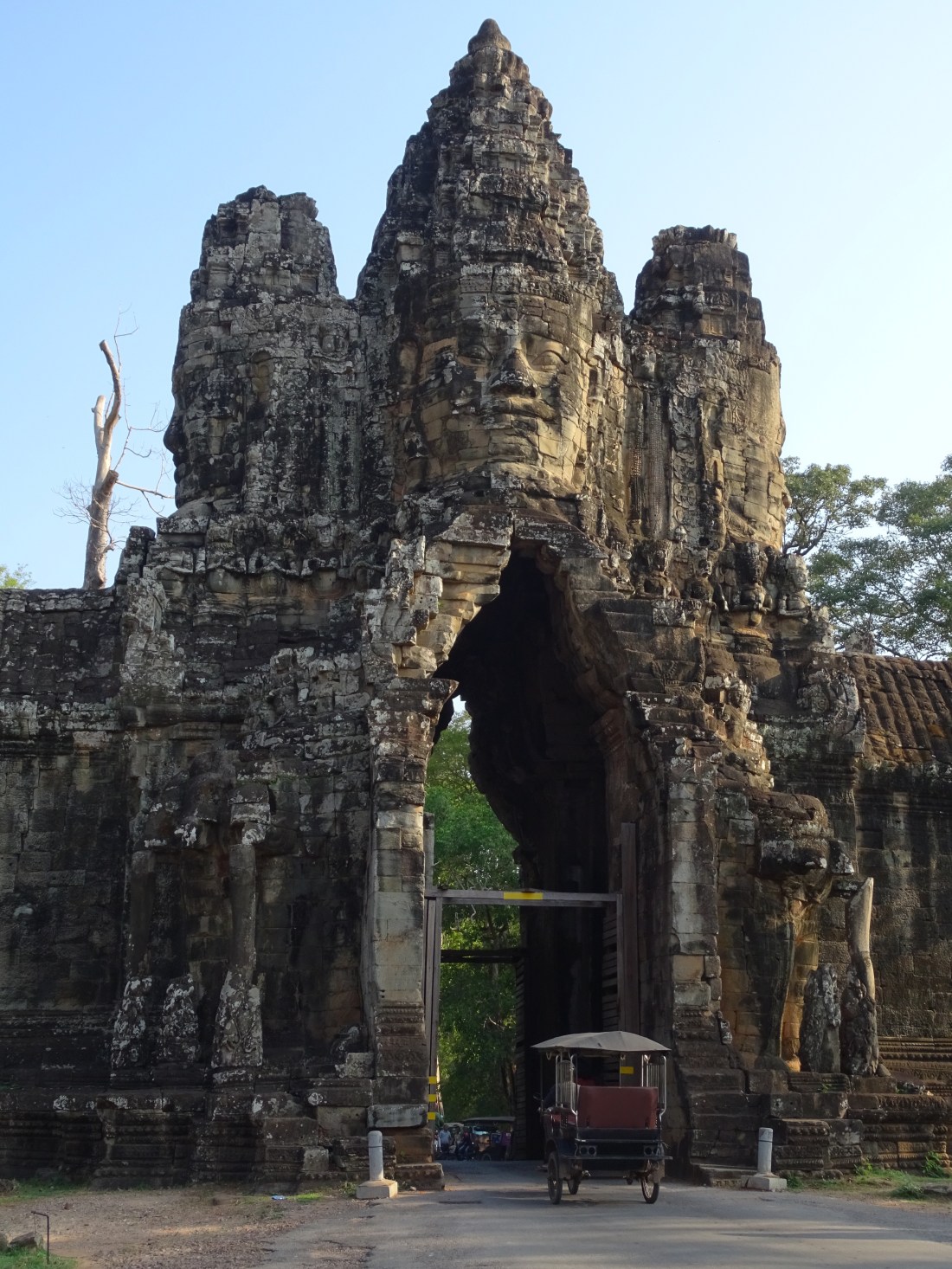
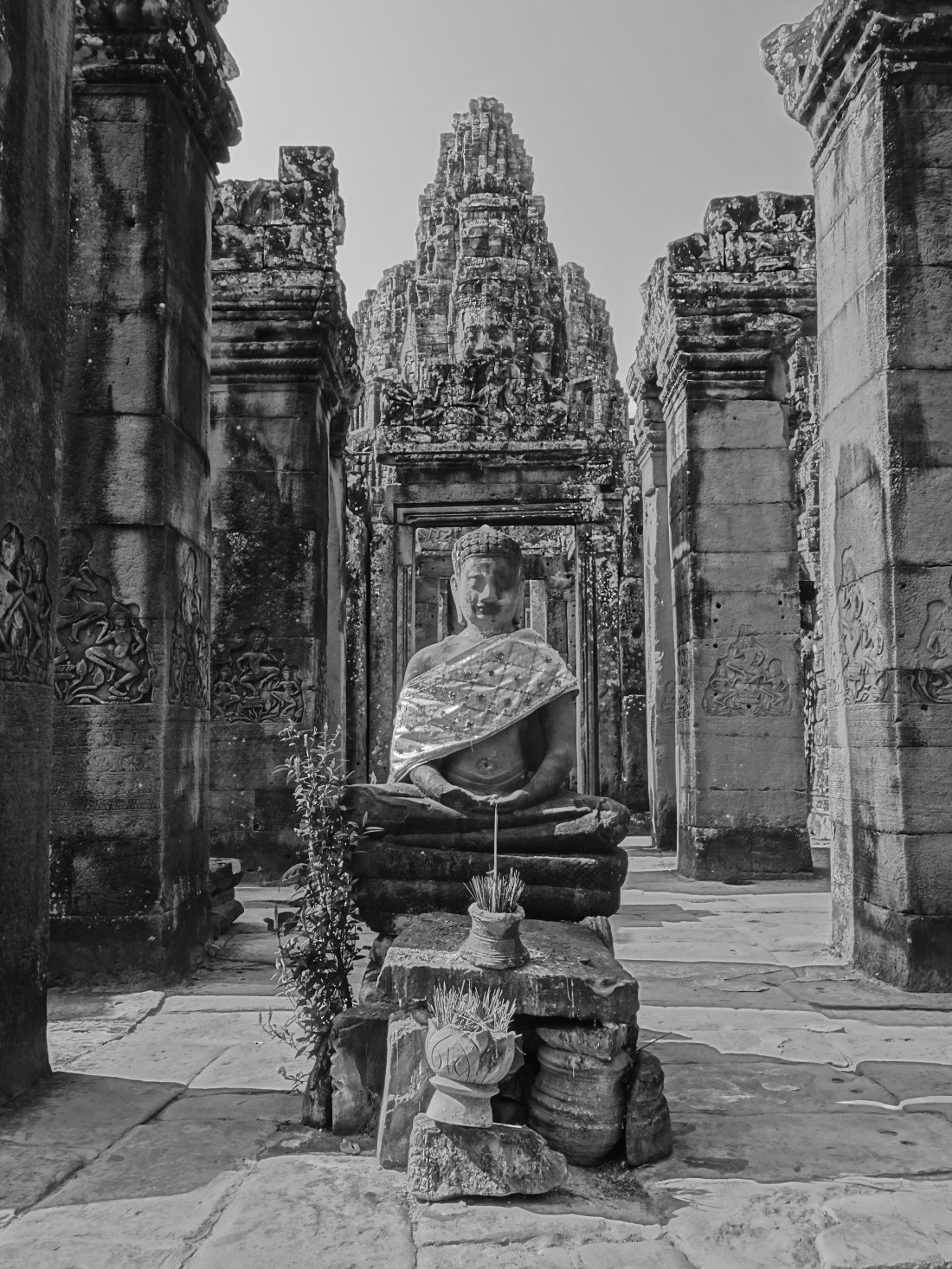
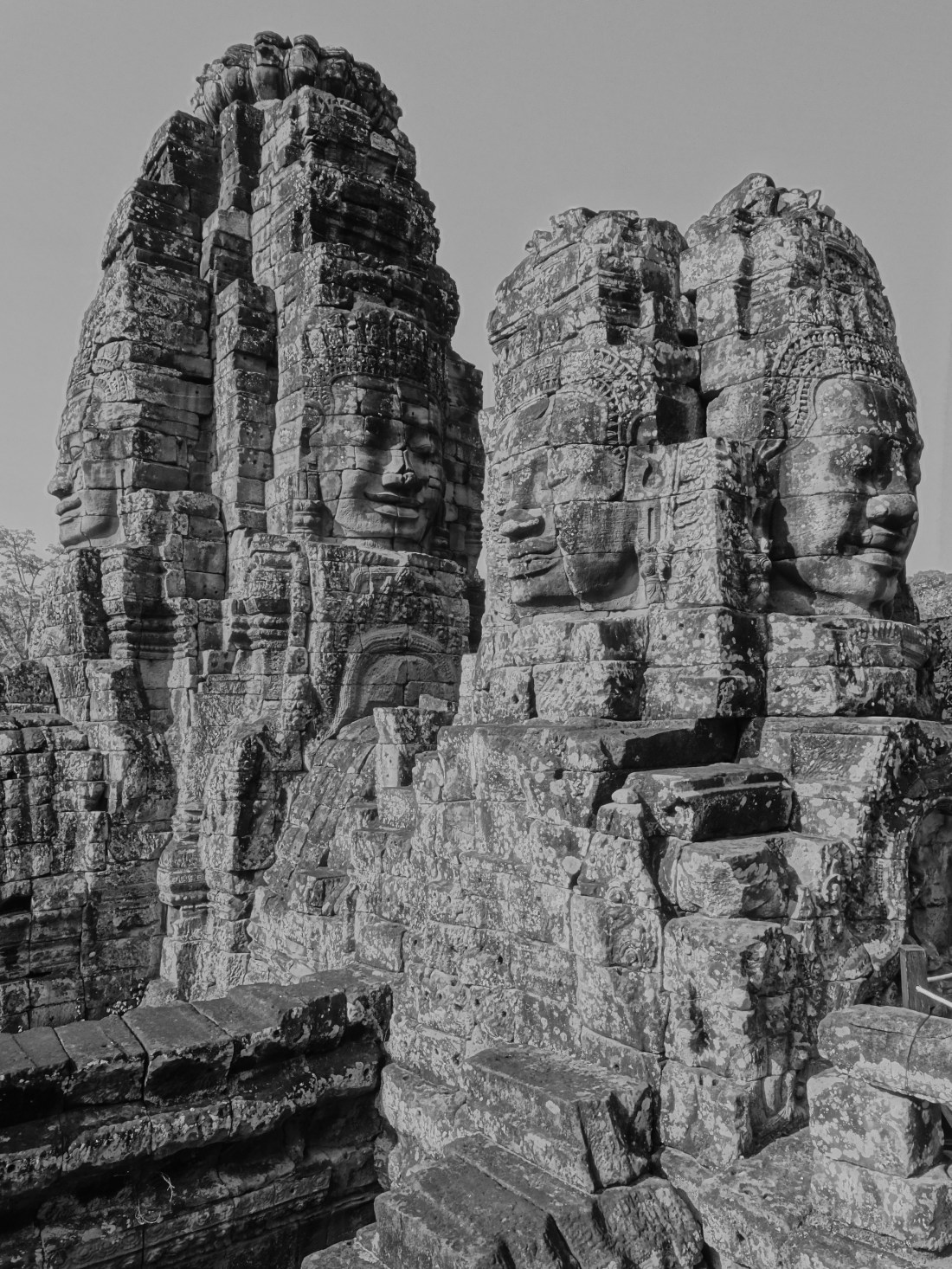
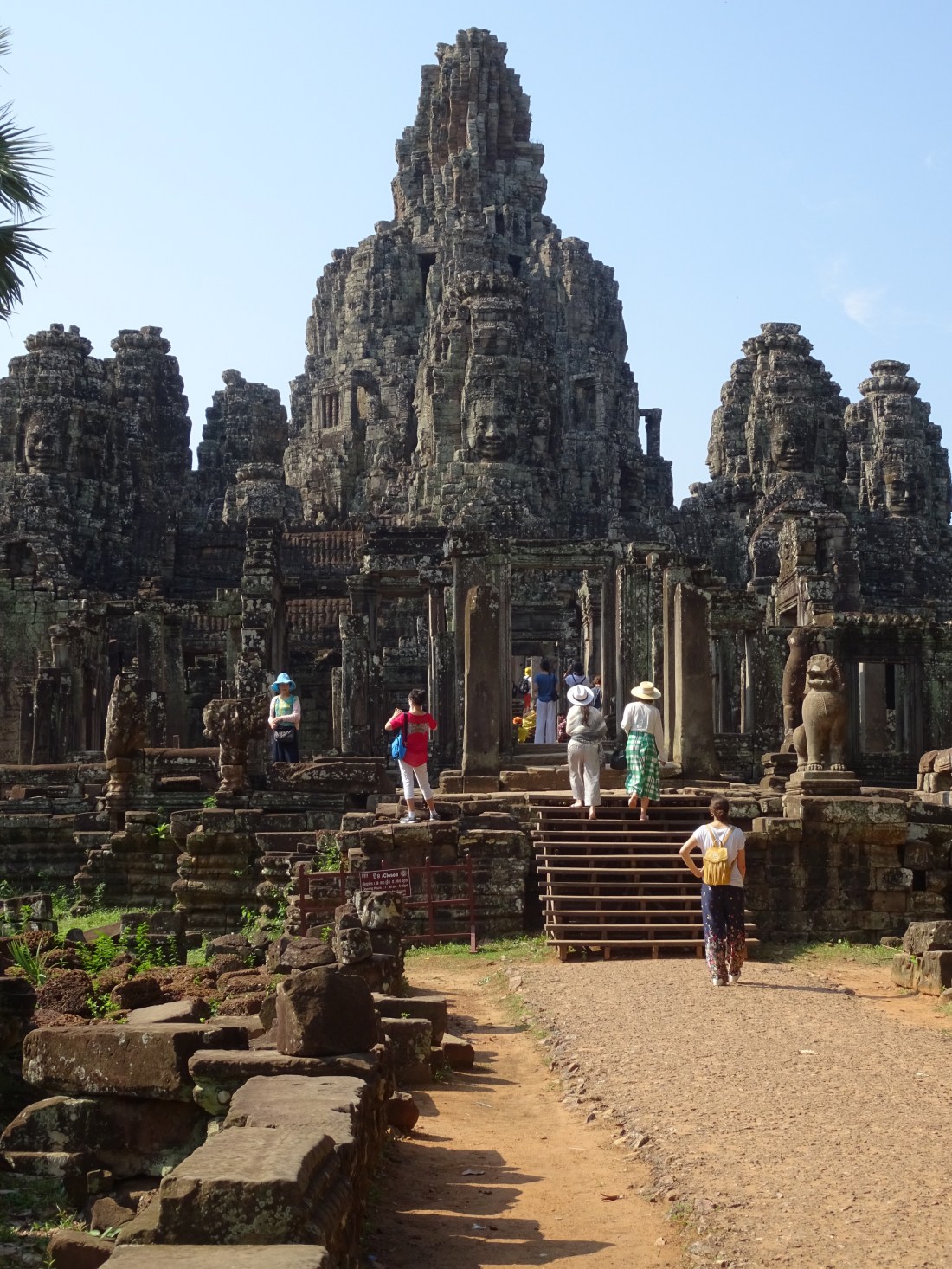
We had very different experiences of the temples despite walking together. Rach was in a photographer’s heaven and Ged was in full on think like an archaeologist mode. For both of us though this was unique and unforgettable. Each temple in the archaeological park may be borne out of the same culture, but each one has its own unique aspects (same, same, but different). For example, the repeated motif of the four heads in the Bayon temple of Angkor Thom city make it instantly recognisable. As does the gigantic reclining Buddha at the back of the Baphuon temple, the brickwork of the East Mebon temple, or the lake surrounding the Neak Pean temple. We were worried about temple fatigue but this never happened. There is always something cool and new to see here.
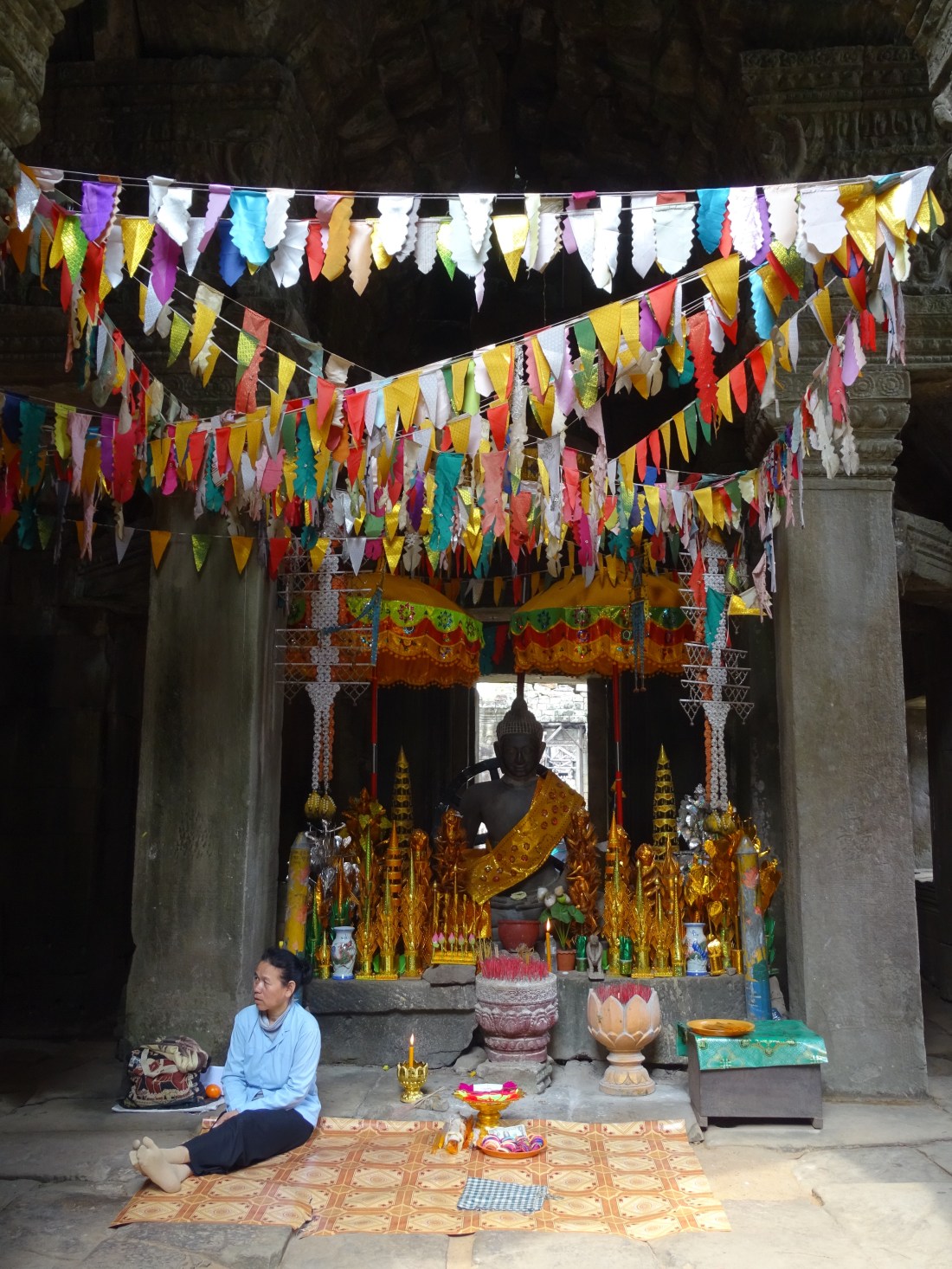
Most temples are dedicated to Buddha, some to the Hindu Gods, and some a mix of both. The holy Buddhist water snake, Naga, protects most Buddhist temples, and the Garuda (sacred Hindu bird) holds aloft many beams in the stone corridors. Sometimes these creatures are seen together; a symbol of peace between the followers of the two religions. Although its impossible to know if this depicts the reality of the past or merely the intention of the rulers at the time, it was a heartening motif to see as we walked around.
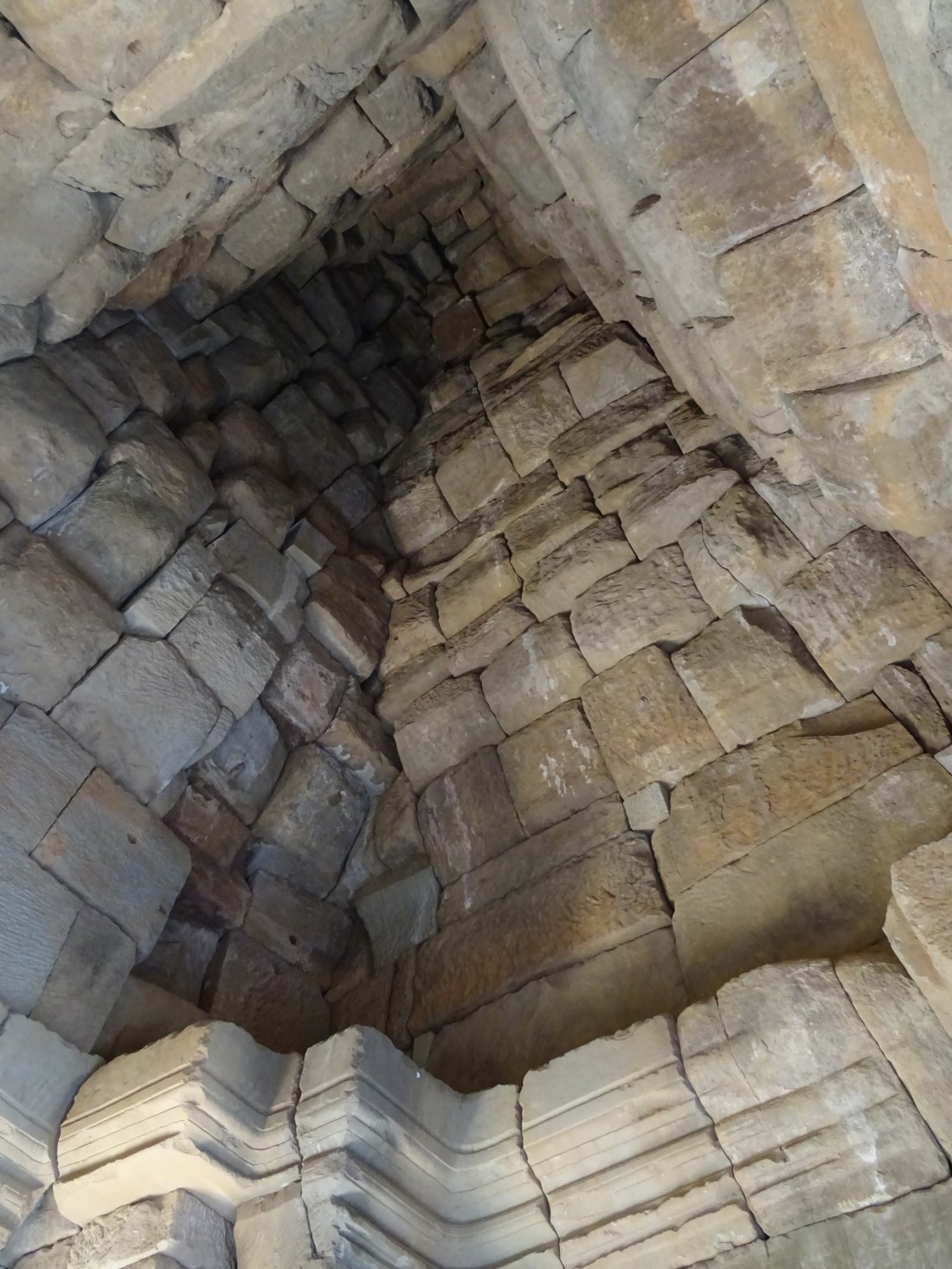
Aside from the artistic themes of the temples, the method of construction at each site is nothing short of genius. Apart from the later temples most of the carvings and roofs seem to be made from sandstone blocks stacked with no mortar, but a complimentary interlocking system (think lego) instead.
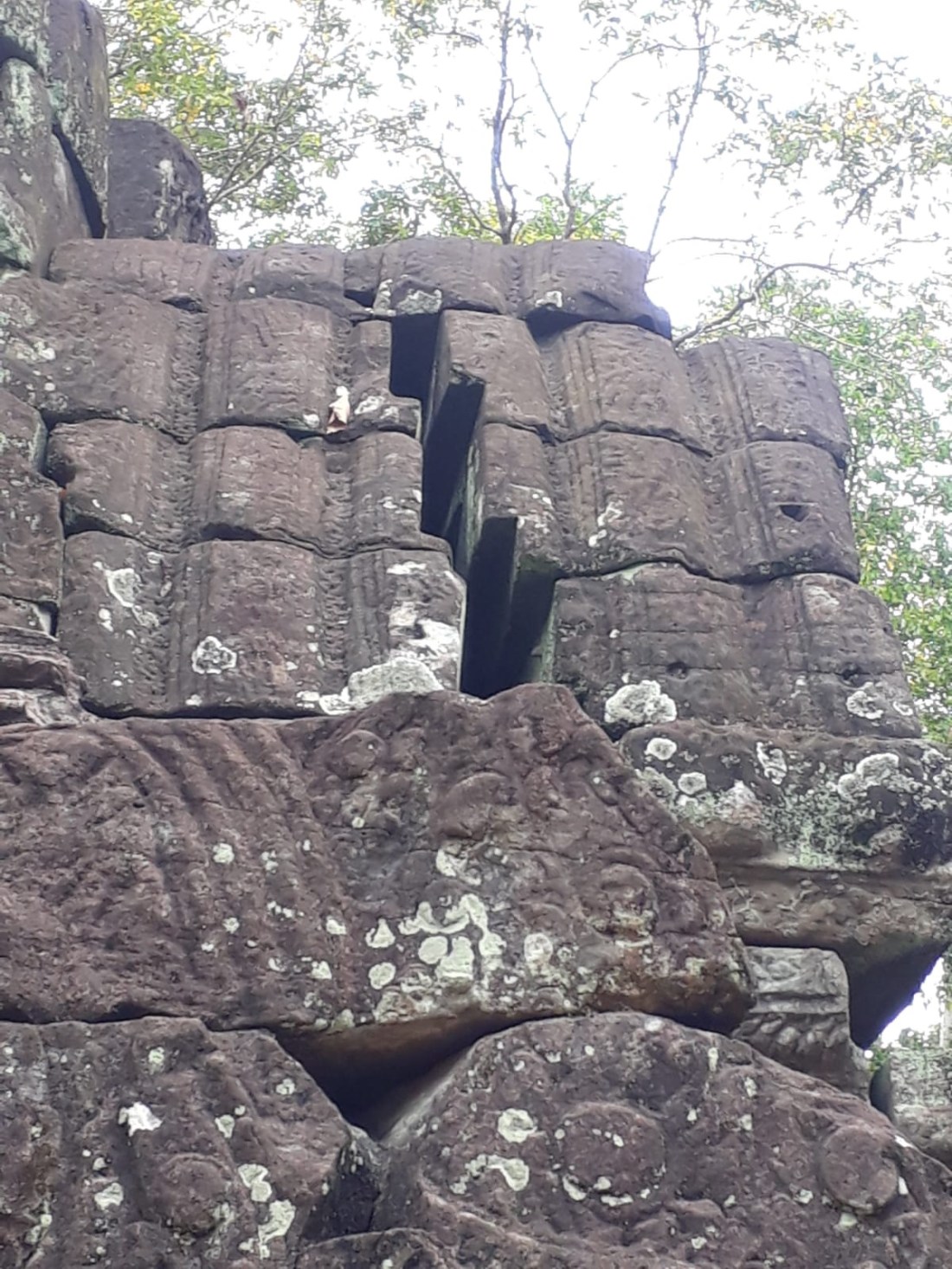
This was impressive enough with a vertical wall, but the ingenuity of the ceilings particularly struck Ged. Seamlessly interlocking and curved stones that get smaller as they climb to form domes or long arches are everywhere in the archaeological park and make it hard not to be constantly staring upwards!
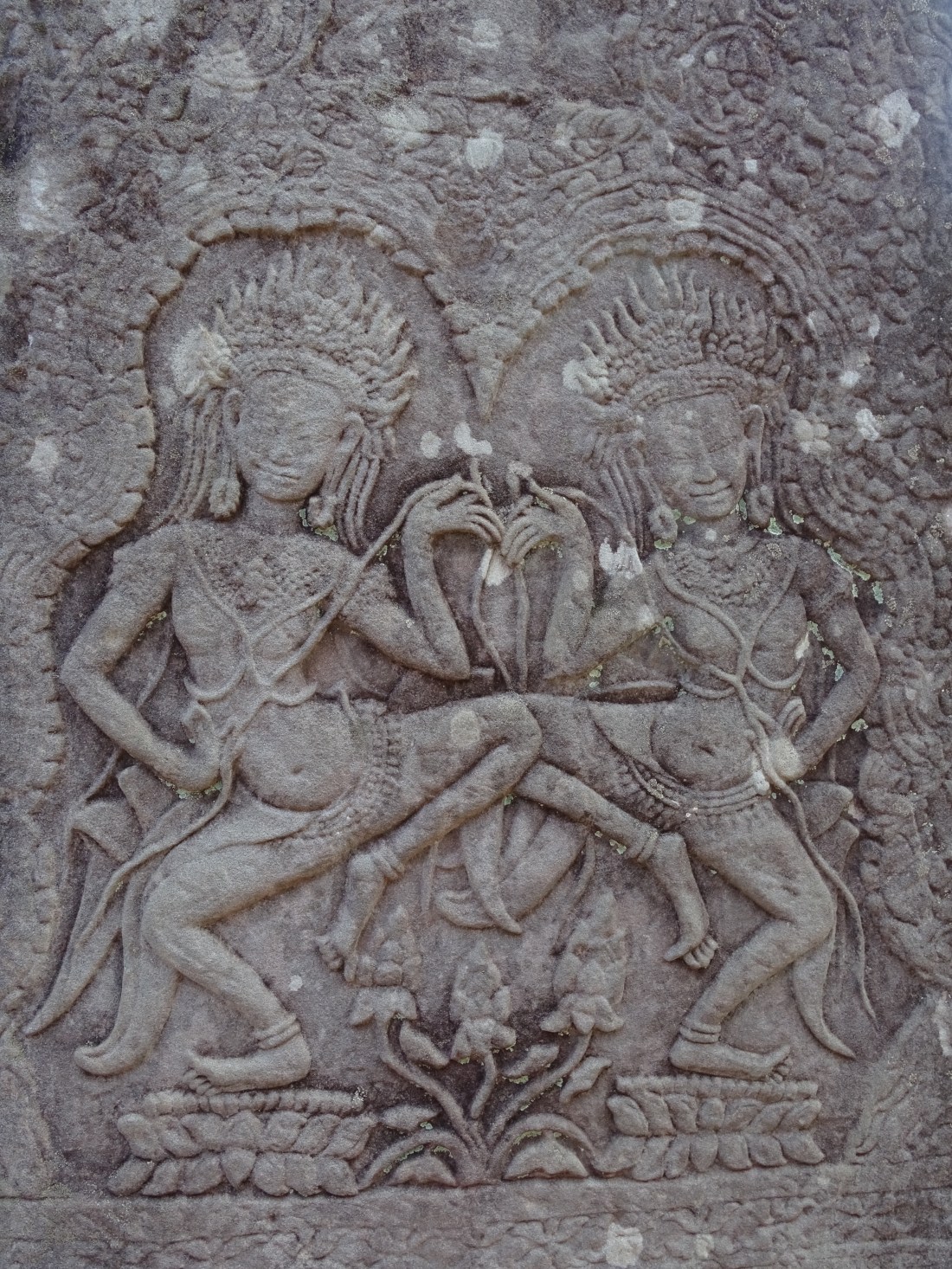
What’s more many of these blocks are more than just feats of engineering; they have also been carved with astonishing scenes in bas-relief. Battles, dancers, worshippers, and deities all telling their story, some seemingly with a surreal lifelike quality, giving the impression of movement in the half lit corridors.
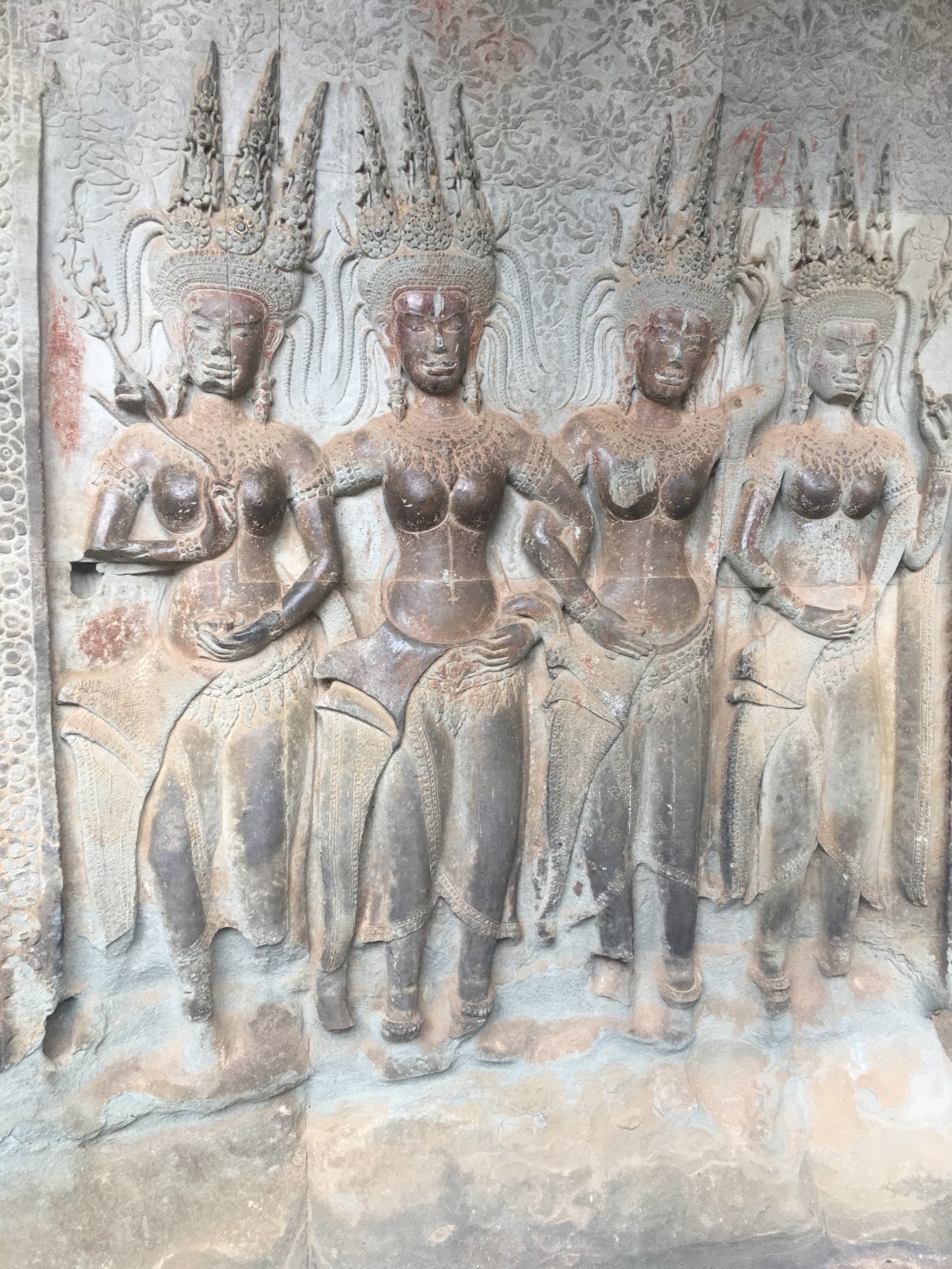
The archaeologist in Ged looked at many aspects of the sights most tourists seemed to miss (the training had to kick in some time and he no doubt bored Rach to death with it). Most visitors walked through these sites snapping pics of the carvings, eroded towers and crumbling courtyards, appreciating the temples as they are now, but these places should not be thought of as merely ruins. They were once vibrant, mysterious, and holy sanctums and in the few (sometimes engineered) moments we found ourselves alone it’s something you can still almost sense in the still quiet.
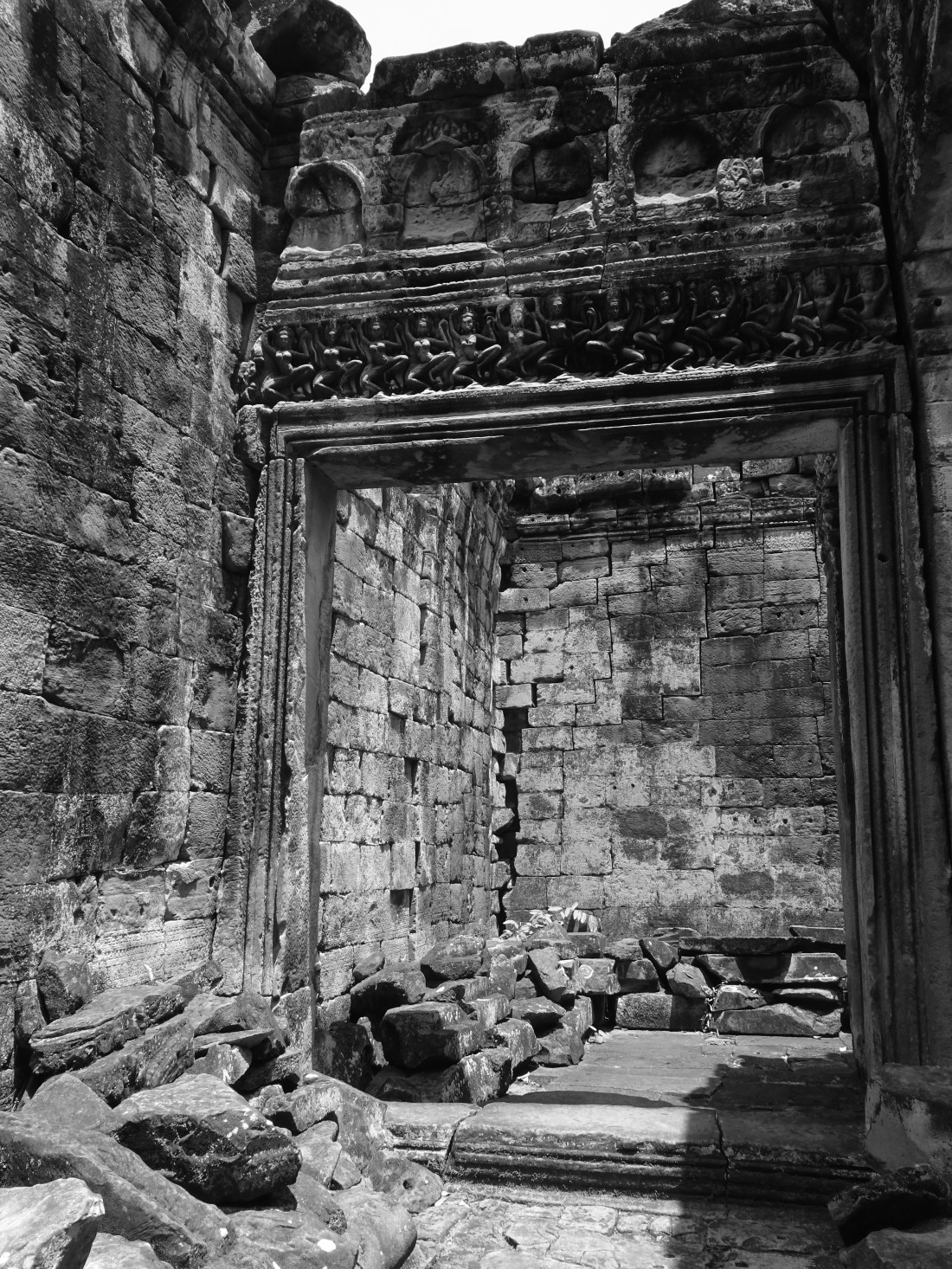
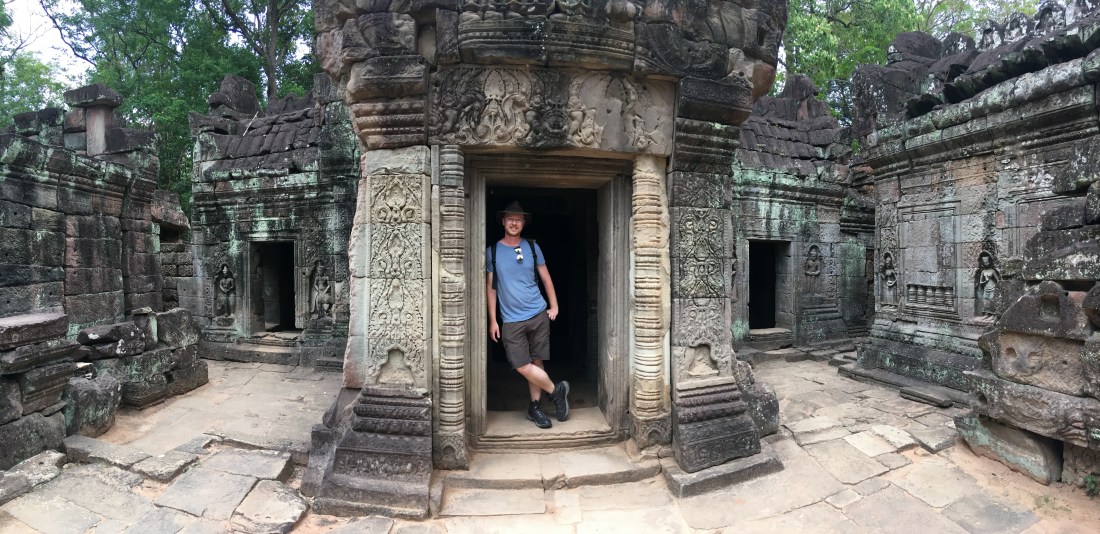
Adding to this mysterious quality is the way the temples, despite some restoration, are still crumbling. just to varying degrees. While the courtyard above appears to be fairly well intact, for example, in other places nature is literally trying to take them back.
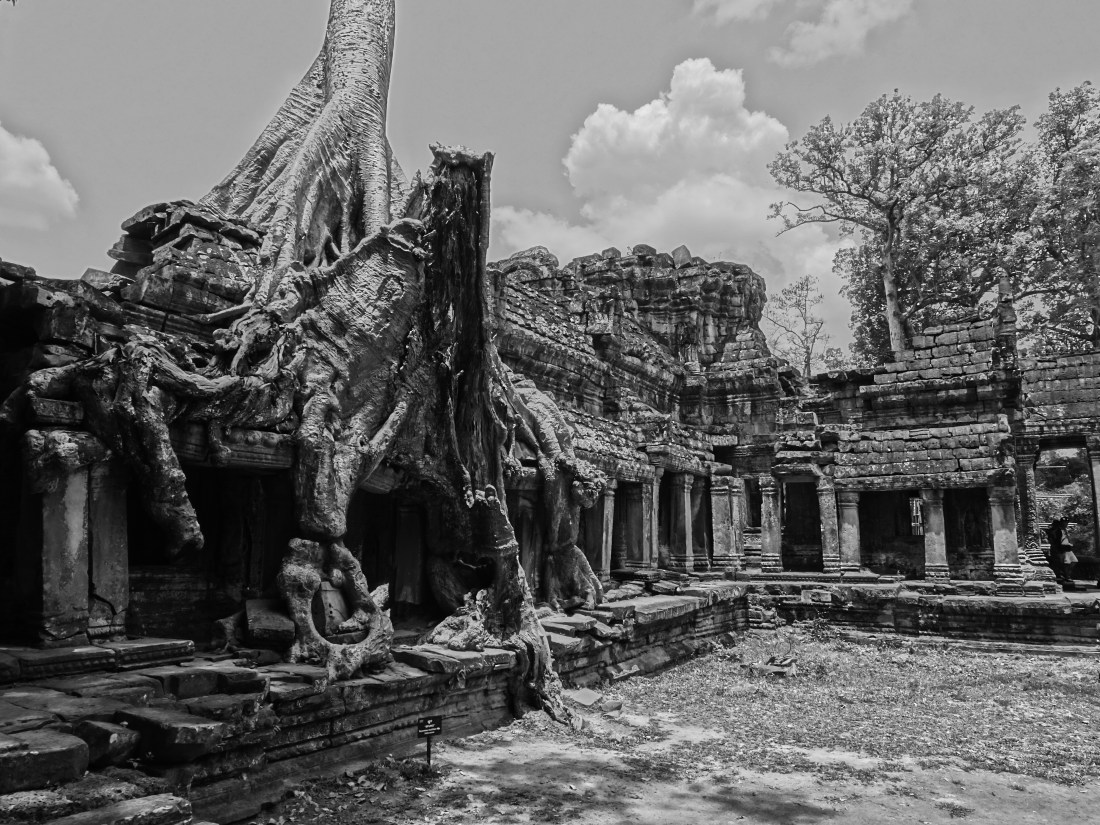
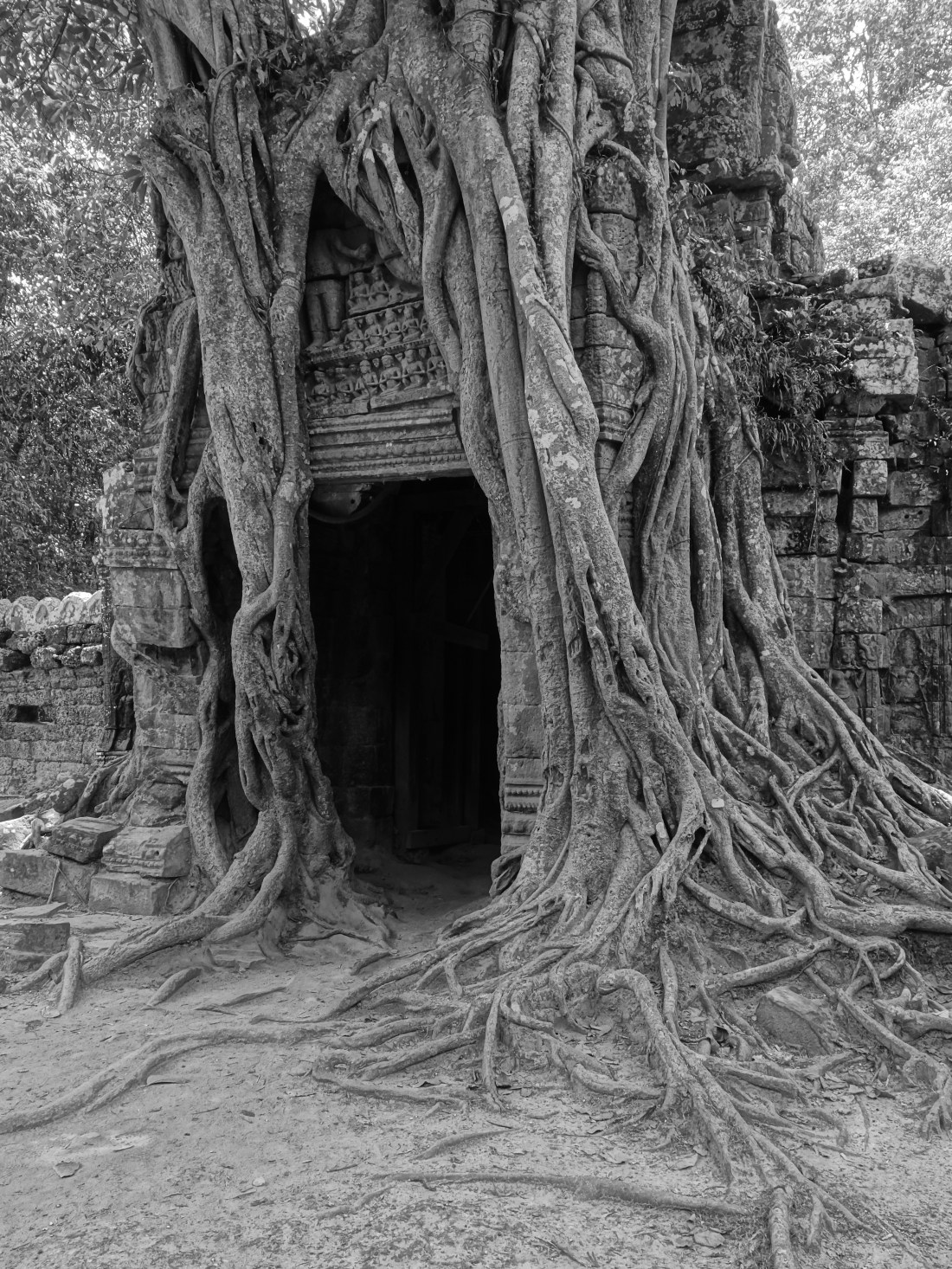
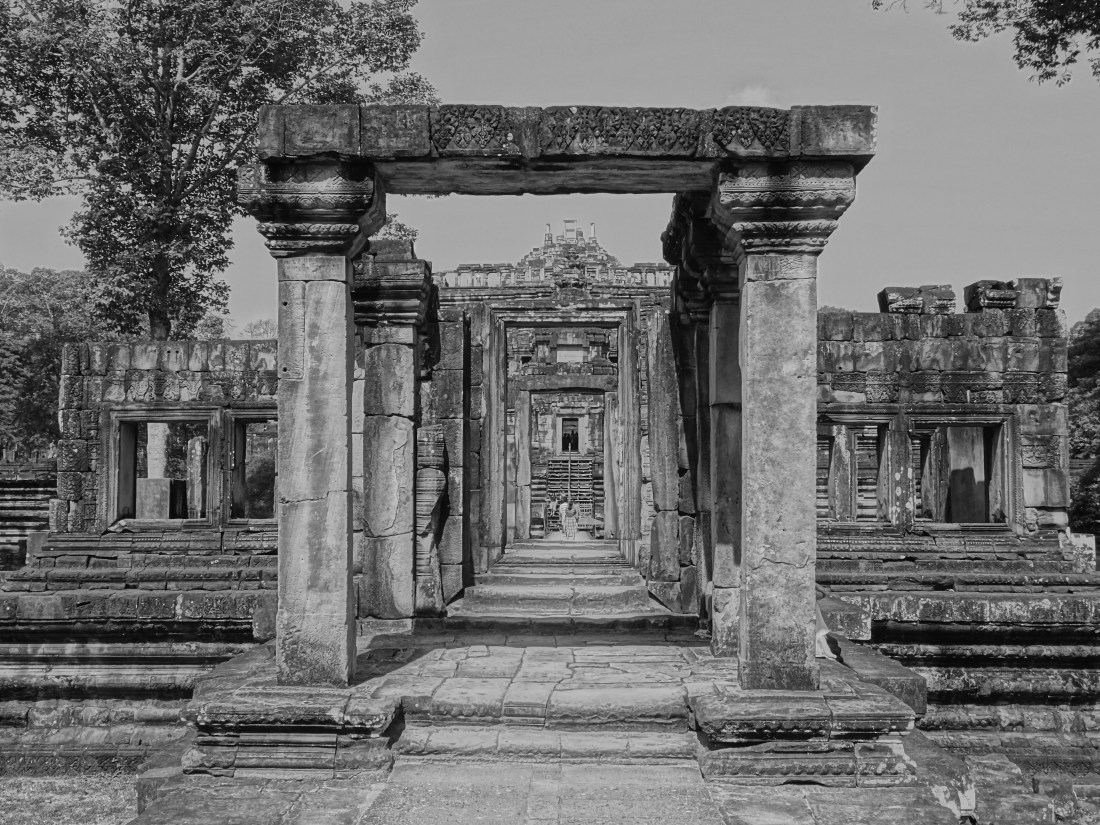
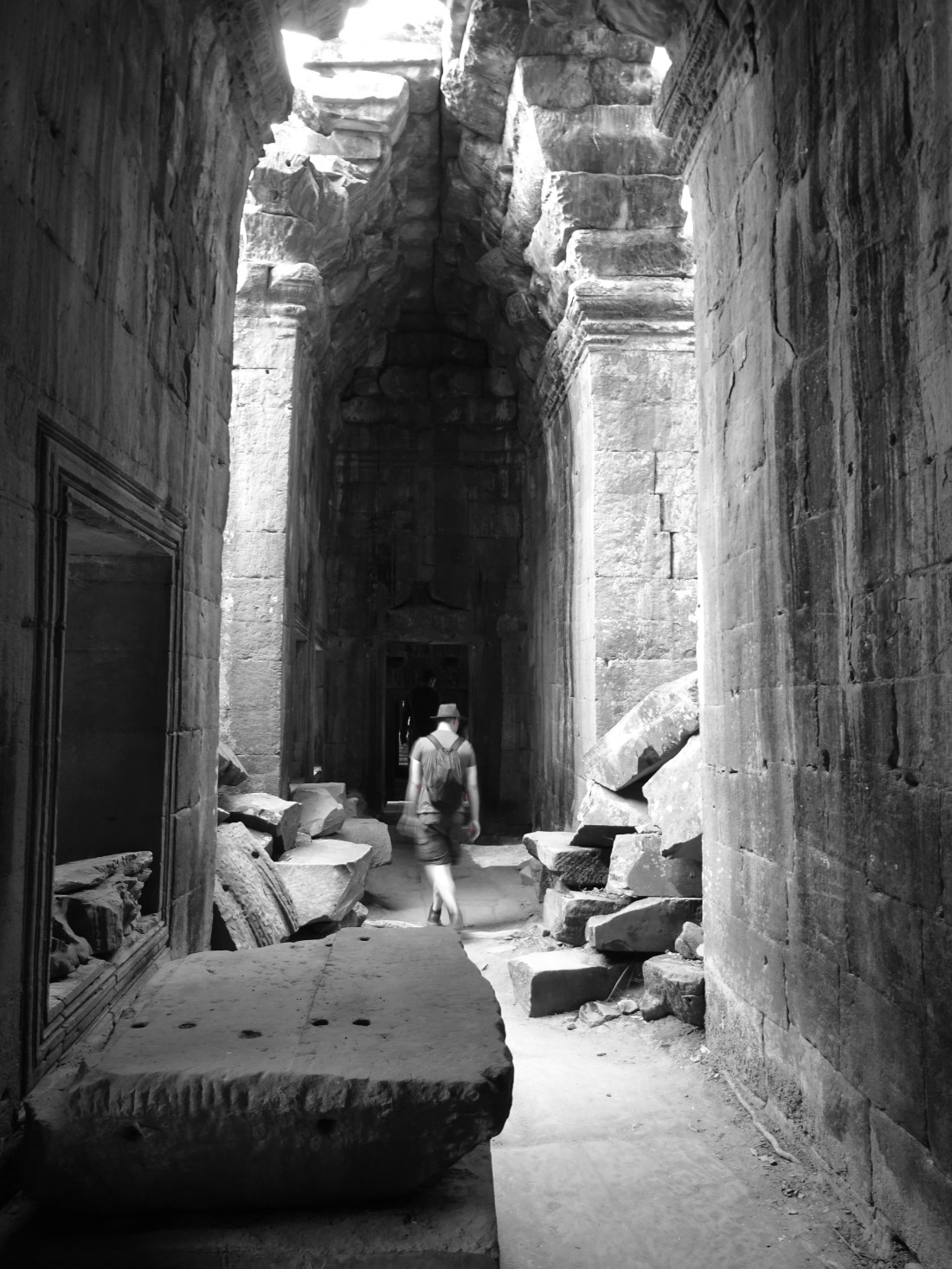
Through the loss of what once was, however, we have gained an opportunity to see these sites in a new way. For example you can now often see the full length of a temple through the dead straight open corridors, right to their sacred heart, when there once would have been multiple doors blocking the way. Evidence of the door jambs shows that in the past a person would have to pass through many, many doors to get to the centre, and only if they were worthy to do so, not knowing what lay on the other side of each door before it opened. This gave power to these sites and to those that controlled movement through them.
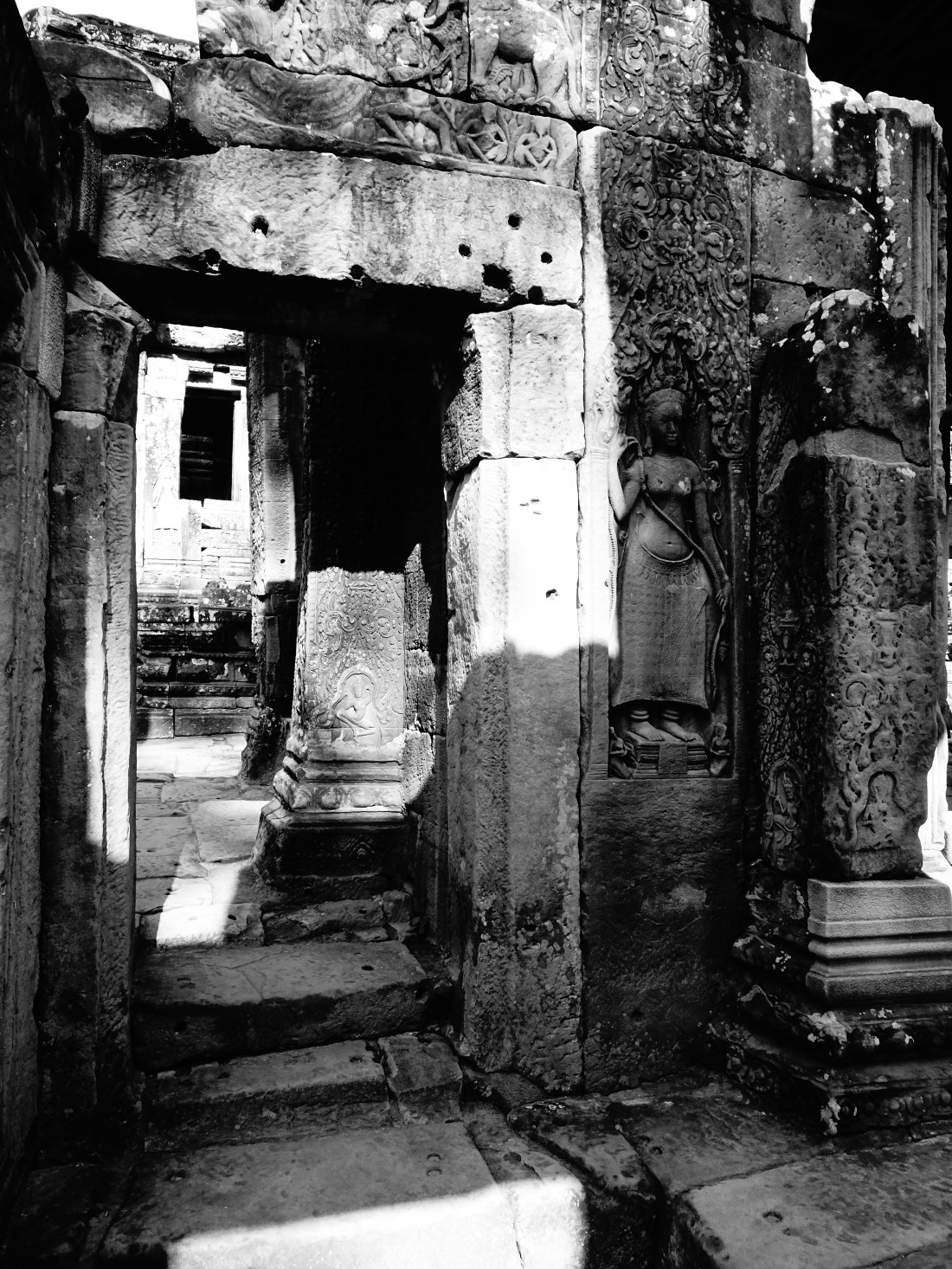
The lines of endless tourists bumbling through the temples today does nothing to hint at the way these sites functioned in the past. However, evidence of active worship is still present in many parts of the archaeological park and in some places there is an equal mix of tourism, spiritualism, and nature as the jungle continuously encroaches back into these majestic and sacred structures. More on that tomorrow.
At 3:30pm our first day in the park was done and we were starving! Having not tried Cambodian street food yet, we wanted to try something authentic. We’d read about street food here being heavily influenced by the French and baguettes stuffed with roasted meat seemed to be the way to go. As luck would have it there was a street seller just outside our hotel. For $1.50 USD we got a footlong baguette with loads of amazing roast pork, some weird (but good) stuffing, and spicy sauce. This was a belter buttie and we were as happy as pigs in muck as we sat down by the pool to enjoy the sun until tea time. Honestly, it is hard work this travelling malarky!
For the evening we took advantage of a happy coincidence. An old colleague of Ged’s was in Siem Reap travelling as well so we met up with her and her fella. It was brilliant to catch up with Kate and meet Sean (another Liverpool fan), have some cheap Khmer food at Khmer Kitchen (not the best though) and a few drinks down Pub Street. Ged has never been to a place like Magaluf but Pub Street in Siem Reap is what he thinks a night out in Magaluf must be like. Blasting music, bladdered punters, and blaring neon lights. What a contrast to our daytime surroundings!
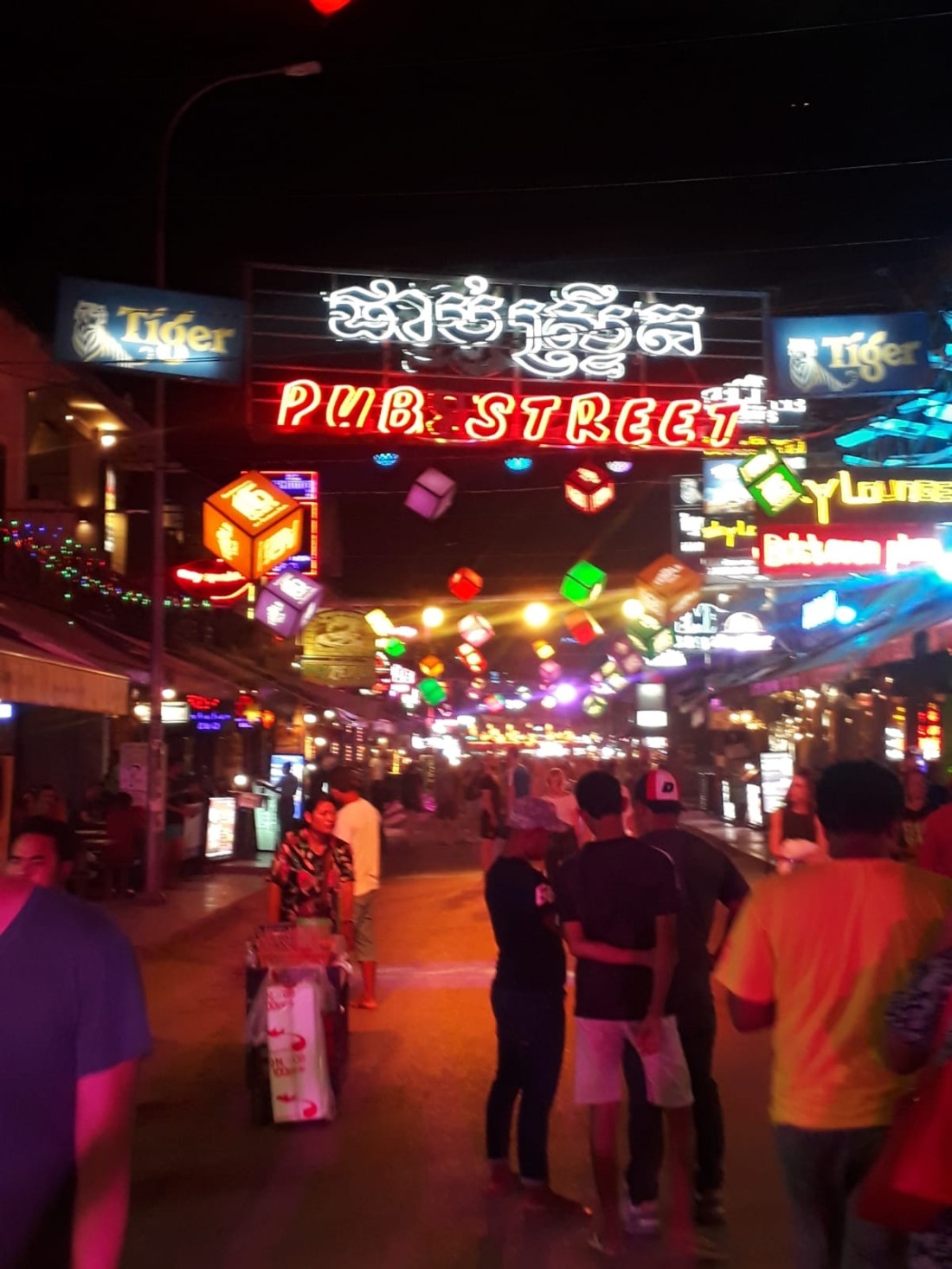
We found one of the quieter bars, had a few beers, a few laughs, and played cocktail roulette. This was Kate’s idea – you pick a cocktail for the person next to you and don’t tell them what they’re going to get. Plenty of opportunity to be mean. At about £3 a cocktail, we couldn’t go wrong but we were going to be up and out for 5:30am the next day so we weren’t too wild.
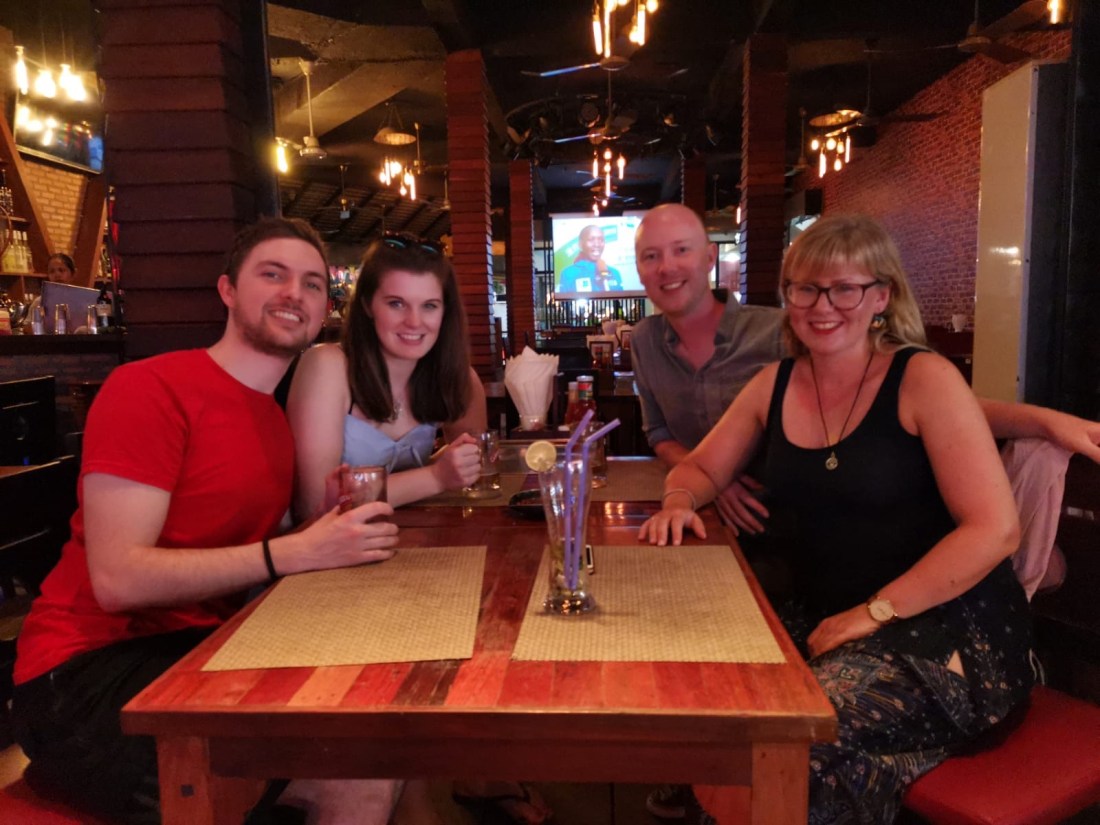
About 11.30pm we decided to hit the hay after a brill night with a top couple. Time to go find a tuk tuk! However, Kate stopped Rach dead in her tracks as we walked. She had spotted something of monumental importance. A guy making ice cream curls on a cold slab with any flavour you could think of. There was nothing for it. They had to round the night off with this little indulgence. The kid chopped and scraped with rapid fire hands and soon had curls of Oreo ice cream ready for Rach.
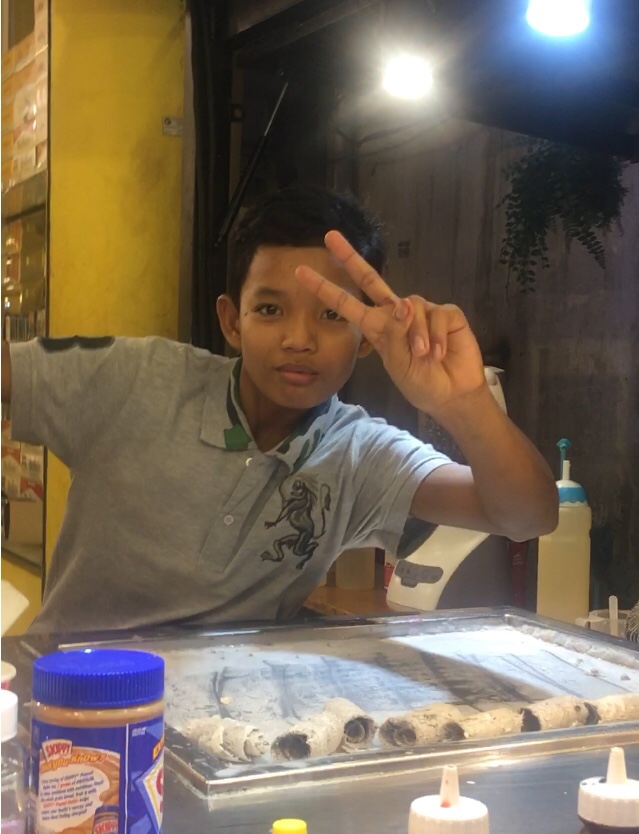
Rach barely said a word as we walked to the end of the road to jump in our Grab tuk tuk home. Needless to say it was good ice cream. What a corker of a day!
4 April
For our second day we had done our research. We had booked a different, and recommended, tuk tuk driver to pick us up pre sunrise. The plan was to get to Angkor Wat in time to see the sun come up, and proceed for the rest of the day as follows:
12. Angkor Wat (first time for sunrise)
13. Ta Prohm (the Tomb Raider temple)
14. Banteay Kdei
15. Ta Keo
17. Angkor Wat (second time)
As before we’ve not talked about each site individually – there is info in the links above about each place and you can see the direction we went on the map below:
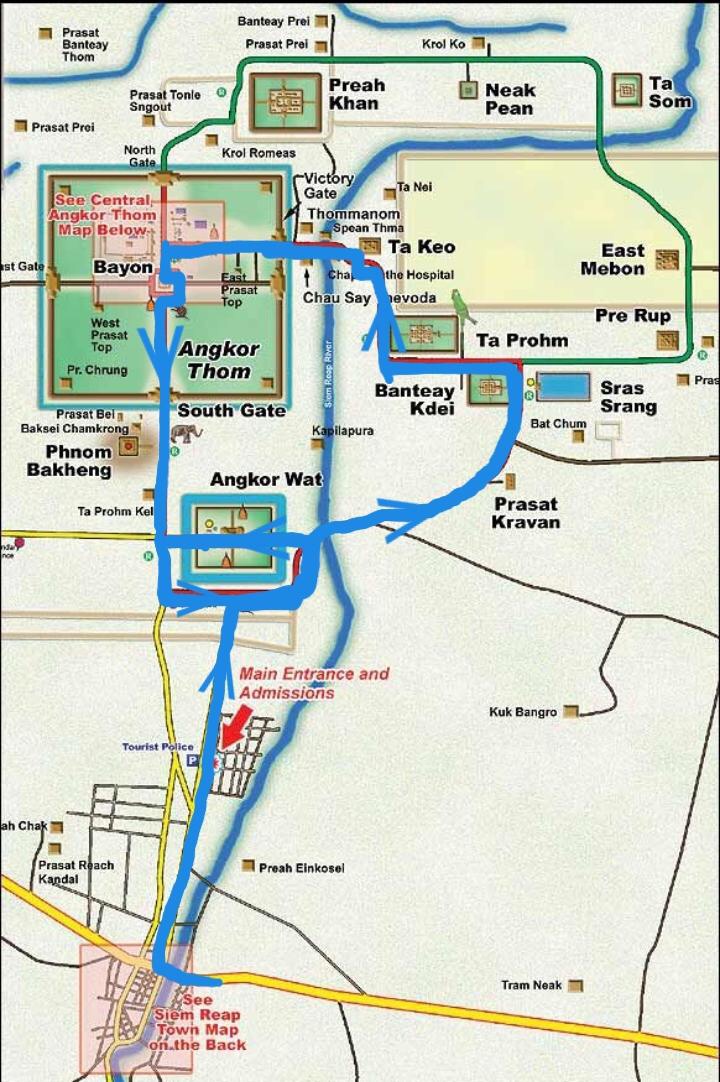
We broke with the norm and went to the East gate of Angkor Wat for around 6.15am. This seems a silly place to go for sunrise with everyone heading for the West gate (in front of Angkor Wat) but we had a plan. We arrived at the temple the second it opened at its rear entrance, the light already growing around us in the exact worst spot to see the sun rising behind the cones of the temple. Hardly a single person was there.
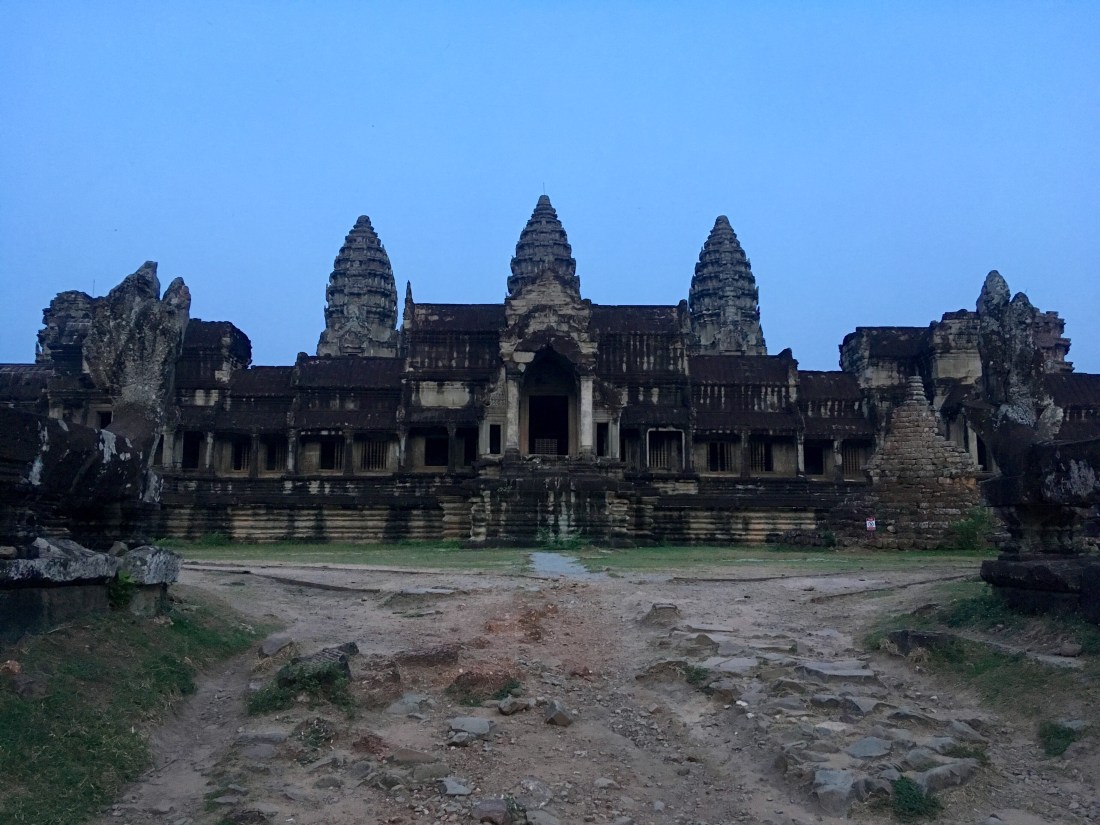
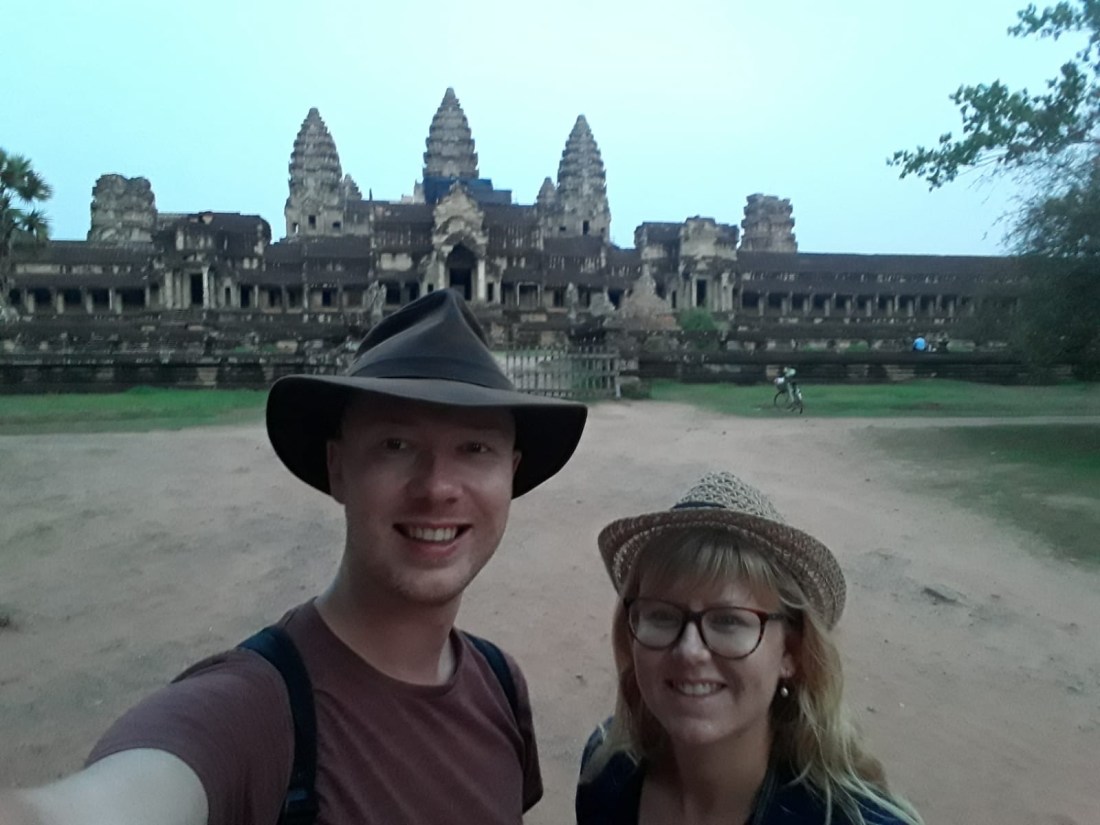
We entered the temple and had the entire place almost to ourselves. Bingo. For 20 minutes we wandered the corridors, looked at the statues, and visited the altars as the first rays of light chased us through the entrance door. The place was serene and we could almost feel the raw spiritual power of the place in the empty courtyards and the first solitary monk at prayer.
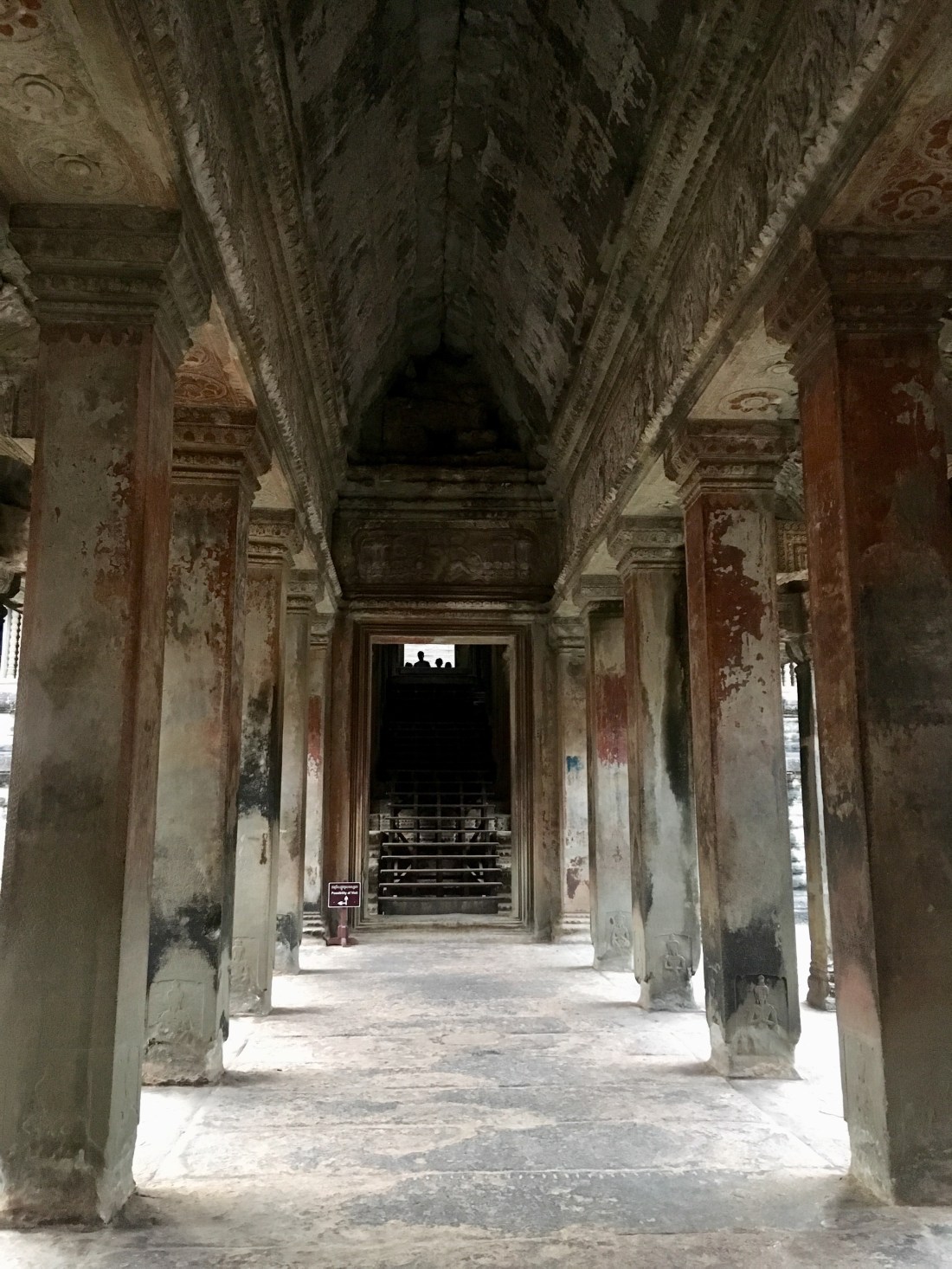
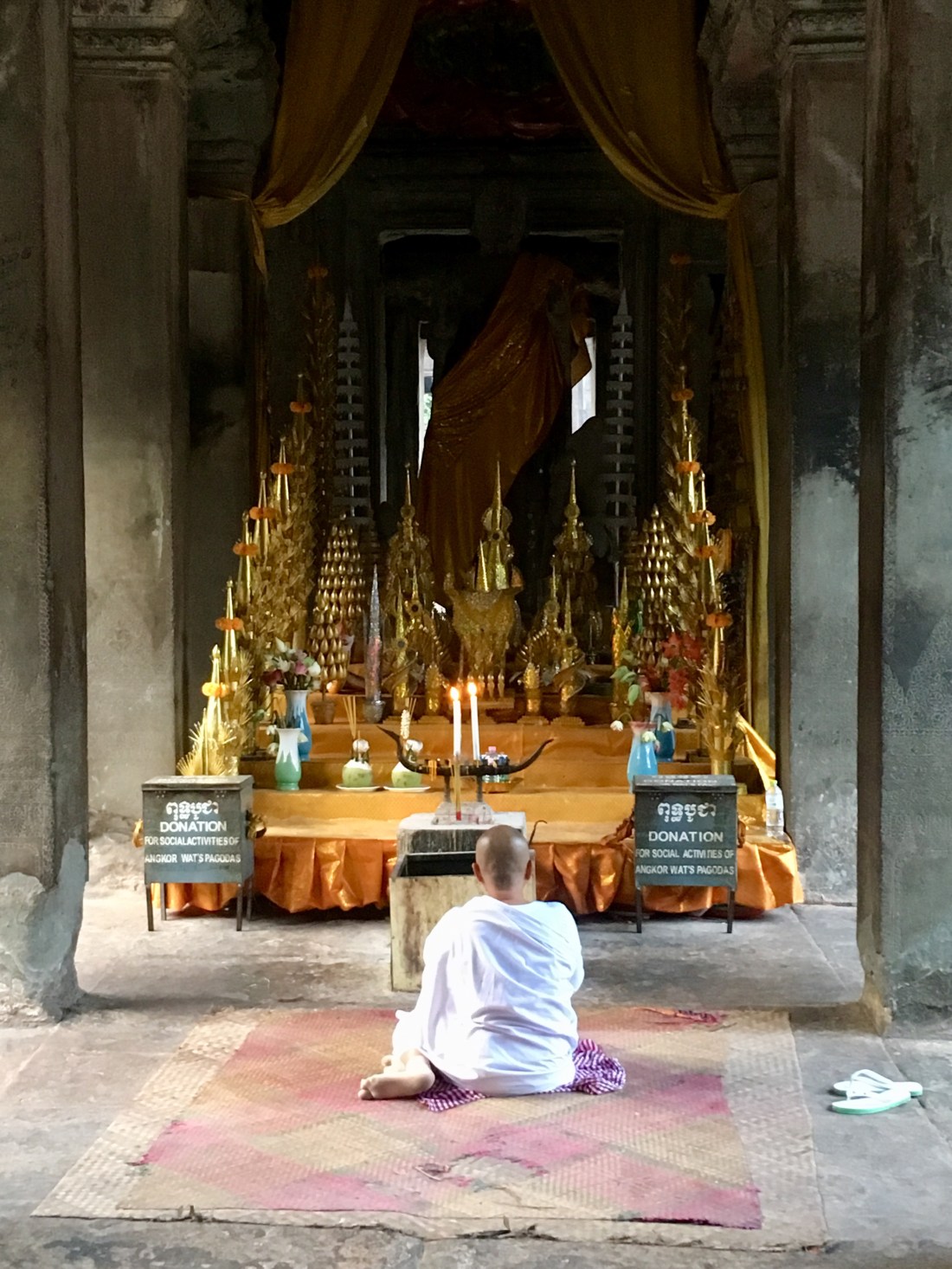
We made our way to the main entrance and were greeted by thousands of people amassed just past the lakes on the vast lawns in front of the temple. They were all looking back towards the temple, so we had our crowning glory – a few snaps with no other tourists in them!
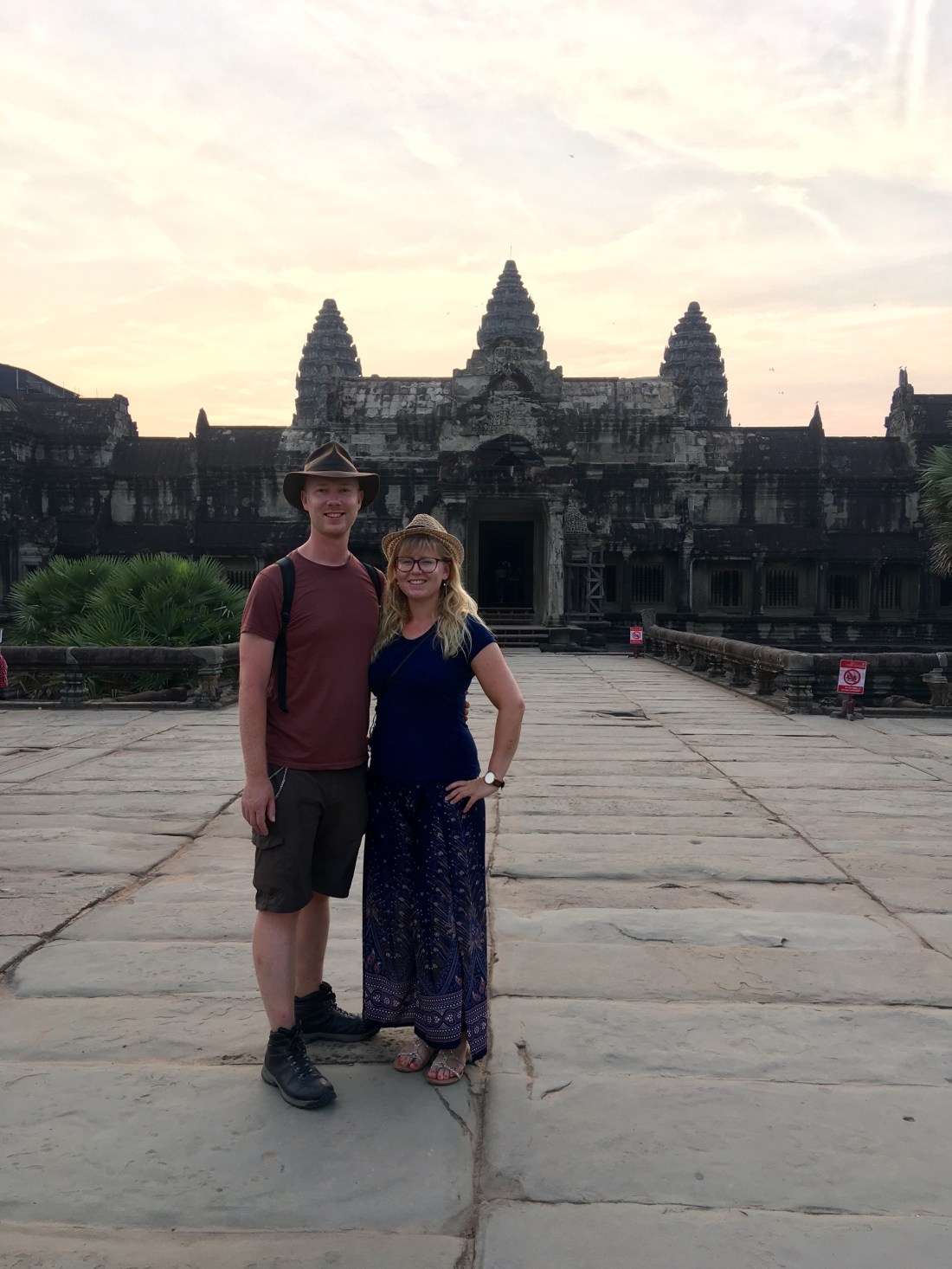
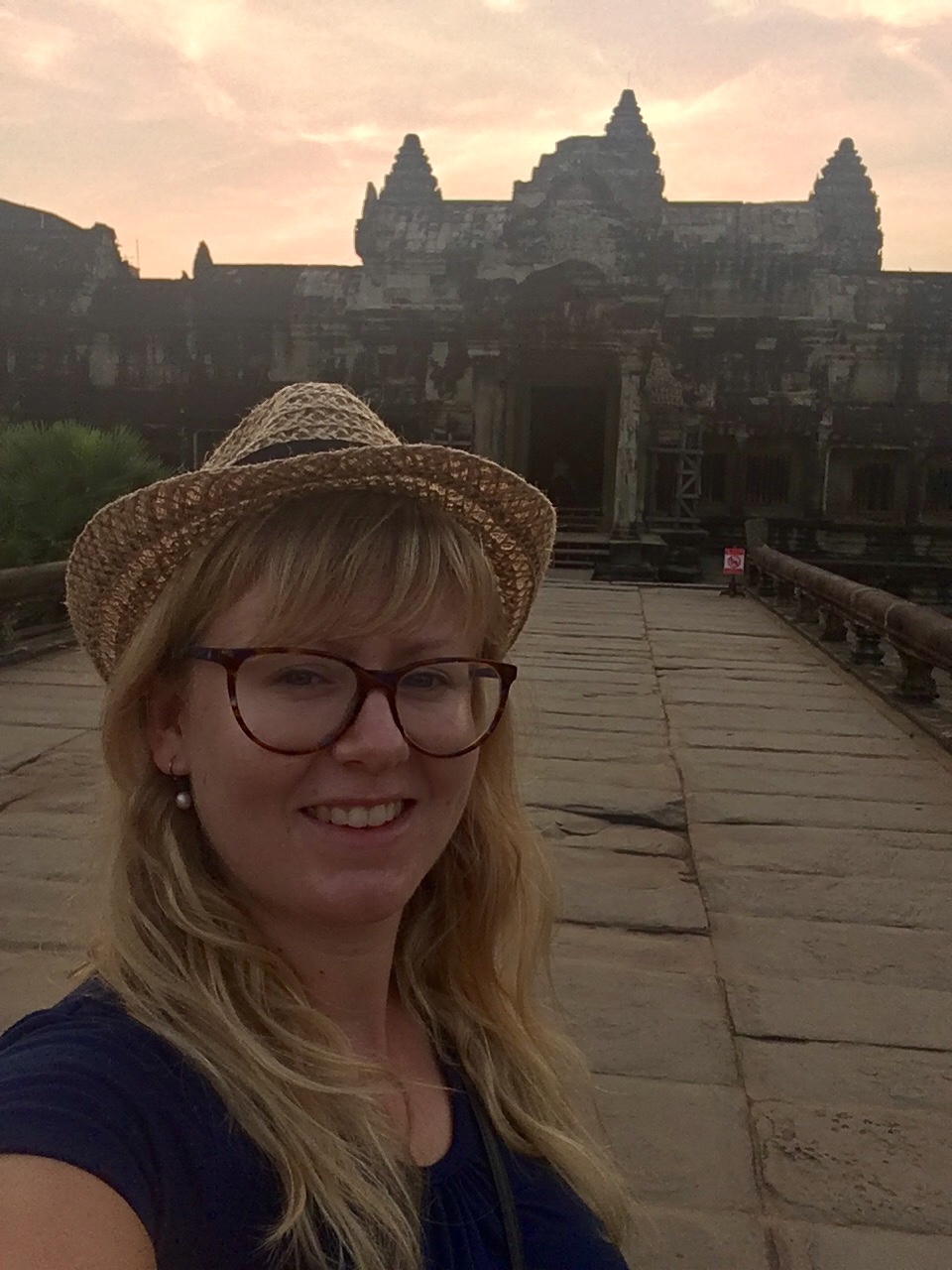
We then walked down the main walkway and took our place in the crowd just in time. We turned around as the disc of the sun crested the roof of the temple. It truly was breathtakingly beautiful. We took a couple of the obligatory photos all tourists do and stopped to watch this mesmerising spectacle.
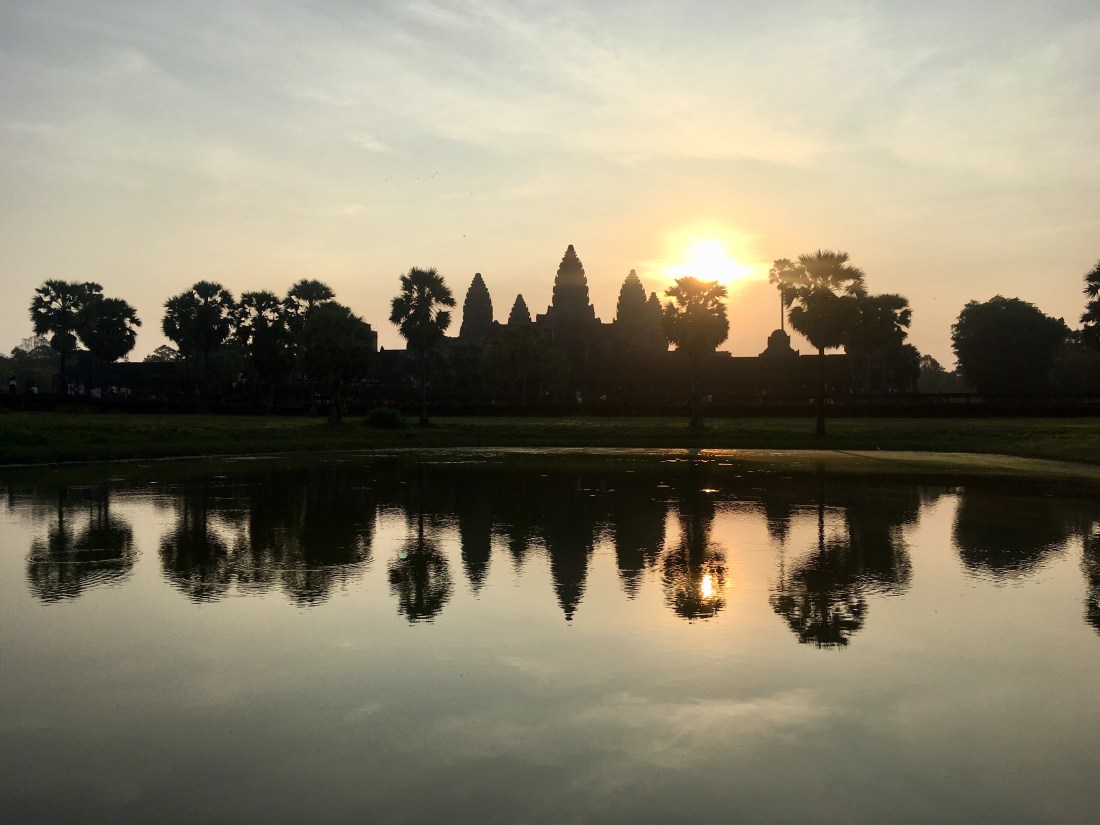
Today, as a ruin, the beauty of the temple at sunrise may only be surpassed by a few places in the world. So in the hay days of the temple, to the people who lived there, one can only imagine the wonderous feelings this sight must of imbued. It was likely the biggest building a person would see in their lifetime, the home of Buddha, the seat of religious power, resplendent in sunshine as the day starts anew. Awesome in the true meaning of the word.
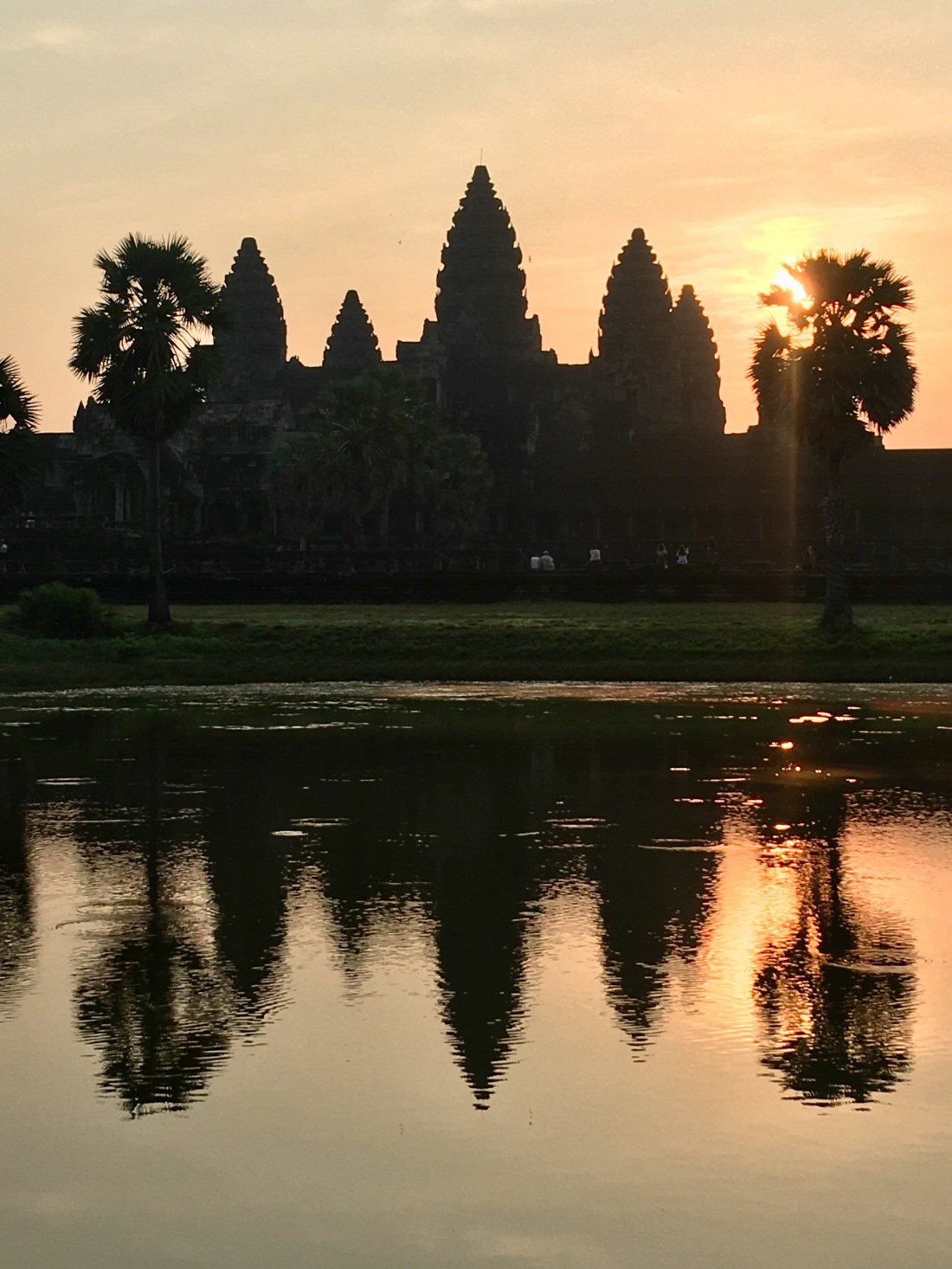
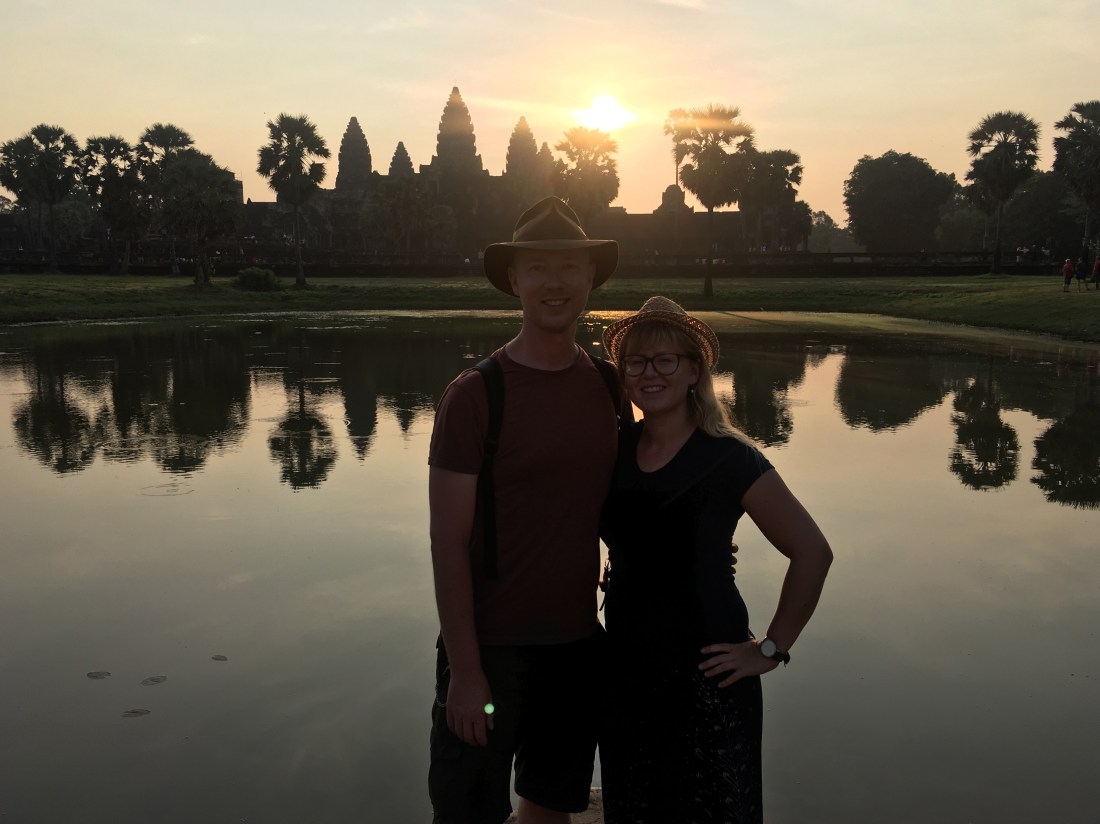
Most people had left to go into Angkor Wat itself when we eventually left some 40 minutes later, and we could see hundreds of heads bobbing up and down in the windows of the temple. How glad we were we’d done our research about this better route to take and how privileged we felt to see it almost to ourselves.
We walked across the floating bridge away from the temple complex to find our driver asleep in a makeshift hammock in his tuk tuk. Talk about asleep on the job!
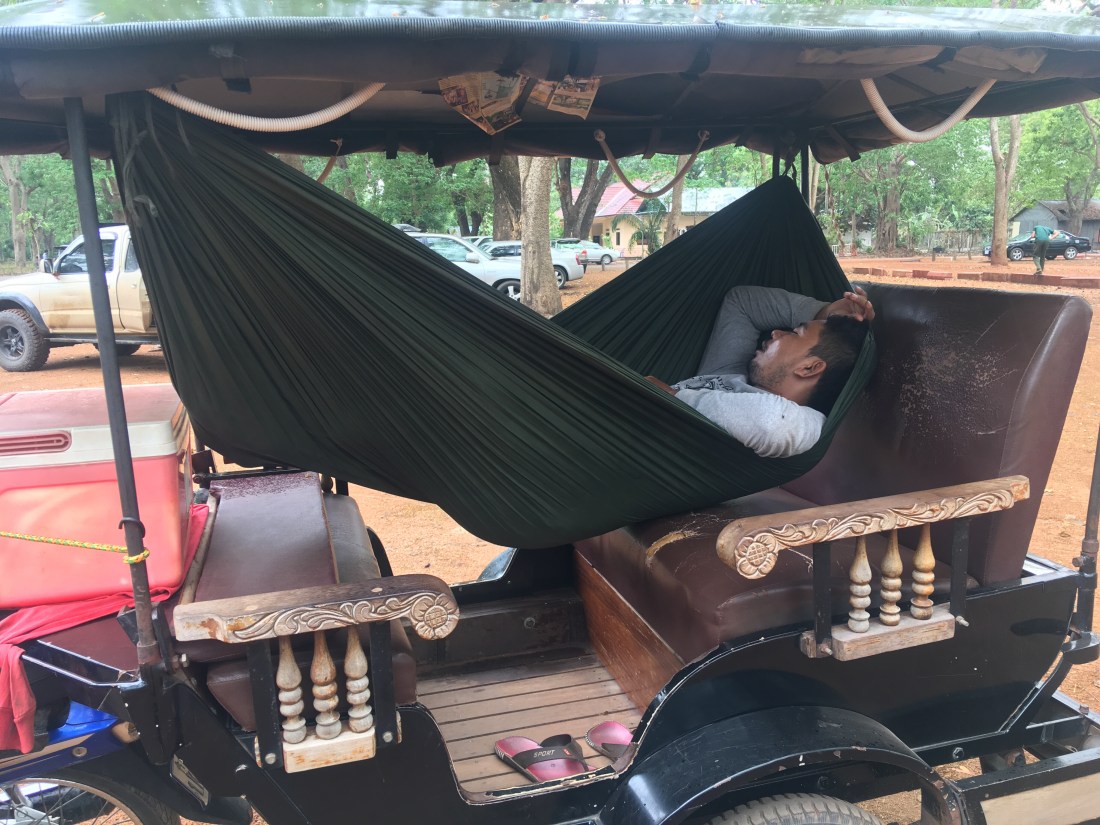
We woke him (as politely as we could) and hit the road. We had so, so much more to see and time was ticking on!
Our second stop at about 8am was Ta Prohm which is famous locally for being used in the original Tomb Raider film staring Angelina Jolie. The path through twisted and turned with a different view around each.
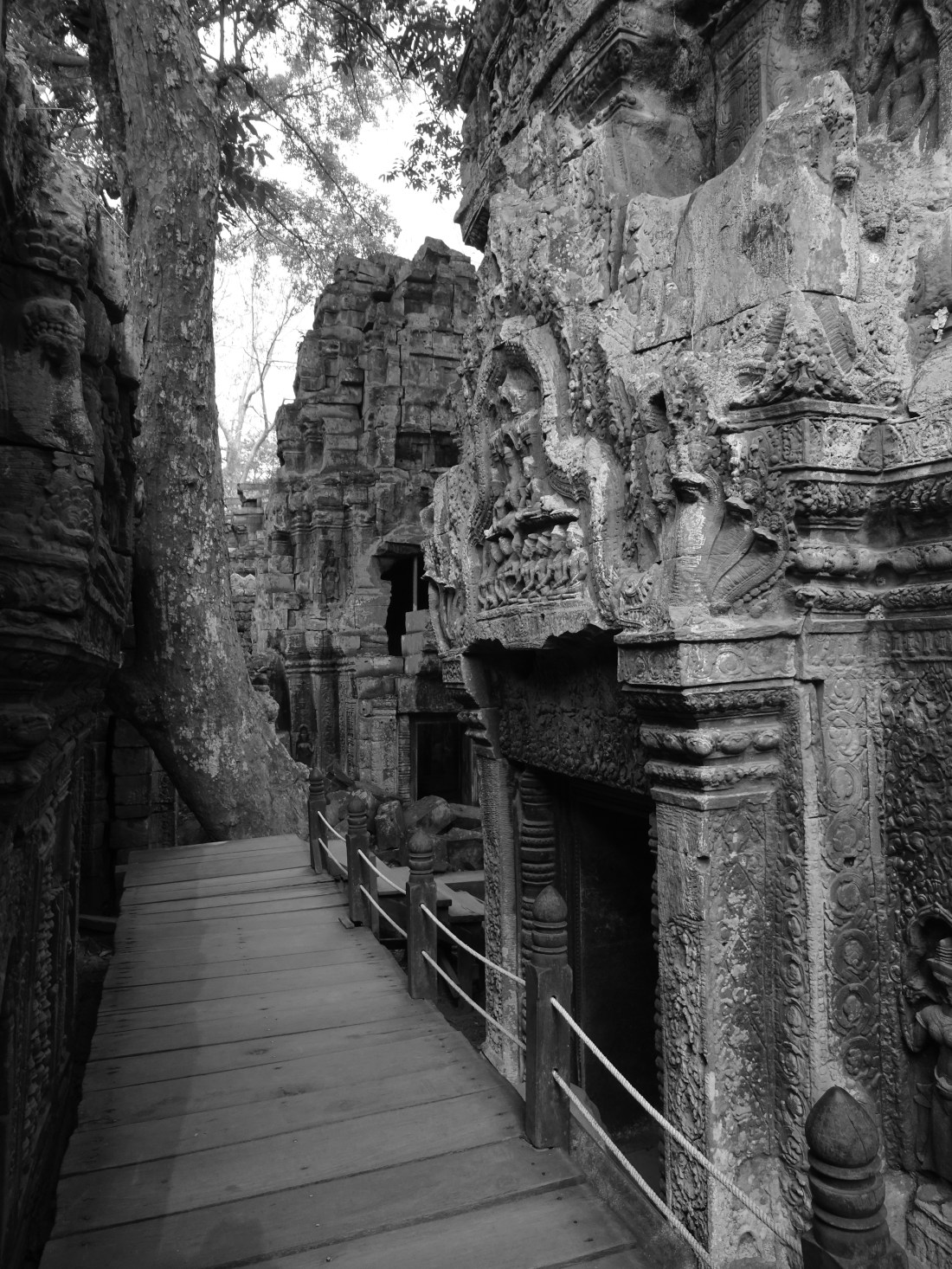
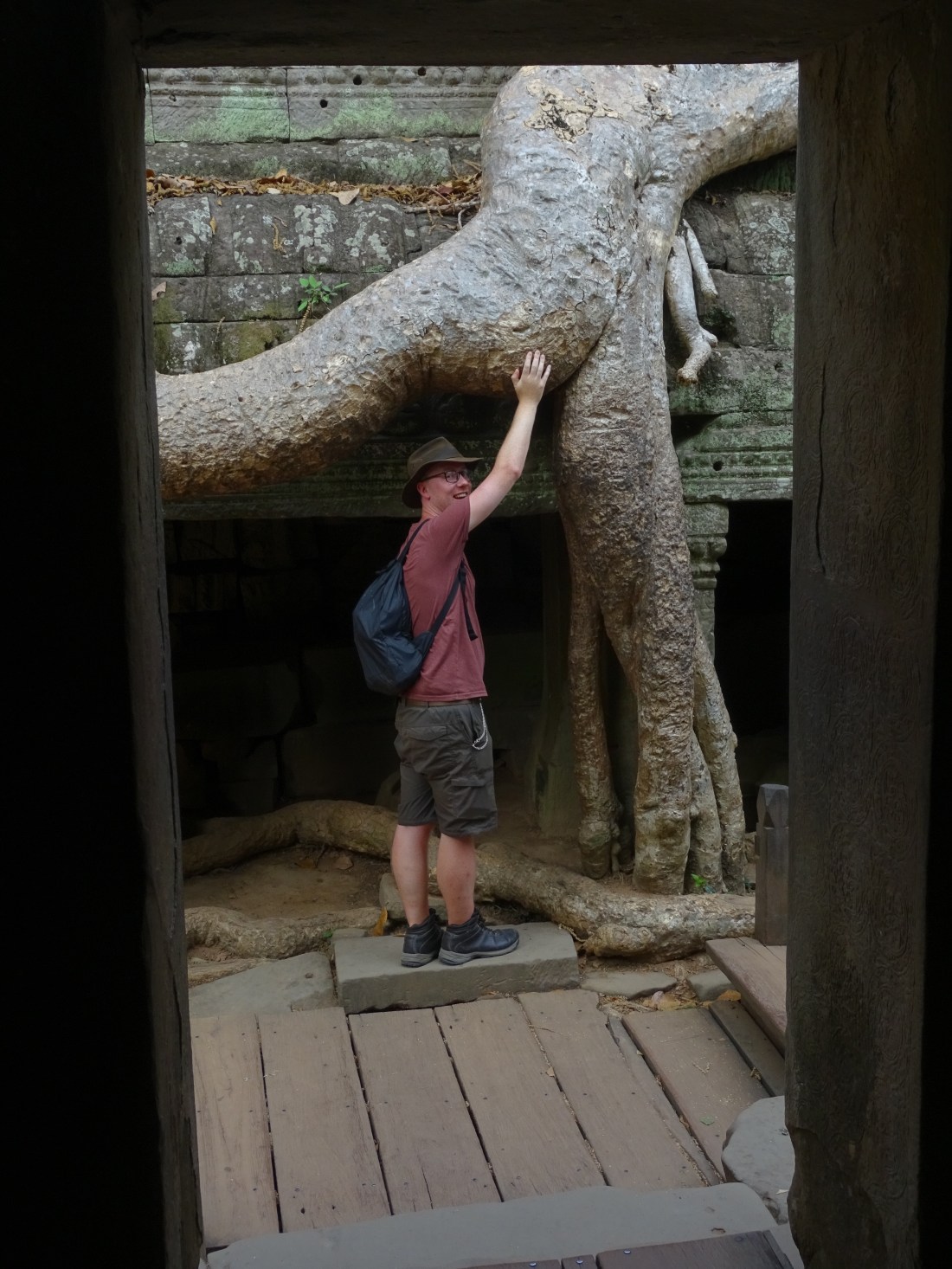
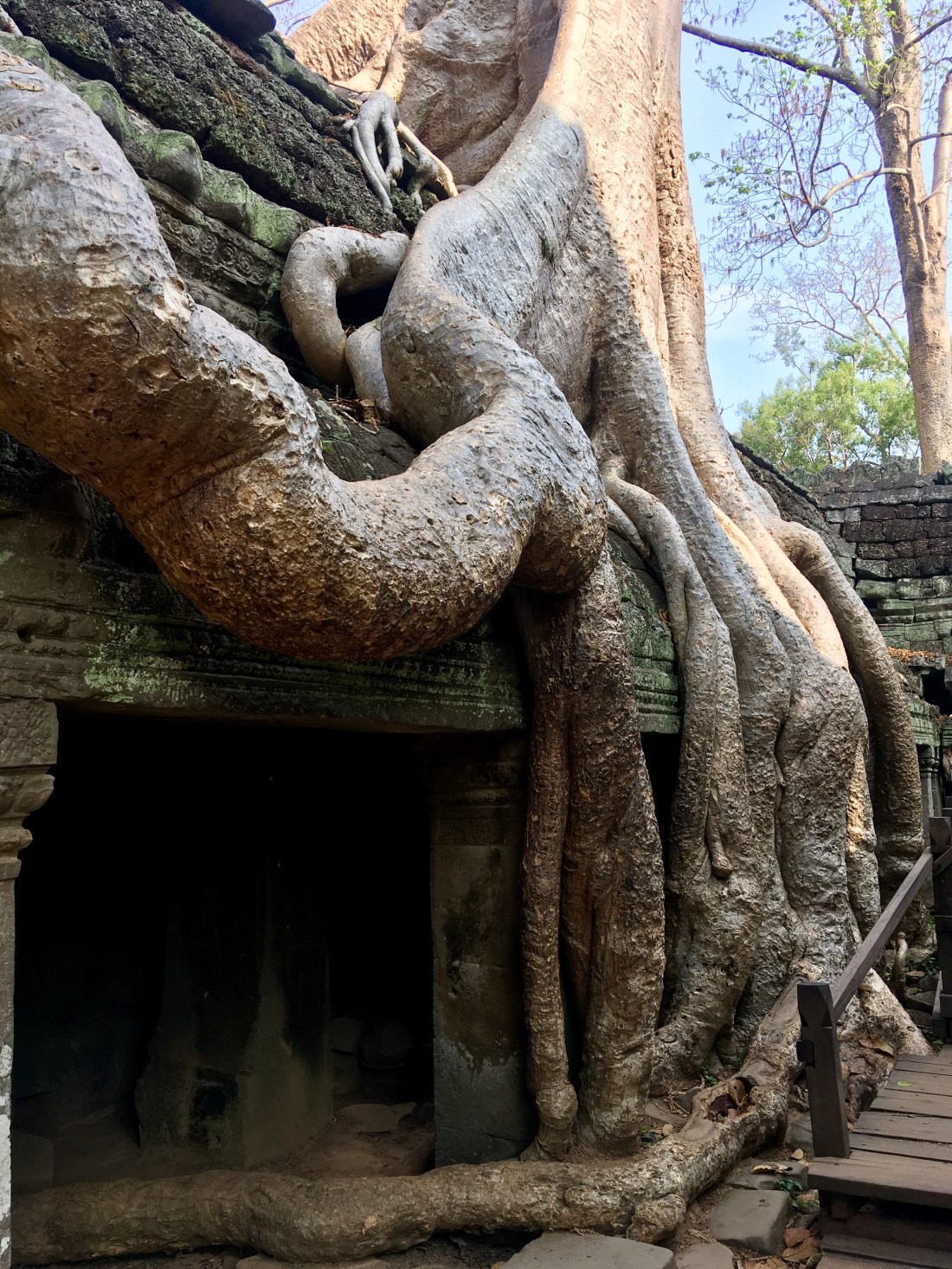
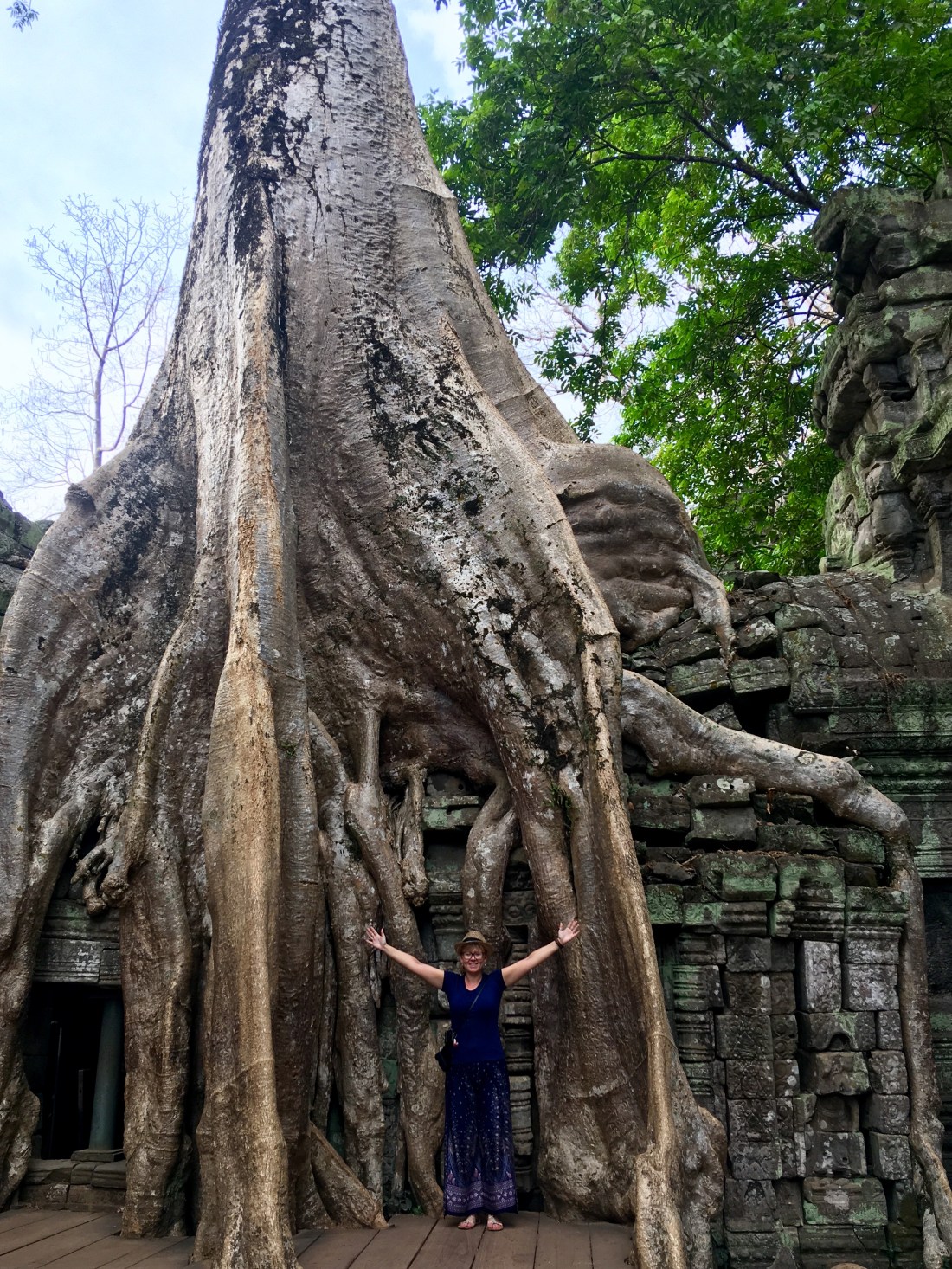
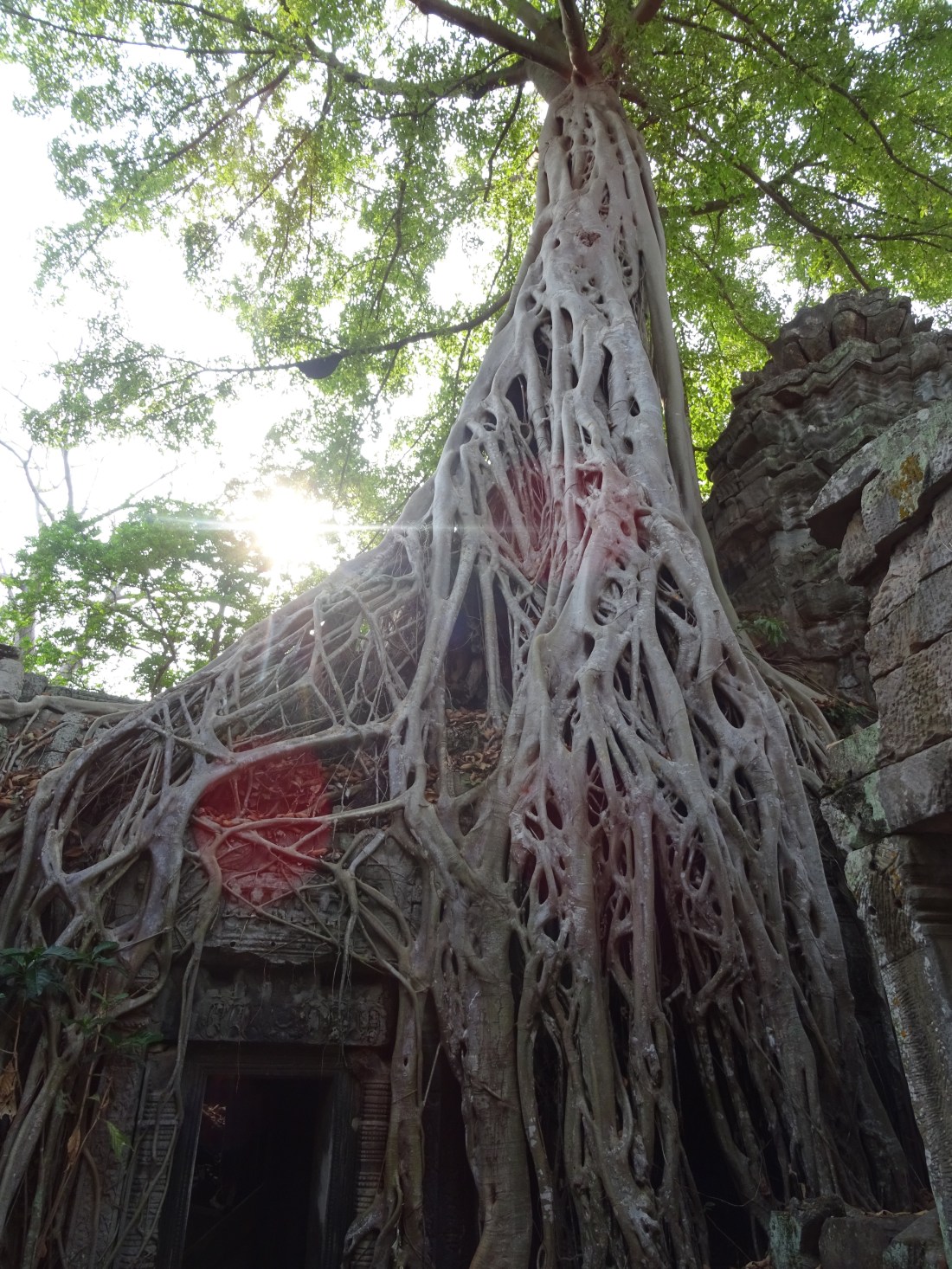
It was cool to see where some of the scenes were shot, but this temple has much more. There is an ethereal feeling about this place in particular, in part due to the huge trees that grow out of the walls and gateways which make it seem as if the temple and the jungle grew together and have always been there.
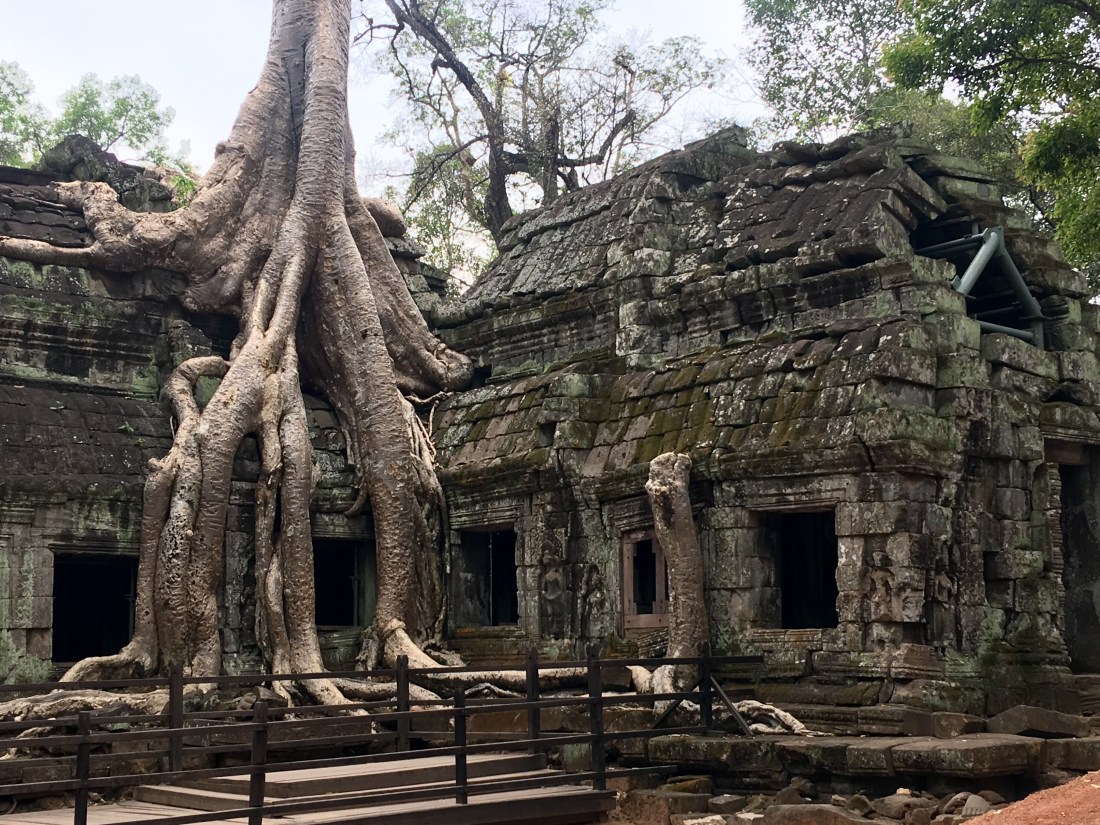
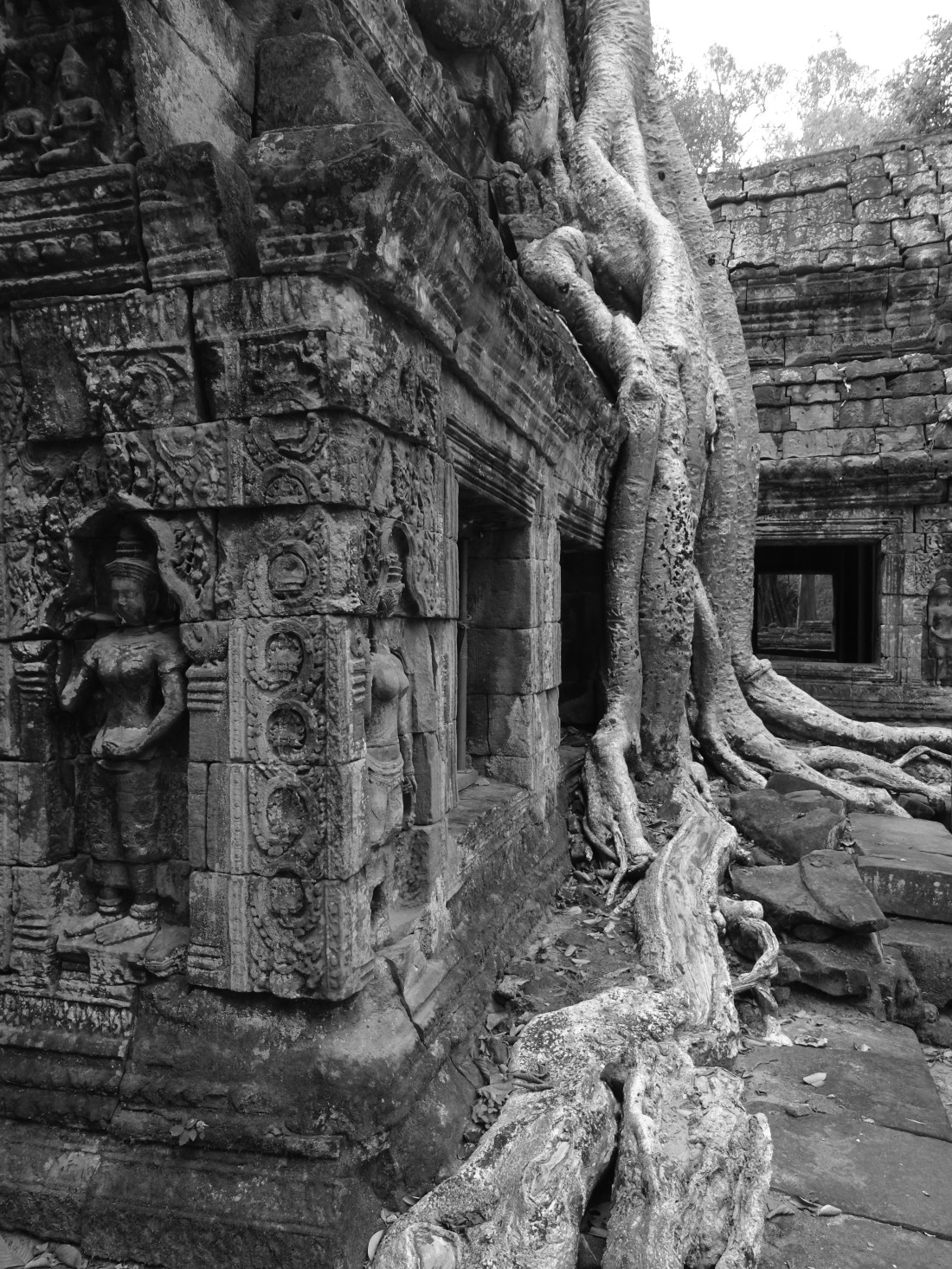
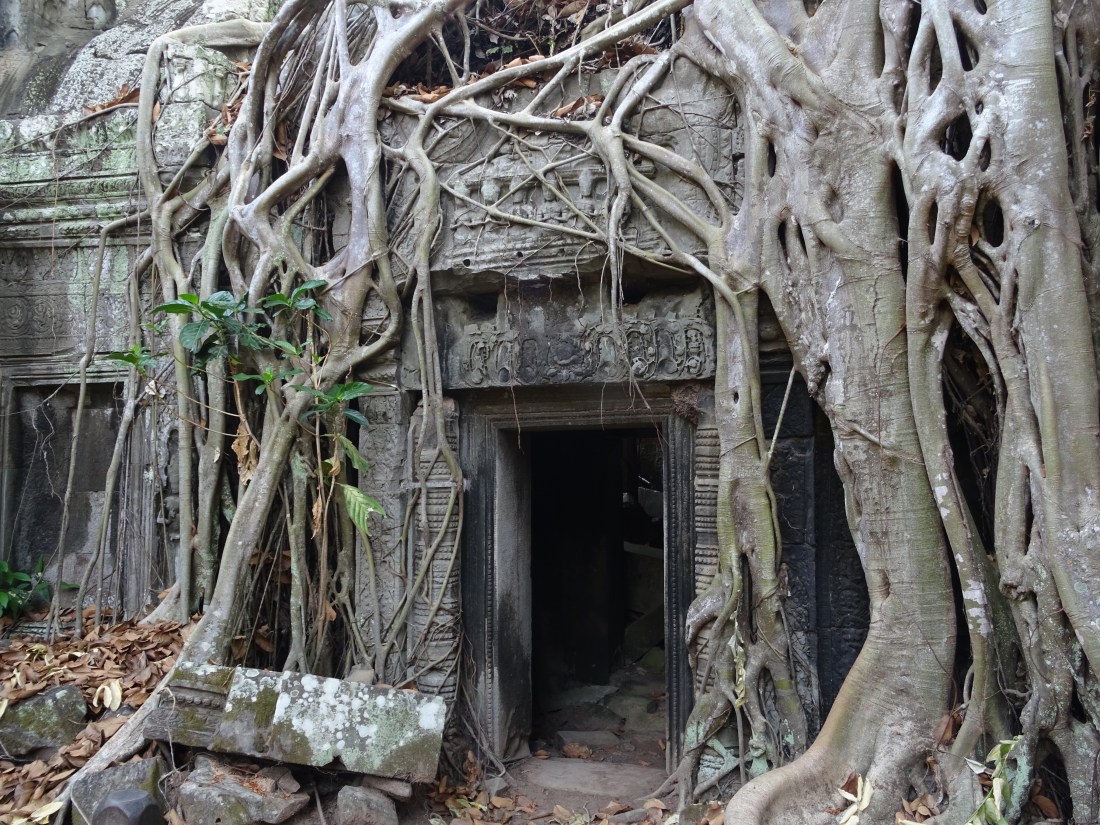
In fact they were everywhere! Destruction in its most beautiful form, the roots winding around the crumbling stone in snake-like shapes, and sometimes others (see pic below – peachy!)
We could have stayed all day sitting in the shade and looking at the stunning architecture intermingled with the crazy trees. There was too much to see though so onwards we went!
We carried on visiting site after site, enjoying each different place in its uniqueness from the last. Rach even made friends with this wee one!
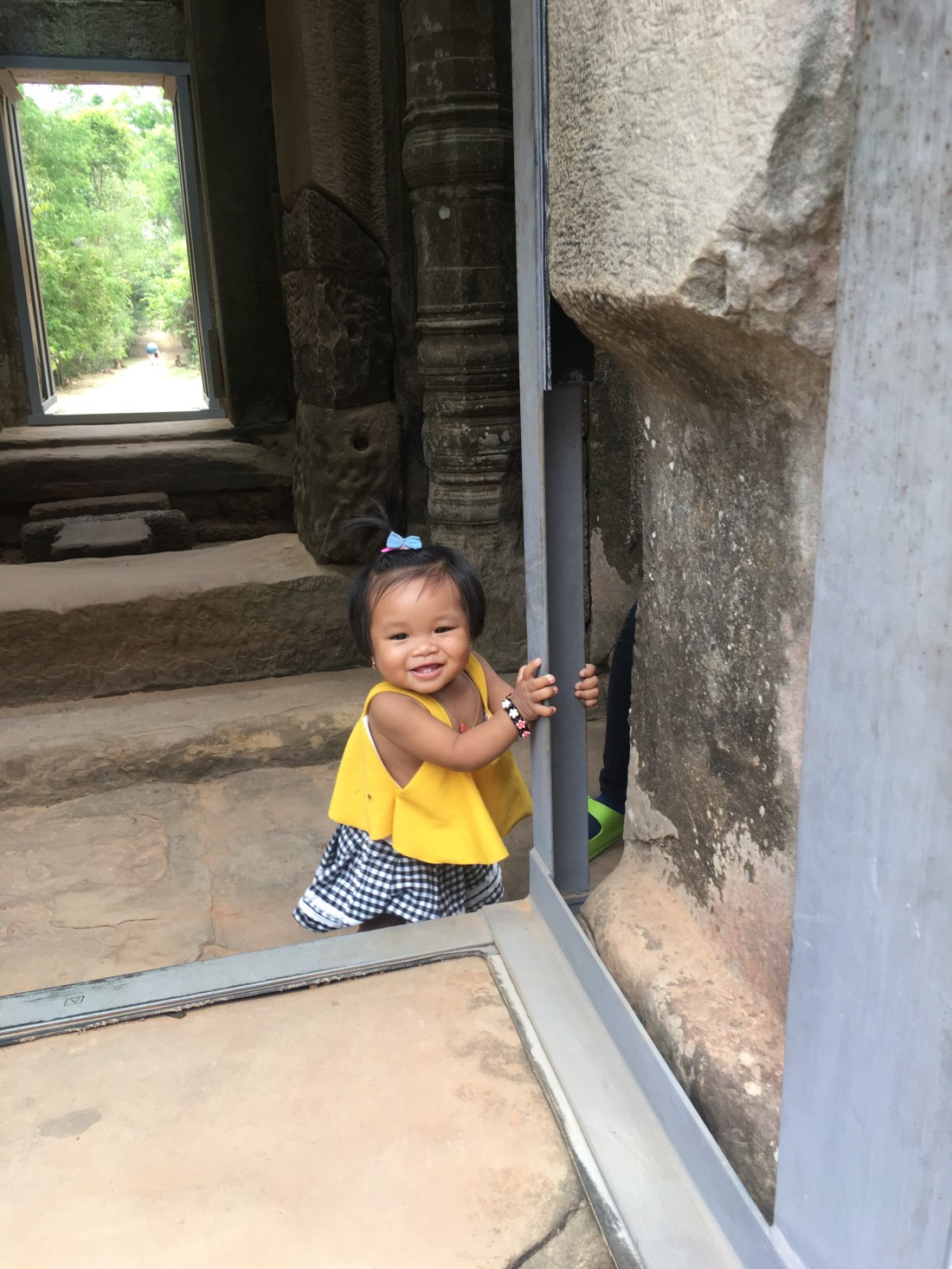
We also learned more about the conservation work, a truly international effort from many countries, which has been ongoing for the last few decades. It is really warming to see that the world wants, and is attempting, to save this temple landscape which perhaps deserves to be a wonder of the world. Ged could have spent months here and is in danger of seeing if he can somehow wangle his way on a dig in the future!
As we rode in our tuk tuk between temples we both agreed that the worst thing about visiting the Angkor Archaeological Park was the bus loads of tourists that swarm the sites, in a rush to take their photos, stepping on and bumping into anyone (or anything) in their way. These gangs of tourists seem to only look at each carving for a second before taking a picture and moving on, never really stopping to think about what the place was like for the people that lived or worshipped there. We’d experienced this ‘speed tourism’ to some extent on the first day at Bayon (the first temple we went to in Angkor Thom), but thankfully had gone ahead of the crowds to most places on our second day. As we drove past Ta Prohm (the Tomb Raider temple) for the second time, on our way back to Angkor Wat, there were masses of people elbowing each other to get a picture of themselves with the parts of the temple used in the film. We couldn’t help but think that there should be restrictions on the number of visitors to the sites, not only to make visiting more enjoyable, but also to preserve the sites (our tuk tuk driver said that lots of damage had been done by careless/wreckless tourists). We are well aware that we are tourists too, part of the same problem, but we hope that we stop to consider these amazing places more and respect their beauty and spirituality. We don’t know what the solution is here but educating visitors about the craftsmanship and the way the sites functioned may be a start. These were our musings as we bobbed along between sites and between the crowds.
The second time we visited Angkor Wat we had more light and company, unlike our morning sneak in through the east gate.
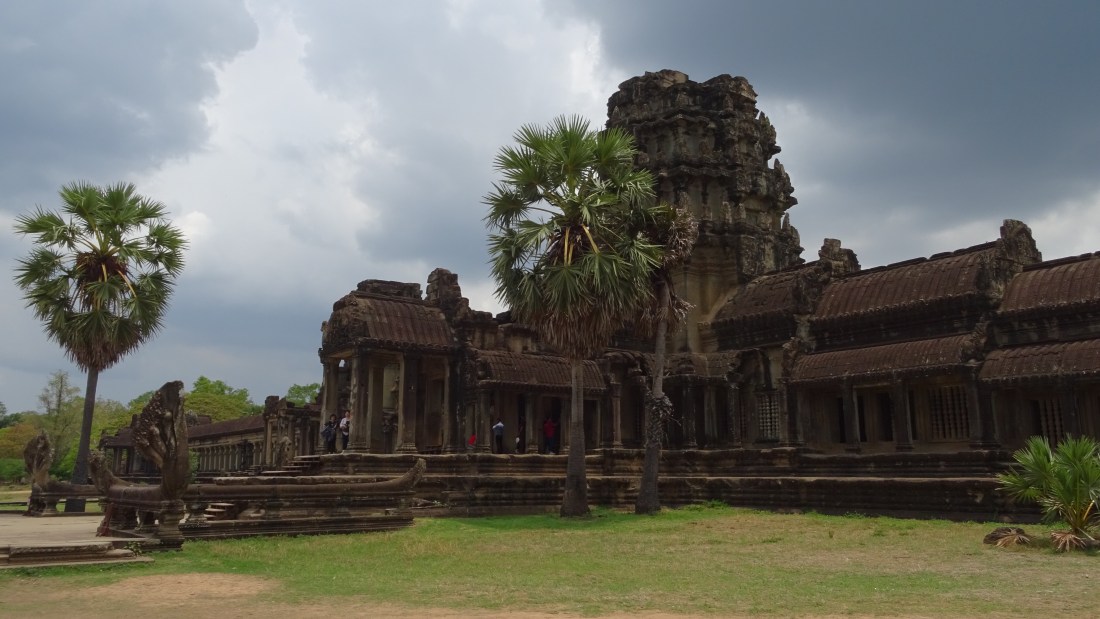
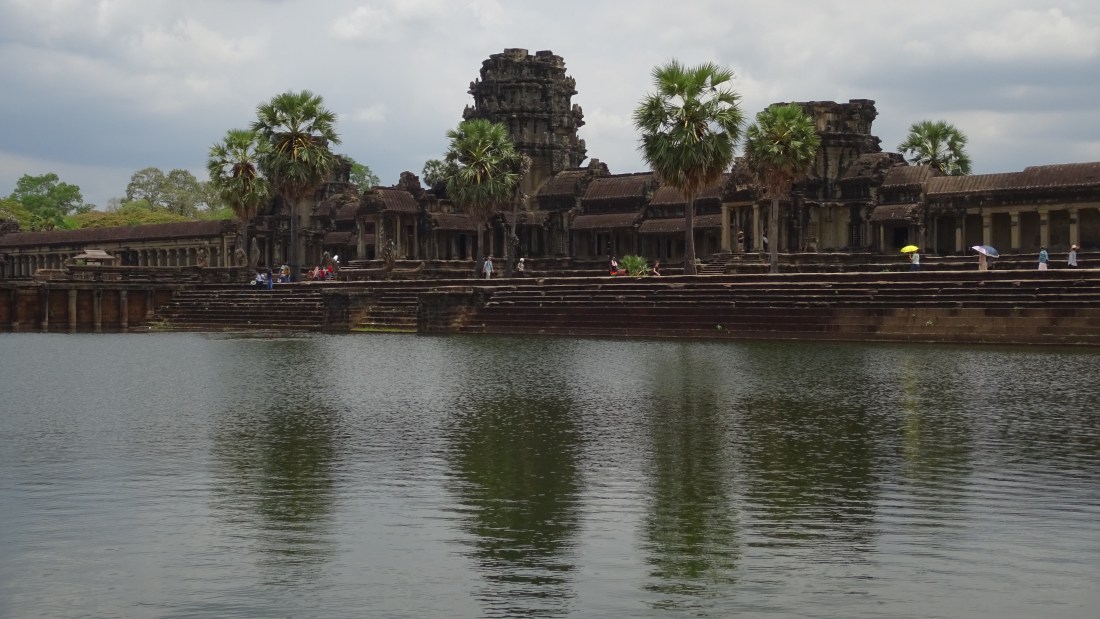
However, this wasn’t really a bad thing. The temple was somehow more alive than it had been earlier and wasn’t as busy as it could been as most people had been there earlier just after sunrise when we had scarpered to Ta Prohm! We traced the same route through the temple as before, but in reverse as we’d come through the main entrance, and took more time as there was no rush to see the sun rise. The carvings in the temple are truly beautiful, but many have been ravished by time, the elements, or visitors over the last century.
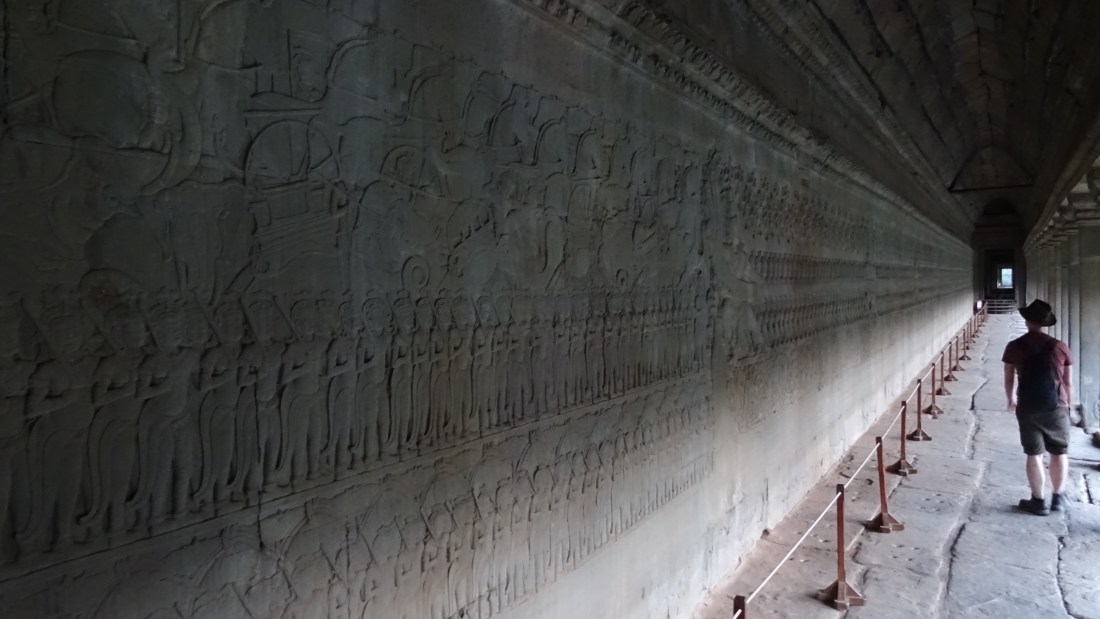
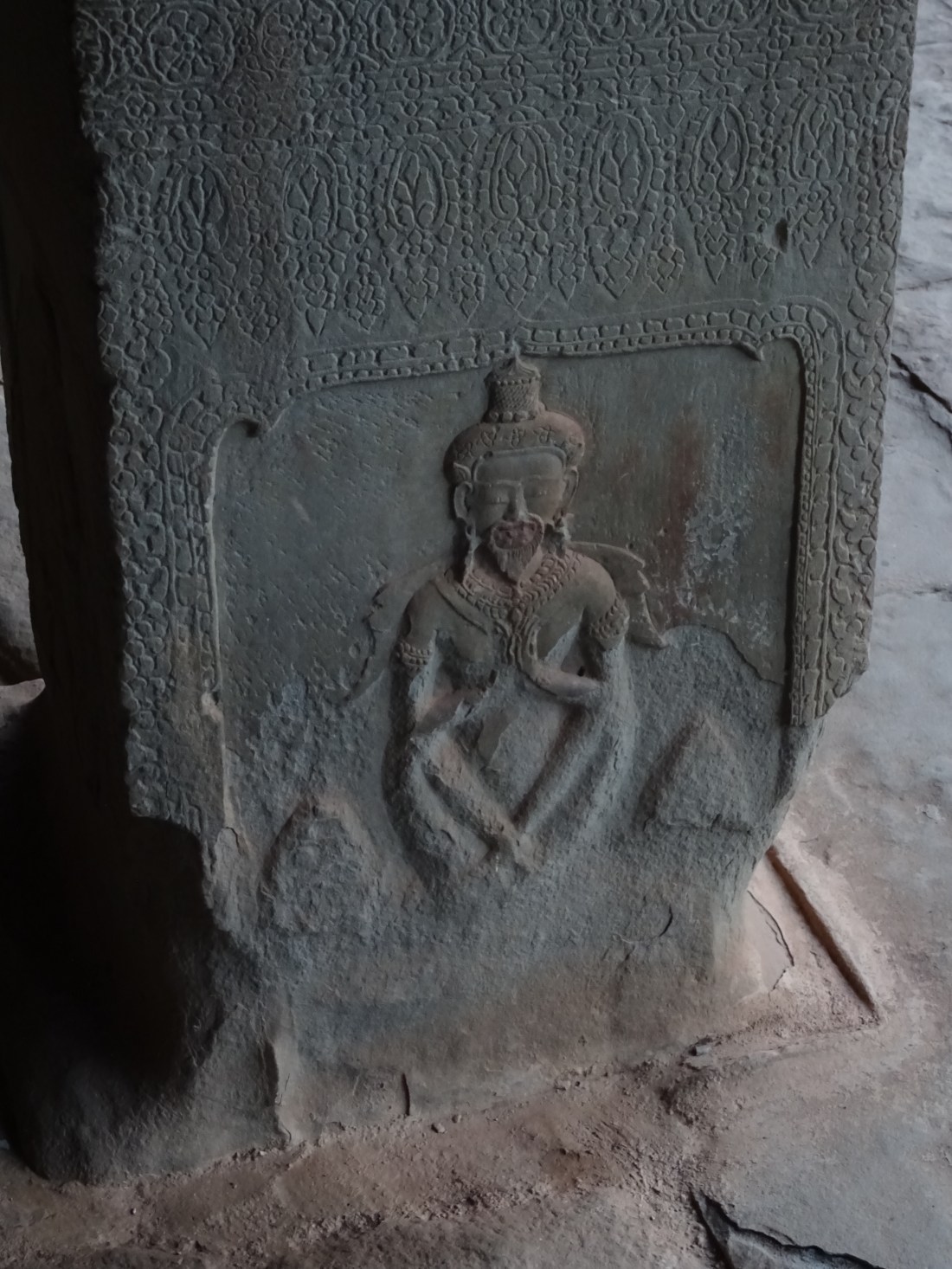
The corridors and the courtyard of the temple are eminently inspiring, especially when you consider the time and skill needed back then to build such an enormous structure.
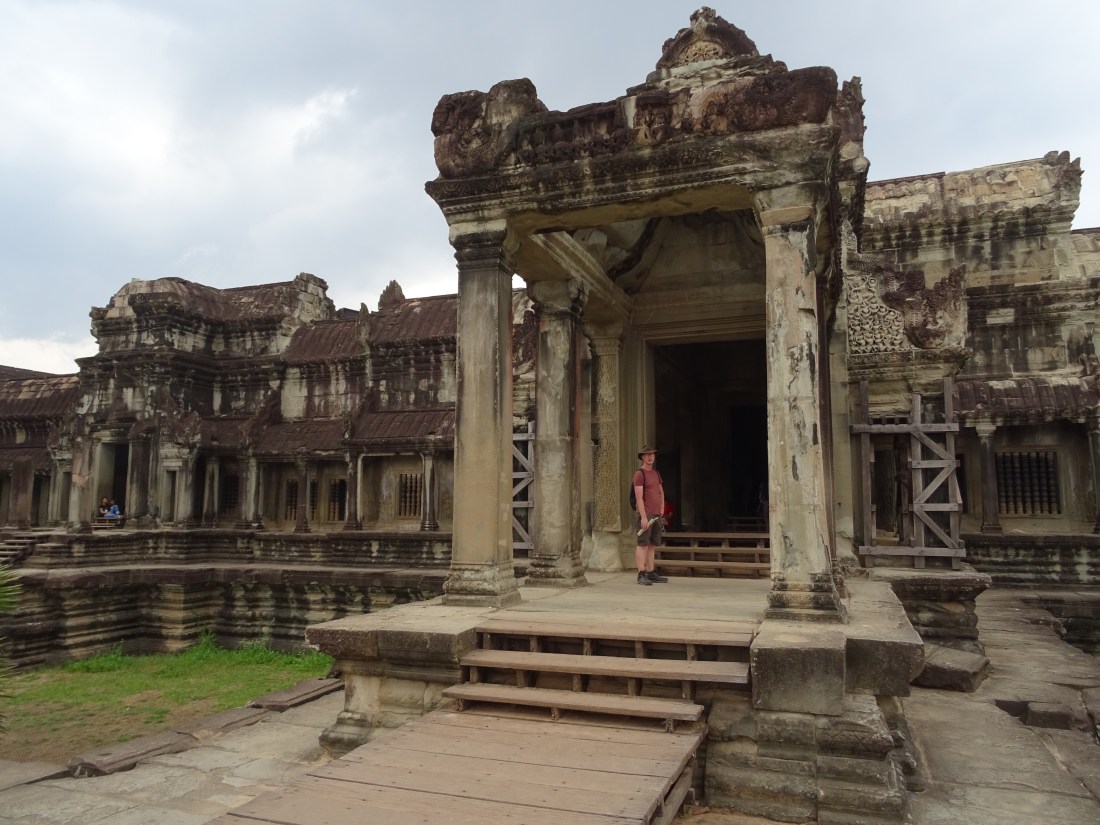
As we walked though we heard a low rumble in the distance. Then another, closer this time. Suddenly there was a loud crack and an echoing boom as rain start to pelt the ground in the courtyard. We took this as a sign to go. We made our way out of the main entrance to see hundreds of people dashing for cover (many running right at us). We waited a minute or two watching the spectacle of the open area in front of the temple empty of people and listen to the booming thunder echo through the temple behind us.
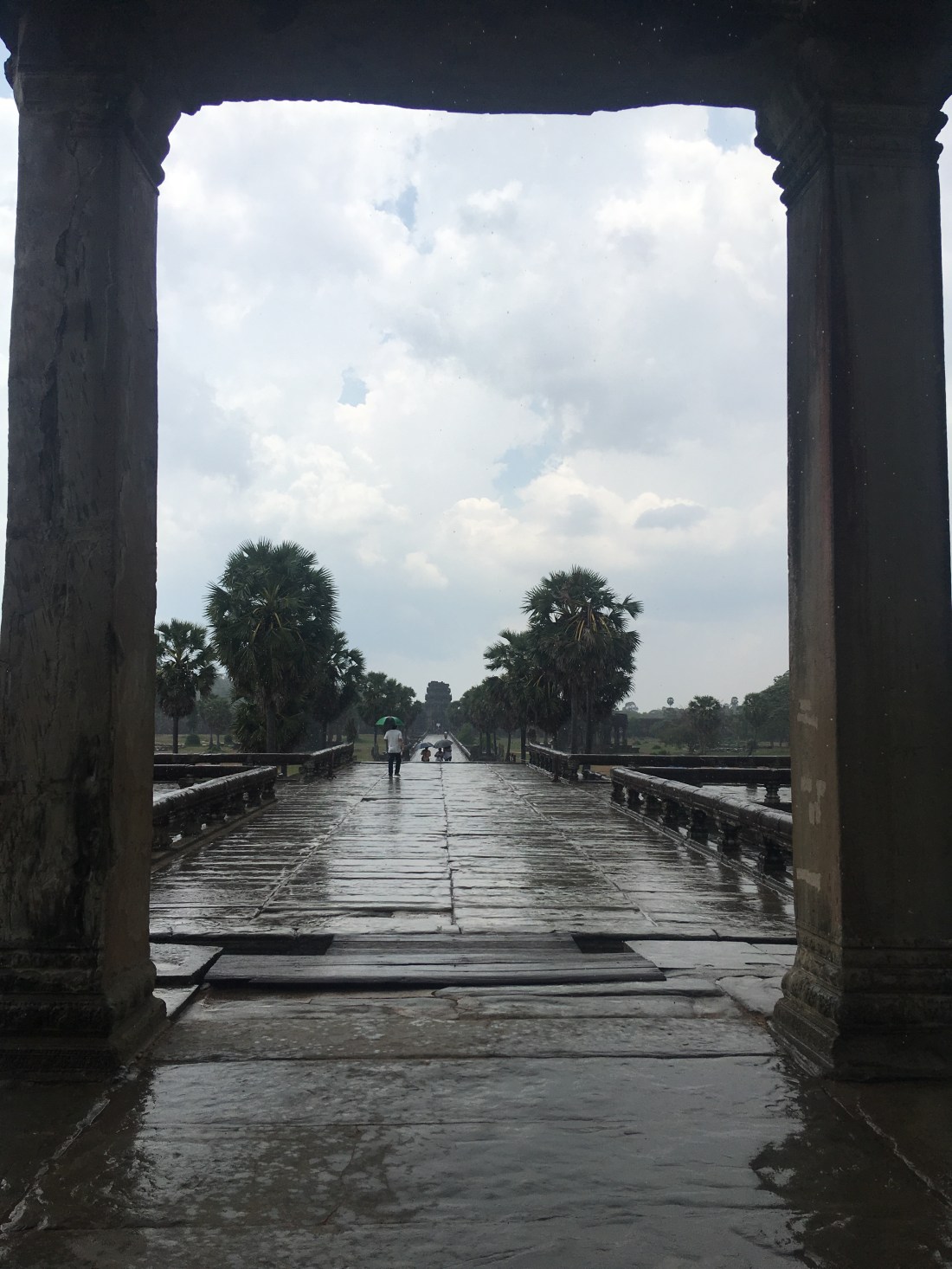
We were the only ones mad enough to walk out into the rain down the central path to the wall at the outskirts of the temple. The rain felt good in the heat (about 35°C) and it was funny seeing everyone cower in arches or under trees. We turned back to the temple hoping to see lightning behind it but no such luck. The cloud was too dense in the distance. Instead, the fury of the sky made itself heard as we looked at the majestic cones of the temple one last time. We found our driver, woke him up, and trundled our way back to the city sad to be leaving such an astonishing place.
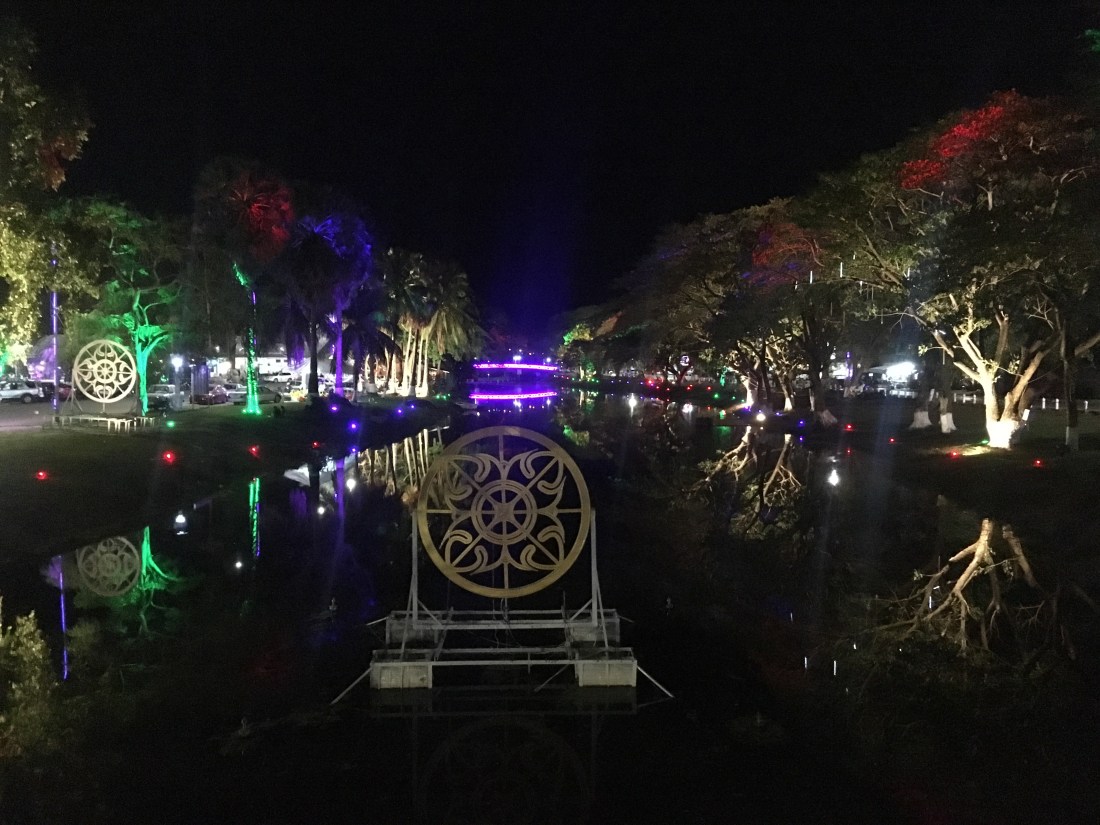
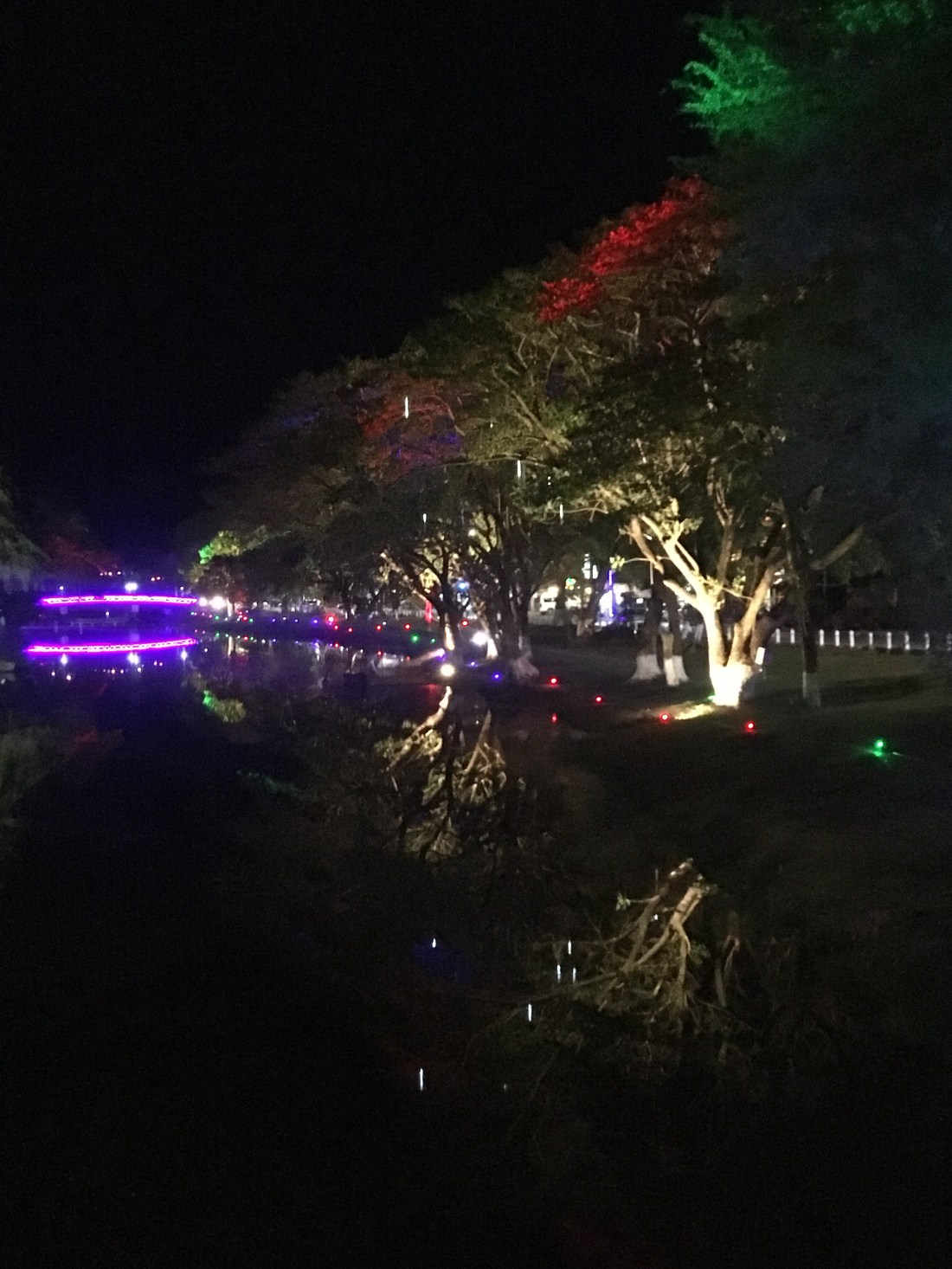
We got back about 1:30pm and we’d been out since 5:30am so we were properly shattered. The plan was to grab another pork buttie, cold beers for 50 cents each from the supermarket next door, have some pool time, and a nap before heading out in the evening. It was a perfect plan and we followed it to the letter, heading out a little later than planned but still finding time to walk down the river lit up at night ready for Cambodia new years in a few days’ time, which we would sadly miss being in Laos by then. Never mind!
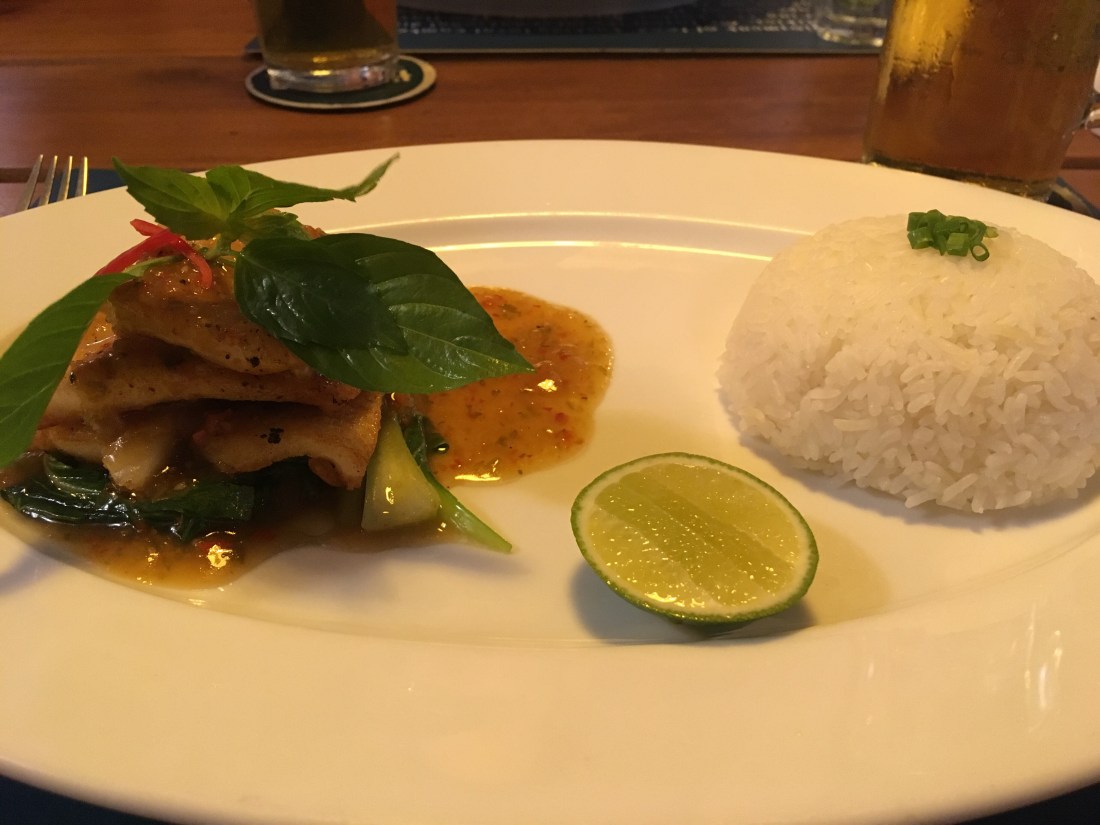
Kate and Sean were still in town so we went to meet them at a place Kate had found called Haven. Not only was the food bob on (Rach’s snakehead fish was particularly good), but the restaurant also trains young people in the catering business, funds social enterprises, and promotes fair trade. Good stuff!
Afterwards we headed in the direction of pub street once more stopping for a beer or two as we went. Pub street seemed a little livelier tonight and the big bars/clubs were definitely trying to deafen punters before they even got in. We found a quieter spot to have a drink and played another round of cocktail roulette. We were all too nice to each other and all got pleasant, if a little weak, beverages. As we sat we were treated to some banging tunes (Spice Girls) and some interesting sites from the local customers……. Who knew Cambodian men had such good calf definition wearing cut off shorts and and neon stillettos?? We eventually found a bar with the desired 50 cent beers and chilled for a bit. Turns out we were all wiped. We parted ways with Kate and Sean across the river and headed back to our heaven of a hotel. We hope we catch them again further on in our travels.
5 April
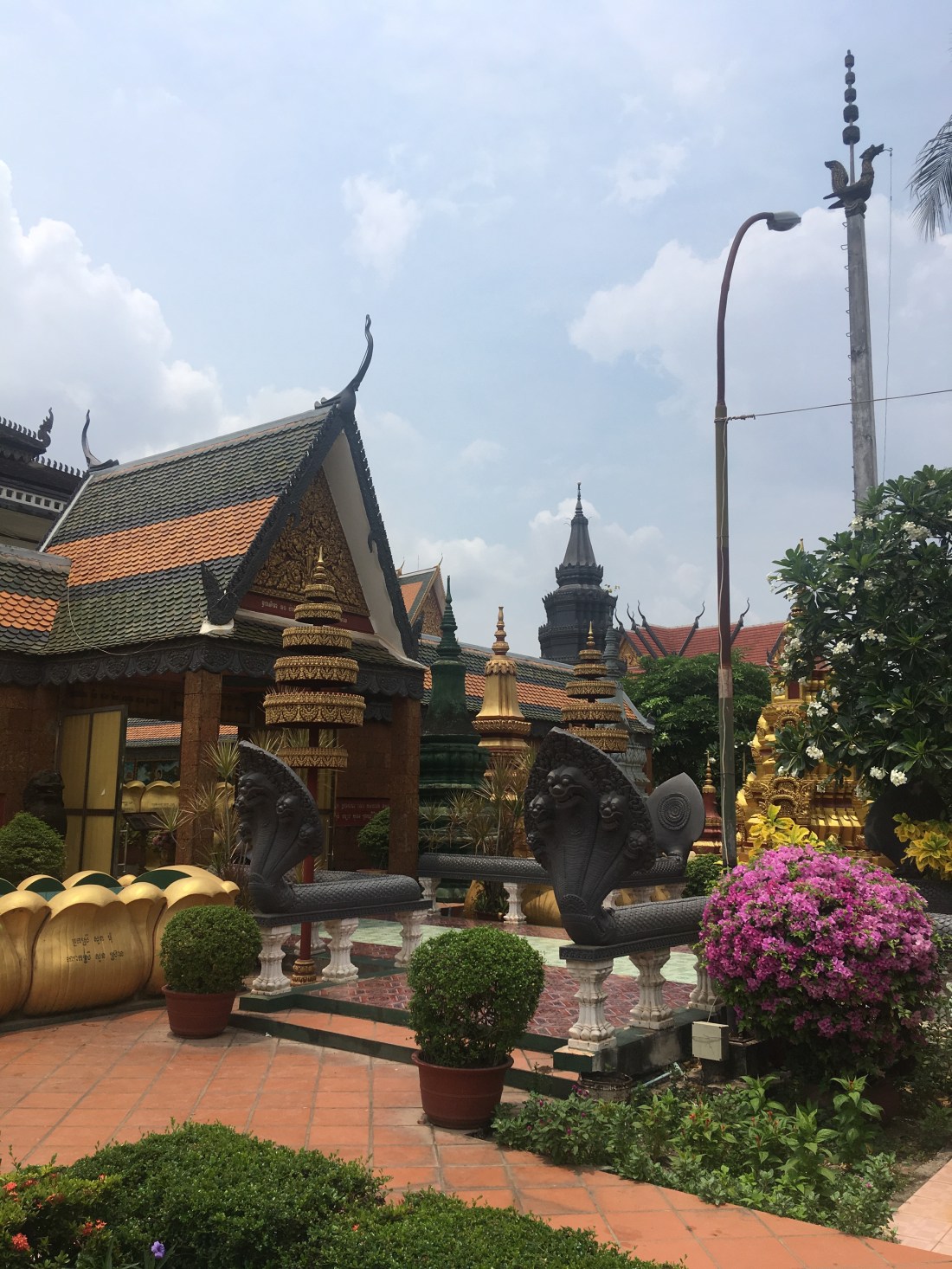
Our flight from Cambodia wasn’t until 7pm so we had most of the day to relax. A late breakfast, a couple of hours by the pool, and a quick pack of the bags (we have still not decided the best way to do this) and before we knew it, it was time for checkout. Luckily the hotel had a luggage storage place so we were free to explore Siem Reap in the afternoon. We hadn’t really seen the place during the day so decided to walk down the river in the direction of the market. The day was HOT so we ducked into a temple to enjoy the shade on the way. Wat Preah Prom Rath was beautiful, but had a very strange set of statues as one installation.
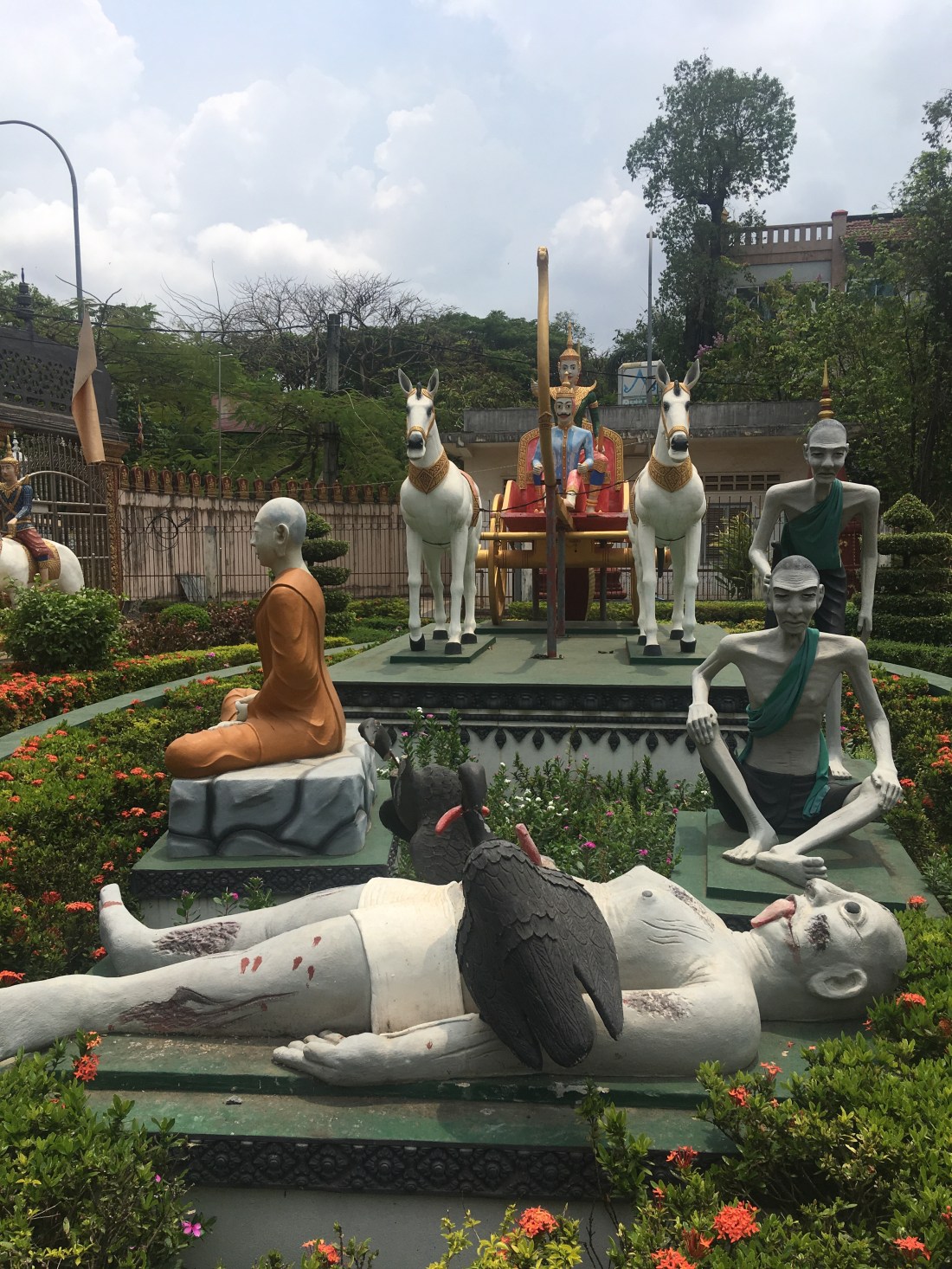
The statues pictured here illustrate the story of Prince Siddharth’s first time leaving the comforts of the palace. For the first time he saw illness, old age, death, and a monk, then went home. The end. There seems to be no moral end to the story engraved at the temple, but we think one about living a privileged life with no care of others is implied. In any case, the statues were a little strange!
We eventually got to the markets which were noisy with hawkers shouting at tourists trying to get them to look at their wares. Most of the market (apart from the food market and a couple of stalls) sells tourist tat of the worst kind or fake jewellery. As you approach a stall the seller (always female) starts shouting at you, and we do mean shouting. They offer discounts on crap you wouldn’t buy in a million years so we quickly passed many stalls without even stopping to look. There are the odd exceptions though. Some stalls sell original paintings, or what appear to be hand made clothing, or wood carvings. The vendors at these types of stalls didn’t shout as you approached and gave you time to look at their goods. They still offered “discounts” and tried to get you to buy multiple items, but they were calmer about it. Rach ended up buying some bargainous billowing wrap trousers for a couple of bucks.
Before long it was time to head back to the hotel and grab our bags. As we bumped along to the airport in our tuk tuk we thought about our time in Cambodia and both thought we’d be back. Firstly the food is too good not to, but also it seems there is so much more to see here. The beautiful temples and the manic streets are just the start. We heard very little of the local music or the country side really, and the country seems to be developing so fast we are curious about how we’ll find it in a few years. As we checked in for our flight, we decided that one week is far too little time to spend in Cambodia. For now, goodbye Cambodia and here we come Laos!
 Around the world in 140 days